fufufafa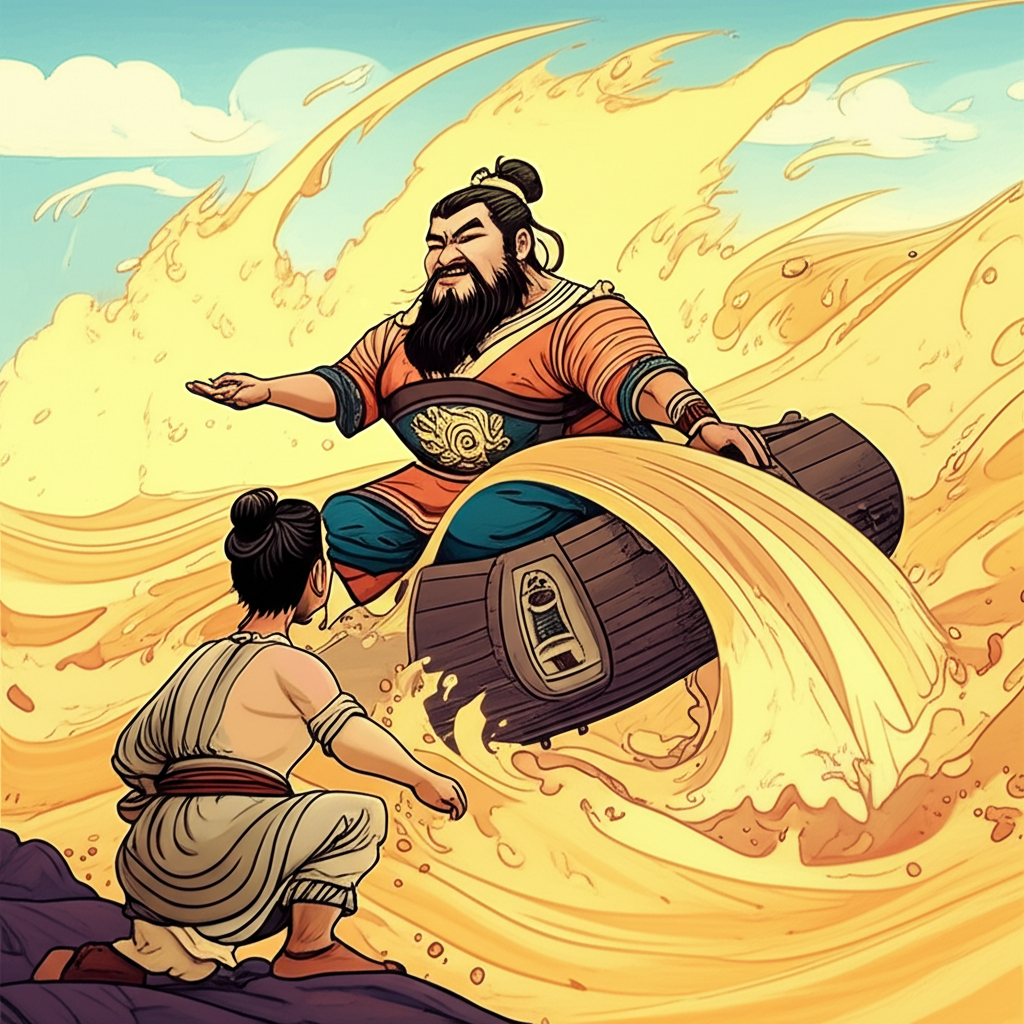
From the mists of ancient China emerges a saga of catastrophic floods, monumental human effort, and the birth of a civilization forged in the crucible of adversity. This is the enduring legend of Gun and Yu, a foundational myth that winds its way through the earliest chronicles of the Chinese people, echoing with the roar of the Yellow River and the indomitable spirit of those who sought to tame it. It is a traditional story, passed down through countless generations, offering a profound glimpse into the worldview of ancient communities grappling with the overwhelming forces of nature.
Origins and Cultural Background
The myth of Gun and Yu is deeply embedded in the cultural fabric of pre-dynastic and early dynastic China, a period characterized by burgeoning agricultural societies clustered along the fertile, yet volatile, banks of the Yellow River. This era, stretching back thousands of years before the common era, saw communities reliant on the river’s bounty for irrigation and sustenance, yet perpetually threatened by its unpredictable and often devastating floods. For these ancient people, the world was a realm governed by powerful, often capricious, natural forces. The Yellow River, known as "China’s Sorrow" as much as "China’s Mother," was a dualistic entity: a giver of life and a bringer of destruction.
In this environment, people perceived their existence as intertwined with the rhythms of nature. They sought explanations for the world’s phenomena in stories of celestial beings, powerful spirits, and heroic figures who interacted with these forces. Leadership was not merely political but deeply tied to the ability to ensure the well-being and survival of the community against environmental threats. The narrative of the Great Flood, therefore, wasn’t just a tale; it was a societal blueprint, a reflection of their fears, hopes, and the qualities they revered in their leaders. It spoke to a collective yearning for order, stability, and harmony in a world that often seemed chaotic and overwhelming.
Character Descriptions: The Flood Fighters
At the heart of this epic narrative are two figures: Gun and Yu, father and son, whose approaches to the colossal task of flood control define their legendary status.
Gun, the father, is depicted as a lord or chieftain, a figure of significant standing chosen by the mythical Emperor Yao (and later Shun) to combat the relentless deluge. He is often associated with the concept of raw, unyielding will and a direct, confrontational approach to problems. His method involved building immense dams and dikes to block the rising waters. Symbolically, Gun represents human ambition and a reliance on brute force, a desire to impose human will directly upon nature. He is also linked to the mythical "Xirang" (息壤), a self-expanding soil he supposedly stole from the heavens to aid his endeavors. While a figure of great intent, his story ultimately highlights the limitations of such methods when pitted against the overwhelming power of the natural world.
Yu, Gun’s son, stands in stark contrast. Chosen after his father’s failure, Yu embodies perseverance, wisdom, and a profound understanding of natural processes. His approach was not to obstruct the waters but to guide them, to work with nature rather than against it. He represents innovative thinking, self-sacrifice, and the power of intelligent adaptation. Yu is often described as a tireless worker, leading his people with humility and dedication, personally participating in the grueling labor. His figure symbolizes a leader who connects with his people, understands their suffering, and devises solutions born of empathy and strategic insight. These characters, while central to the story, are presented as legendary figures whose symbolic attributes serve to convey important cultural lessons, rather than as beings to be believed in literally.
The Main Story: Taming the Deluge
The story begins with the land of ancient China submerged beneath a devastating flood. Waters raged across the plains, swallowing homes, fields, and entire villages. The people suffered immensely, their lives a constant struggle against the swirling currents and the rising tide. Witnessing this widespread misery, the sagely Emperor Yao sought a solution. He convened his advisors, searching for a hero capable of taming the tempestuous waters.
It was then that Gun, a valiant and determined lord, stepped forward. He proposed to build mighty dams and dikes, believing that by walling off the rivers, he could contain their fury. Emperor Yao, though hesitant about Gun’s confrontational strategy, granted him the immense responsibility. For nine long years, Gun toiled tirelessly, marshalling his people to construct colossal barriers. He even, so the legend tells, acquired the mythical Xirang, a wondrous, self-expanding soil, which he used to build ever-higher defenses. Yet, for all his efforts and the immense labor of his people, the floodwaters remained untamed. The dams held for a time, but the river’s relentless pressure found weaknesses, overflowing and breaking through, often with even greater destructive force. Gun’s strategy was a battle against nature, and nature, in the end, proved unconquerable. His failure led to his exile and, in some versions, his death at Yu-Shan, the Feather Mountain.
Upon Gun’s demise, a miraculous event occurred: from his body, his son, Yu, was born. By this time, Emperor Shun had ascended to the throne, inheriting the same catastrophic flood problem. Recognizing the need for a new approach, Emperor Shun, against the advice of some, chose Yu to succeed his father. Yu, having witnessed his father’s struggles, understood that direct obstruction was futile. Instead, he embarked on a grander, more sophisticated strategy.
For thirteen arduous years, Yu dedicated himself entirely to the task. He did not build dams to block the water but instead channeled it. He led armies of workers, guiding them in dredging new riverbeds, digging canals, and constructing drainage systems that would allow the floodwaters to flow freely to the sea. He traversed the entire land, studying the terrain, mapping the waterways, and devising ingenious solutions tailored to each region. The legend emphasizes Yu’s profound self-sacrifice: three times he passed by his own home during his travels, but he refused to enter, prioritizing his duty to the people above his personal comfort and family. His hands were calloused, his body weary, but his spirit remained resolute.
Through this monumental effort, working in harmony with the natural flow of water rather than against it, Yu finally succeeded. The rivers were guided, the lands drained, and the floodwaters receded, allowing life to return to the ravaged plains. Yu’s triumph brought order and stability, not just to the land but to society itself. His dedication and success earned him the respect and adoration of the people, leading Emperor Shun to eventually pass the throne to Yu, establishing the Xia Dynasty, the first legendary dynasty of China.
Symbolism and Meaning
The myth of Gun and Yu is far more than an ancient disaster story; it is a rich tapestry of symbolism that imparted profound lessons to ancient Chinese society. Gun’s failure represents the perils of human hubris and the futility of confronting nature with brute force alone. It teaches that short-sighted solutions, even those born of good intentions, can lead to greater disaster. His story is a cautionary tale against arrogance and an inability to adapt.
Yu’s success, conversely, embodies the virtues of wisdom, perseverance, and harmony with nature. His approach—channeling and guiding rather than obstructing—symbolizes the principle of working with the natural order, understanding its forces, and finding intelligent, sustainable solutions. Yu’s self-sacrifice highlights the ideal of selfless leadership, where the ruler prioritizes the well-being of the people above all else. His story underscores the importance of communal effort, strategic thinking, and the transformative power of dedication.
The flood itself, a central motif, represents the unpredictable and often destructive forces of the natural world, a primal fear for early agricultural societies. The Yellow River, in particular, symbolized both the source of life and the threat of devastation, mirroring the duality of existence. The myth, therefore, served as a foundational narrative for understanding humanity’s place in the cosmos, the challenges of governance, and the values essential for societal survival and prosperity.
Modern Perspective
Today, the myth of Gun and Yu remains a cornerstone of Chinese cultural identity and is interpreted through various lenses. In literature and art, it is a timeless narrative of heroism, resilience, and the triumph of human ingenuity over adversity. It is frequently referenced in discussions about environmental management, resource allocation, and the philosophical approach to human interaction with nature. Scholars study it as a primary source for understanding ancient Chinese thought, societal values, and the origins of political legitimacy in the concept of meritocracy.
The story’s themes of diligent leadership, collective effort, and the pursuit of harmonious solutions resonate deeply in contemporary China. It serves as an inspirational tale in children’s education, emphasizing perseverance and the importance of public service. Elements of the myth appear in modern movies, animated series, and even video games, reimagined for new generations while preserving its core message. It is a testament to the enduring power of storytelling that a narrative from such ancient times continues to inform and inspire.
Conclusion
The Flood of Gun and Yu, and the subsequent Songs of the Yellow River, is a profound and captivating cultural story from ancient China. It is a legend woven from the hopes, fears, and wisdom of people who lived in a vastly different world, seeking to make sense of the powerful forces that shaped their lives. It is crucial to remember that this narrative, rich in symbolism and historical significance, is a product of human imagination and a reflection of early philosophical thought, not a literal account of historical events or a religious truth.
As Muslims, we recognize that only Allah is the true Creator and Sustainer of all existence, and His power is absolute and incomparable. He alone orchestrates the natural world, sends the rain, and parts the seas, and to Him belongs all praise and dominion. Understanding myths like that of Gun and Yu allows us to appreciate the diverse tapestry of human culture, the universal human need for storytelling, and the imaginative ways different civilizations have sought to understand their world and instill moral values. It stands as a powerful testament to the enduring legacy of cultural heritage and the timeless art of narrative.