fufufafa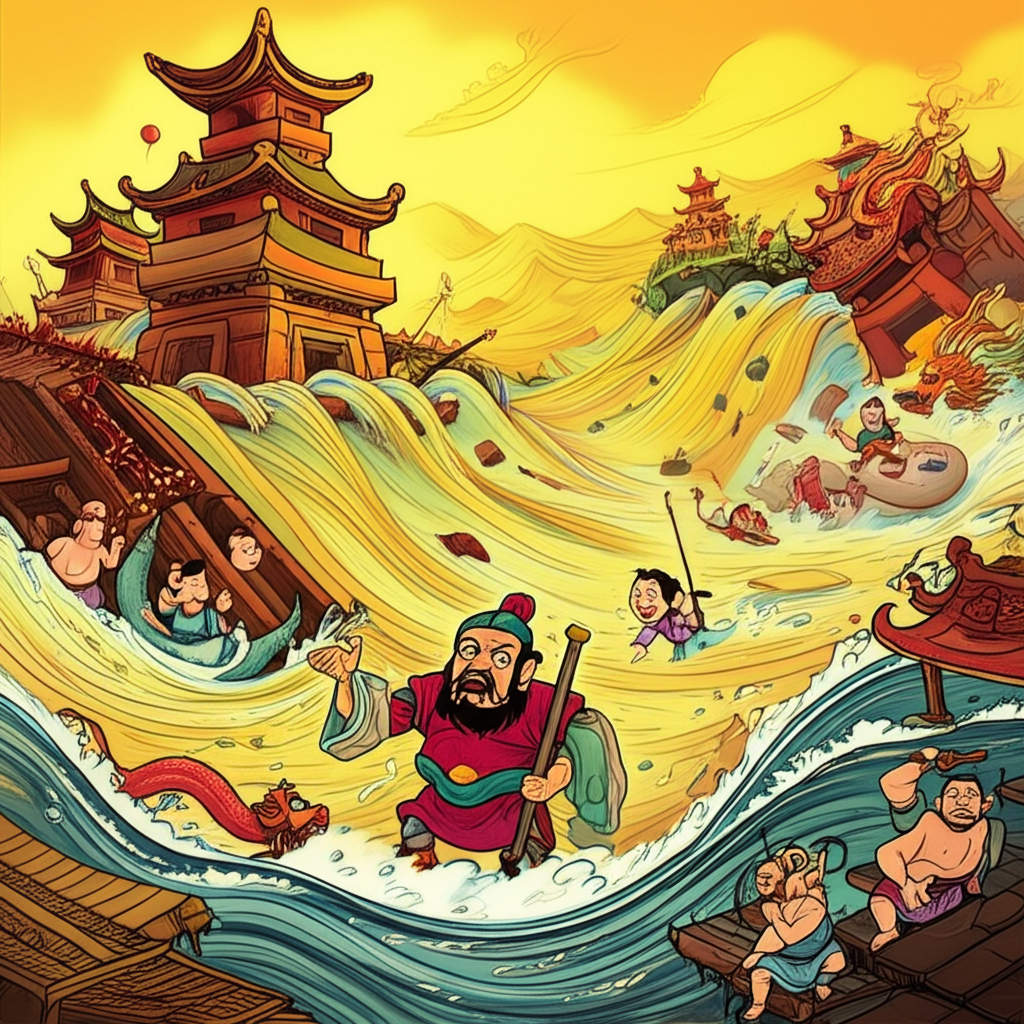
Ancient China, a land cradled by mighty rivers and shaped by the rhythms of nature, is a tapestry woven with countless tales. Among these, the legends surrounding the Yellow River, or Huang He, hold a particular significance. The Huang He, often called "China’s Sorrow" for its devastating floods, has been a source of both life and destruction for millennia. It is within this context of awe and fear that the myth of the Flood of Gun and Yu emerges, a powerful narrative passed down through generations, offering a glimpse into how ancient peoples grappled with the untamable forces of nature. This is not a chronicle of historical events, nor a divine decree, but a profound story told by ancient Chinese people to explain the world as they understood it.
The cultural landscape from which this myth springs is one deeply intertwined with agriculture and the environment. The ancient Chinese civilization flourished in fertile river valleys, particularly that of the Yellow River. Their understanding of the world was often animistic and deeply respectful of natural forces, which they perceived as potent, often capricious, entities. Life was a delicate balance, heavily dependent on the predictable cycles of the seasons and the benevolent flow of water for their crops. However, when these cycles were disrupted, and the rivers overflowed their banks, it was an overwhelming force that threatened their very existence. In such times, they sought explanations not just in observable phenomena, but in the realm of the supernatural, crafting stories to make sense of chaos and to imbue heroes with the strength to face insurmountable challenges.
At the heart of this myth stands Gun, a figure often depicted as a wise but ultimately flawed hero. He is sometimes portrayed as a descendant of an ancient dynasty, a skilled engineer, or a demigod tasked with a monumental undertaking. His symbolic attribute is his relentless persistence, his unwavering determination to control the uncontrollable. However, his methods, while ingenious in their conception, were ultimately deemed unsuccessful. He is often associated with the use of xifan, a magical, impermeable earth that he employed to build dikes and dams. This represents a symbolic struggle against the overwhelming power of water, an attempt to impose human will and order upon the wild, elemental force of the flood.
The narrative unfolds in a time of unprecedented cataclysm. The Yellow River, in its boundless fury, had broken free from its ancient channels, inundating the land, drowning villages, and leaving a trail of devastation. The people cried out for salvation, and the Emperor, desperate for a solution, turned to Gun. Gun, filled with the resolve of a man facing an impossible task, embarked on a monumental effort to contain the raging waters. For nine long years, he toiled, raising earthworks, building dams, and channeling the floodwaters. He was a figure of tireless effort, his every action driven by a singular purpose: to protect his people. Yet, despite his immense labor and the innovative techniques he employed, the floodwaters continued to surge, breaking through his defenses, and ultimately overwhelming his efforts. The legend states that Gun was ultimately punished for his failure, exiled or even executed, his monumental works washed away by the very waters he sought to control.
But the story does not end with Gun’s defeat. From his sacrifice, or perhaps his continued legacy, emerges Yu the Great. Yu is often depicted as Gun’s son, inheriting his father’s mission and, crucially, his father’s understanding of the problem. Where Gun had attempted to block the water, Yu’s approach was different. He learned from his father’s mistakes, recognizing the futility of direct confrontation with such a primal force. Yu is symbolically associated with wisdom, perseverance, and a profound understanding of natural flows. He is often shown as a hardworking, humble leader, his body calloused and weathered by his immense labors. His key attribute is his ability to channel and guide the waters, rather than to simply dam them. He dredged rivers, dug canals, and created a vast network that allowed the floodwaters to flow safely to the sea. His work was not about conquest, but about cooperation with nature, understanding its power and redirecting it for the benefit of humanity. He is often depicted as a figure who worked tirelessly, often separated from his family, his entire being dedicated to the welfare of his people and the taming of the Yellow River.
The symbolism embedded within the Flood of Gun and Yu is rich and multifaceted. Gun’s story can be interpreted as a cautionary tale about hubris and the limitations of brute force against the overwhelming might of nature. His use of impermeable earth might represent a rigid, inflexible approach that ultimately fails. His punishment can be seen as a reflection of how the ancient Chinese viewed the consequences of failing to respect natural laws or perhaps the limitations of even the most determined individual against the forces of the cosmos. Yu, on the other hand, embodies the ideal leader and the successful approach to environmental challenges. His success lies in his adaptability, his wisdom, and his understanding that true control often comes from working with nature, not against it. He represents the triumph of thoughtful planning, persistent effort, and a deep connection to the land. The story also speaks to the importance of lineage and the transmission of knowledge, with Yu learning from his father’s failures and achieving what Gun could not.
In the modern world, the myth of Gun and Yu continues to resonate. It is studied in literature, history, and cultural studies programs, offering insights into ancient Chinese cosmology and societal values. The figures of Gun and Yu have been immortalized in art, literature, and even popular culture. In video games, they might appear as powerful characters, their legendary feats translated into fantastical abilities. In films and television, their stories are retold, often focusing on the epic struggle against the flood and the heroism of Yu. These interpretations, while drawing from the original myth, often adapt it to contemporary storytelling conventions, exploring themes of man versus nature, leadership, and resilience.
It is crucial to reiterate that the Flood of Gun and Yu is a traditional story, a piece of cultural heritage passed down through the ages. It is a testament to the imaginative power of ancient peoples to explain the world around them and to find meaning in its most formidable challenges. As Muslims, we recognize that only Allah is the true Creator and Sustainer of all existence, the ultimate power behind the natural world. These ancient narratives, while captivating and culturally significant, are understood within the framework of Islamic belief as human attempts to comprehend divine creation.
The enduring power of the Flood of Gun and Yu lies in its ability to speak to universal human experiences: the struggle against adversity, the quest for solutions, and the enduring hope for a better future. It is a story that reminds us of the profound relationship between humanity and nature, and the timeless lessons that can be learned from the earth, the rivers, and the stories that echo from our collective past. It is a testament to the richness of cultural heritage and the enduring power of human imagination to weave tales that inform, inspire, and connect us to our ancestors.