fufufafa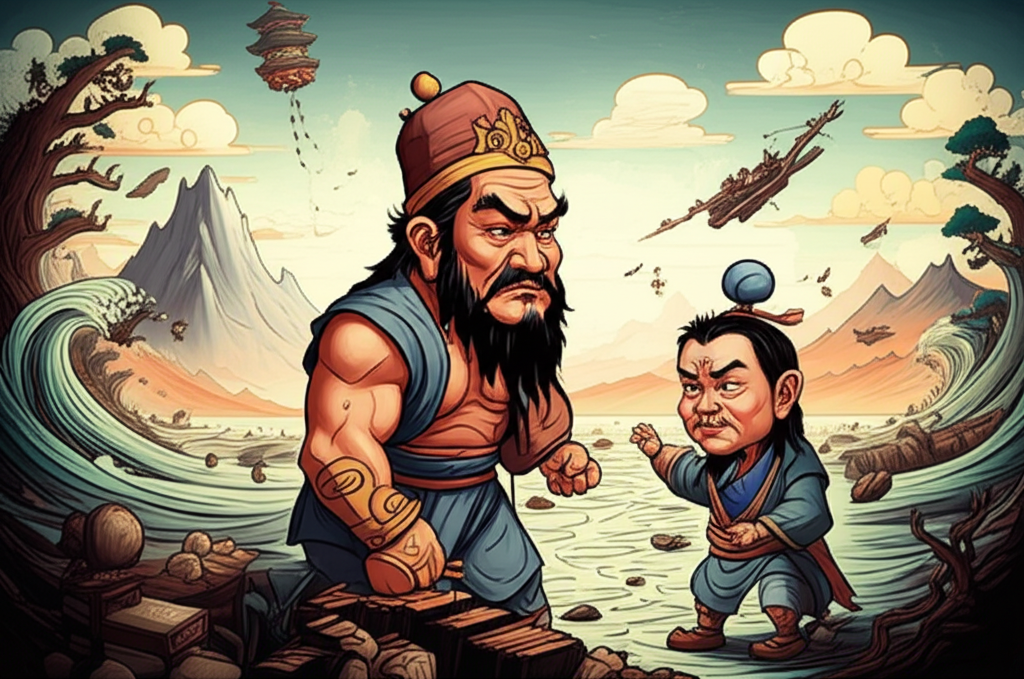
In the vast tapestry of human storytelling, where myth and history intertwine, certain narratives emerge from the mists of time, carrying echoes of ancient wisdom and the collective imagination of a people. One such tale, deeply embedded in the folklore of China, is the legend of the Great Flood, often personified and attributed to the monumental efforts of figures like Gun and Yu. These stories, passed down through generations, offer a fascinating glimpse into how ancient societies grappled with the raw power of nature, the challenges of survival, and the enduring human drive to overcome adversity.
This is a traditional story, a narrative woven from the threads of ancient Chinese belief and cultural understanding, meant for historical and educational appreciation, not as a matter of present-day faith or practice.
Whispers from a World of Elemental Forces
The genesis of these flood myths can be traced to a period in ancient China when humanity’s relationship with the natural world was one of profound awe and, at times, abject fear. These were societies deeply connected to the rhythms of the earth – the bounty of the harvest, the destructive fury of storms, and the life-giving, yet perilous, flow of rivers. The environment was not merely a backdrop; it was a potent, often unpredictable, force that shaped every aspect of life.
In this worldview, the cosmos was seen as a dynamic interplay of elemental forces, often imbued with spiritual significance. Natural disasters, like the cataclysmic floods that periodically reshaped the land, were not random events but were often understood as manifestations of the divine will, or the consequence of a cosmic imbalance. It was within this context of a world governed by powerful, often anthropomorphized, natural forces that the stories of the Great Flood and its legendary heroes took root. The Kunlun Mountains, a sacred and imposing range in Chinese mythology, often served as a celestial or primordial origin point for many of these powerful tales, a place where the heavens and earth met and where great beings resided.
The Unyielding Force: The Great Flood
The Great Flood, as depicted in these ancient narratives, was an event of unimaginable scale. It was a deluge that swallowed mountains, swept away villages, and threatened to drown the very existence of humanity. The waters were not merely water; they were a primal force, a testament to the untamed power of nature that ancient peoples both respected and feared. The sheer destructive potential of such a flood would have been a constant threat to early agricultural societies, whose survival depended on predictable water cycles. The memory of such devastating events, magnified and mythologized, would have been etched into the collective consciousness.
The Labor of Gun: A Father’s Futile Struggle
At the heart of this epic struggle against the waters stands Gun (鲧), a figure often described as a heroic, albeit ultimately unsuccessful, leader. He was a being tasked by the celestial emperor to control the relentless floodwaters. Gun’s strategy was one of containment. He employed the use of earth and stone, building dams and levees in an attempt to stem the tide. His efforts were immense, his dedication unwavering. He toiled tirelessly, battling against the surging currents, his ingenuity and strength a symbol of human resilience.
However, the ancient tales often depict Gun’s methods as ultimately flawed. The earth he used would be washed away, the stone dams would crumble, and the floodwaters, seemingly possessed of an insatiable will, would find new paths of destruction. Despite his monumental efforts, Gun’s approach was characterized by a stubbornness that, in the eyes of the heavens or the narrative itself, proved to be his undoing. For his inability to succeed in his task, and perhaps for some perceived transgression, Gun was punished. The stories vary, but often he is depicted as being banished or, in some versions, even transformed into a beast or a stone, eternally bound to his failed efforts. His legacy became one of a noble intention met with an insurmountable challenge, a cautionary tale about the limits of brute force against the elemental power of nature.
The Legacy of Yu: A Son’s Enduring Triumph
Following in his father’s footsteps, and inheriting the monumental burden of controlling the flood, came Yu the Great (大禹). Unlike Gun, Yu’s approach was one of redirection and channeling, rather than brute force containment. He understood that the water, an unstoppable force, could not simply be dammed. Instead, he conceived of a vast, intricate system of canals and channels, guiding the floodwaters away from the populated lands and towards the sea.
Yu’s undertaking was not merely a feat of engineering; it was a testament to unparalleled dedication and leadership. The narratives paint a vivid picture of his tireless work, often described as personally participating in the digging of canals, leading his people with an example of unwavering commitment. He is said to have worked for years, often away from his home, so engrossed in his task that he would pass his own village without stopping to see his family, his focus solely on saving his people. He navigated treacherous terrains, faced immense hardships, and inspired a generation to cooperate in this monumental effort.
Yu’s success was not just in his engineering prowess, but in his understanding of the natural world and his ability to unite people. He organized labor, established laws, and brought order to a chaotic world. His efforts were a resounding success. The floodwaters were tamed, the land was made fertile, and civilization could once again flourish. Yu the Great became a symbol of virtuous leadership, perseverance, and the ability of humanity to overcome even the most daunting challenges through wisdom and collective action. He is often credited with establishing the first dynasty, the Xia Dynasty, solidifying his role as a foundational figure in Chinese history and culture.
Symbolism in the Deluge: Nature, Order, and Leadership
The myth of Gun and Yu is rich with symbolic meaning, reflecting the anxieties and aspirations of ancient Chinese society.
- Nature’s Power and Human Vulnerability: The flood itself represents the overwhelming, uncontrollable power of nature. It highlights humanity’s inherent vulnerability in the face of such forces and the constant struggle for survival.
- The Limits of Force vs. Wisdom: Gun’s failure underscores the idea that brute force or rigid containment is not always the answer when confronting natural phenomena. Yu’s success, conversely, emphasizes the power of wisdom, adaptability, and understanding the inherent flow of things.
- Leadership and Sacrifice: Both Gun and Yu embody different aspects of leadership. Gun represents the dedicated but ultimately flawed leader, while Yu epitomizes the wise, self-sacrificing, and effective leader who prioritizes the well-being of his people above all else. His dedication, symbolized by his repeated passing of his home, highlights the immense personal sacrifice required for true leadership.
- Order from Chaos: The myth represents the transition from a state of primeval chaos, embodied by the flood, to a state of civilized order, established by Yu’s efforts. The taming of the waters is synonymous with the taming of the wild and the establishment of a structured society.
Modern Echoes: Enduring Narratives
In the modern era, the legend of Gun and Yu continues to resonate. It is a cornerstone of Chinese mythology, frequently retold in literature, children’s books, and artistic representations. The narrative has been adapted into films, television series, and video games, showcasing the enduring appeal of this epic tale of human perseverance against overwhelming odds. In academic circles, the myth is studied for its insights into ancient Chinese cosmology, societal structures, and the evolution of their understanding of governance and natural phenomena. It serves as a potent symbol of national identity and the historical narrative of Chinese civilization.
A Story for Our Times
As we reflect on the legend of Gun and Yu and the monumental flood they are said to have faced, it is crucial to remember its origins as a traditional story, a narrative born from the cultural and environmental landscape of ancient China. It is a testament to the power of human imagination and the enduring desire to find meaning in the face of life’s greatest challenges.
As Muslims, we recognize that only Allah is the true Creator and Sustainer of all that exists, including the forces of nature. These ancient stories, while culturally significant, are not to be mistaken for divine truth. Instead, they offer us a window into the past, allowing us to appreciate the rich tapestry of human heritage, the evolution of storytelling traditions, and the universal themes of struggle, resilience, and the pursuit of order that continue to captivate us across generations. The echoes of the Kunlun Mountains and the flood that shaped them continue to inspire, reminding us of the enduring power of narrative to connect us to our past and to explore the depths of the human spirit.