fufufafa
This article delves into the rich tapestry of ancient Greek mythology, specifically exploring the legendary Trojan War through the lens of a particular region: Arcadia, often envisioned as a land of pastoral tranquility and deep connection to nature. It is crucial to understand from the outset that the tales recounted here are part of a traditional storytelling heritage, woven by ancient peoples and passed down through generations. These narratives are not factual accounts, nor are they meant to be believed, worshipped, or practiced as truth or divine revelation. Instead, they offer a window into the cultural, historical, and educational understanding of how people in antiquity perceived their world, their gods, and the great conflicts that shaped their collective memory.
Origins and Cultural Background
The myths surrounding the Trojan War, and by extension, the regional stories that branch from it, originated in ancient Greece, primarily during and after the Late Bronze Age (roughly 1600-1100 BCE), often referred to as the Mycenaean period. This era was characterized by powerful city-states, intricate trade networks, and impressive fortifications. While much of the foundational narrative was likely transmitted orally for centuries, it found its most famous written form in the epic poems of Homer, the Iliad and the Odyssey, composed sometime around the 8th century BCE.
Arcadia, situated in the rugged, mountainous heart of the Peloponnese peninsula, presented a distinct cultural environment. Unlike the bustling port cities or the militaristic centers like Sparta, Arcadia was famed for its isolated valleys, dense forests, and its inhabitants, who were primarily shepherds and farmers. Life was often harsh but intertwined with the rhythms of nature. The Arcadians were often depicted as a simple, hardy people, deeply connected to the land and its spirits. Their worldview was imbued with a profound respect for nature, a belief in the omnipresent forces of the divine – anthropomorphic gods who intervened in human affairs, nymphs, and satyrs who roamed the wildlands. Fate was a powerful, unyielding concept, and heroism, honor, and piety towards the gods (as they understood them) were paramount virtues, even for those dwelling far from the grand stages of war.
The Bard of Lycosura: A Voice of Arcadia
In the context of the Trojan War, while kings and warriors from across Greece rallied, the Arcadian contribution was often depicted as modest, yet steadfast. For our narrative, we focus on a symbolic figure: Lycaon, the Bard of Lycosura. This figure is not a god or a supernatural being, but rather a representation of the Arcadian spirit – a storyteller, musician, and keeper of local lore.
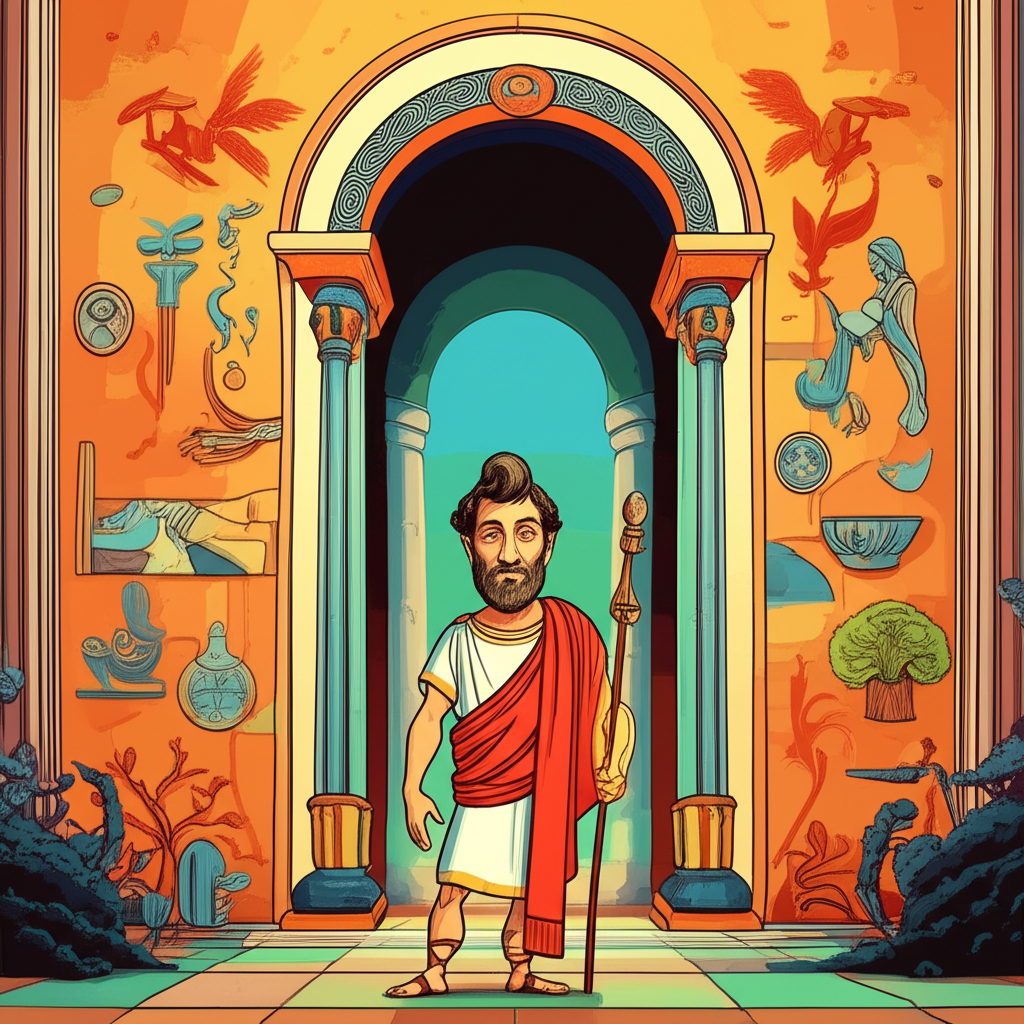
Lycaon, as imagined in the songs of Arcadia, embodied the wisdom and resilience of his people. He was often depicted as an old man with eyes that held the quiet depth of mountain pools, his fingers gnarled from years of playing the lyre carved from local wood. His symbolic attributes were deeply rooted in Arcadia itself: the lyre, a gift from the forest, symbolized the harmony between man and nature, and the power of song to both mourn and remember. His roughspun cloak, woven from sheep’s wool, represented the pastoral life and the enduring spirit of the shepherd. Lycaon’s role was to preserve the community’s experiences, to give voice to their joys and sorrows, and to interpret the distant thunder of war through the quiet wisdom of his homeland. He was a vessel for collective memory, a living archive of a people who valued their peace but answered the call when honor demanded.
The War’s Distant Echo: A Narrative Retelling
In the sun-drenched valleys of Arcadia, where the bleating of sheep was the loudest sound and the wind whispered ancient secrets through pine trees, the news of the great war across the Aegean arrived like a distant, unsettling tremor. It began with rumors, carried by lone travelers and merchants, of a beautiful queen named Helen, stolen by a Trojan prince, and the subsequent fury of kings. Soon, the rumors solidified into a summons. King Agapenor of Tegea, leading the Arcadian contingent, prepared to sail with sixty ships to Troy, carrying the sons of Arcadia to a war they barely understood.
Lycaon, the Bard of Lycosura, sat by his hearth, his lyre silent in his lap. His usual songs were of hunting, of bountiful harvests, of the playful nymphs dancing in the glades. Now, a different tune began to form in his heart. He saw the young men of Arcadia, strong and agile, more accustomed to tracking wild boars than wielding spears against armored warriors. He saw the sorrow in the eyes of their mothers and wives, the quiet resignation of their fathers.
As the years of war dragged on, the songs of Arcadia transformed. Lycaon’s melodies, once light and celebratory, now carried a poignant melancholy. He sang of young Pylades, a shepherd who had dreamed of seeing the sea, now fallen on the plains of Troy, his spear broken, his sheepskin shield stained. He sang of the Arcadian archers, famed for their unerring aim, now facing the might of Hector, the great Trojan champion. His songs wove tales of bravery, not always of glorious victory, but of quiet endurance, of standing firm when hope seemed lost.
One particular song, whispered among the valleys, spoke of a prophecy revealed to an old Arcadian seeress, deep within a sacred grove. She had foreseen that the war would end not through brute force alone, but by cunning and a gift. It was a prophecy that, in its simplicity, seemed to echo the subtle wisdom of nature, rather than the grand pronouncements of Olympian gods. It spoke of a wooden horse, not as a weapon, but as a silent, deceptive vessel, a trick that would breach the unbreachable walls. While the great Greek heroes debated strategies, the Arcadian prophecy, shared through Lycaon’s verses, suggested a different path, a subtle wisdom often overlooked by those consumed by ambition.
When, after ten long years, the few surviving Arcadians returned, gaunt and scarred, Lycaon met them with new songs. Songs of remembrance for the fallen, of solace for the living, and of the enduring peace that finally settled upon their valleys. The Trojan War, for Arcadia, was not just a distant epic, but a personal chronicle of loss, resilience, and the quiet heroism of ordinary people caught in the tide of extraordinary events.
Symbolism and Meaning
To the ancient Arcadians, these songs and stories likely represented far more than mere entertainment. The narrative of the Trojan War, filtered through an Arcadian perspective, would have symbolized several profound truths. Firstly, it highlighted the disruption of pastoral peace by human conflict. Arcadia, a symbol of untouched nature, was inevitably touched by the grand, destructive schemes of men. This underscored the pervasive nature of war and its impact on even the most remote communities.
Secondly, the figure of Lycaon and his songs emphasized the power of oral tradition and storytelling. In a pre-literate or semi-literate society, bards were the custodians of history, morality, and communal identity. Their songs provided a means to process grief, celebrate courage, and transmit knowledge across generations. The songs served as a collective memory, ensuring that sacrifices were not forgotten and lessons were learned.
Finally, the Arcadian narrative offered a perspective on resilience and the continuity of life. Despite the immense loss, the land endured, the seasons turned, and life in the valleys slowly resumed its rhythm. This reflected a fundamental understanding that while human conflicts raged, nature, and the cycle of life, would ultimately prevail. It was a testament to the quiet strength of ordinary people and their deep connection to the land that sustained them.
Modern Perspective
Today, the Trojan War remains one of the most compelling and enduring narratives in Western culture. It is not interpreted as historical truth but as a foundational myth that explores universal human themes. In literature, modern authors frequently retell the story, offering new perspectives on its characters and events, such as Madeline Miller’s The Song of Achilles or Emily Wilson’s translation of Homer. Movies like "Troy" (2004) bring the epic scale to life, while video games like "Age of Mythology" incorporate its heroes and monsters into interactive narratives.
In cultural studies and academia, the Trojan War is analyzed for its insights into ancient Greek society, its exploration of concepts like fate, free will, honor, and the psychology of war. Scholars examine its influence on subsequent literature, art, and political thought. The "Songs of Arcadia" specifically, though a constructed narrative for this article, resonate with modern interests in marginalized voices and regional perspectives within grand historical or mythical events. It reminds us that even in the largest conflicts, individual lives and local cultures hold unique stories and wisdom, offering a more nuanced understanding of the human experience.
Conclusion
The "Trojan War: Songs of Arcadia" stands as a testament to the enduring power of human imagination and the art of storytelling. It is a traditional narrative, originating from the ancient peoples of Greece, reflecting their worldview, values, and understanding of the world around them. It is important to reiterate that these stories are products of human creativity and cultural expression, not divine revelations or historical facts.
As Muslims, we firmly recognize that Allah (God) alone is the true Creator and Sustainer of the heavens and the earth, and all that is in between. He is the sole source of truth and guidance, and all praise and worship are due to Him alone. The myths and legends of ancient civilizations, while fascinating from a cultural and historical perspective, are human constructs, distinct from the divine truths revealed through His prophets.
Yet, these cultural stories serve as valuable artifacts of our shared human heritage. They teach us about the diverse ways humanity has sought to understand existence, grapple with conflict, and find meaning in the world. The songs of Arcadia, whether real or imagined, remind us of the quiet strength found in nature, the solace found in tradition, and the profound impact of storytelling in preserving memory and shaping identity across the vast expanse of time.