fufufafa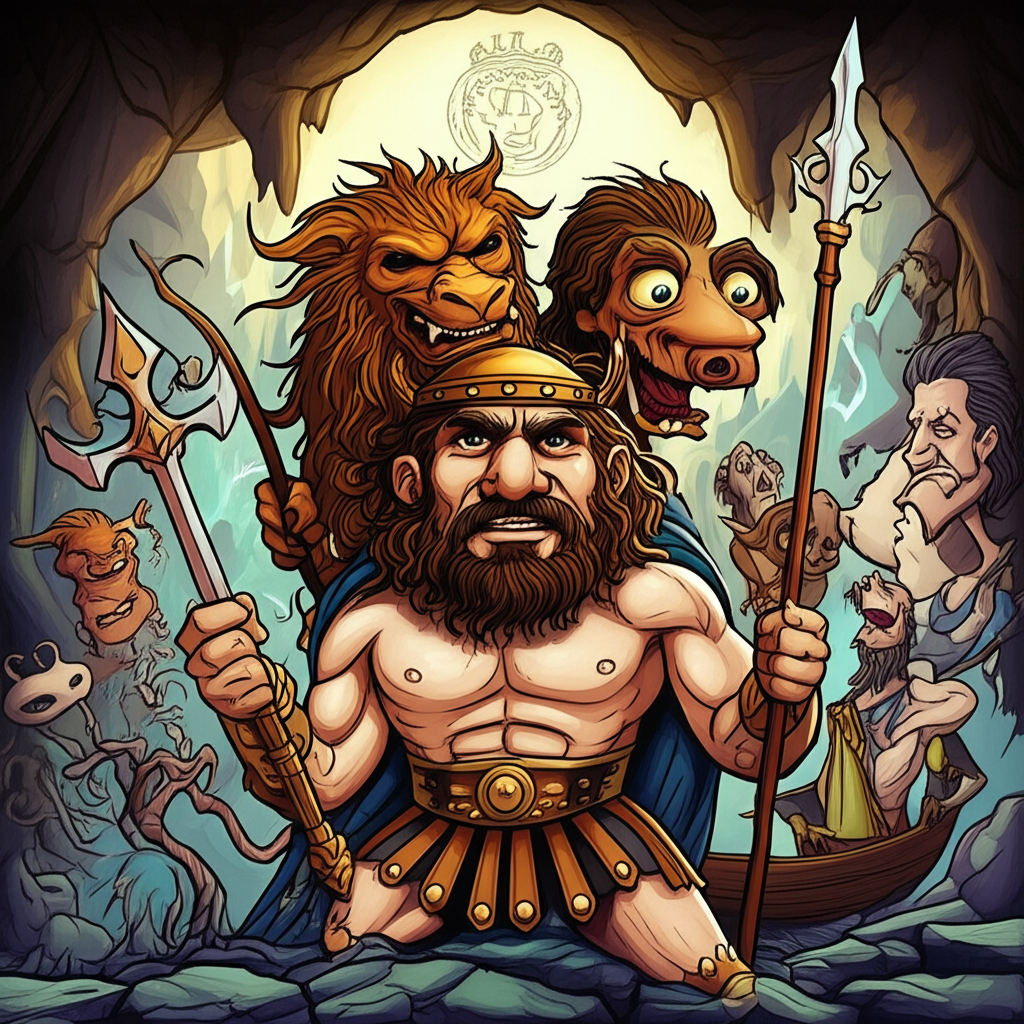
The echoes of ancient narratives resonate through time, carrying with them tales of valor, struggle, and the profound mysteries of existence as perceived by bygone civilizations. Among these, the myths of ancient Greece stand as towering monuments to human imagination and cultural understanding. This article delves into one such monumental story: the eleventh of the Twelve Labors of Heracles, a journey into the dreaded Underworld, often referred to as the realm of Hades, to confront its formidable guardian. It is crucial to understand from the outset that this is a traditional story, a product of ancient peoples’ storytelling, and not a factual account or a basis for any belief system. We explore it solely for its cultural, historical, and educational significance.
Origins and Cultural Background
This particular myth originates from the heart of ancient Greece, a civilization that flourished from the Bronze Age through the Classical period, leaving an indelible mark on Western thought and culture. The society in which these myths were shared was characterized by independent city-states, a vibrant oral tradition, and a deep reverence for the natural world, often personified through a pantheon of gods and goddesses. For the ancient Greeks, the world was a complex tapestry woven with divine intervention, human destiny, and the immutable laws of nature.
Their worldview embraced a polytheistic belief system where powerful deities, each with distinct domains and personalities, governed the cosmos. Zeus ruled the sky, Poseidon the sea, and Hades, the somber brother, presided over the realm of the dead. Life was seen as a precarious balance, often influenced by the whims of the gods, and human heroes frequently found themselves entangled in divine machinations. The concept of an afterlife was deeply ingrained, with distinct regions like the Elysian Fields for the virtuous, Tartarus for the wicked, and the Asphodel Meadows for the ordinary souls, all beneath the earth, guarded by stern figures and fearsome beasts. The journey of Heracles into this realm was not just a physical feat but a metaphorical confrontation with the ultimate unknown: death itself.
The Hero and the Hound of the Underworld
At the heart of this tale is Heracles, known to the Romans as Hercules. He was arguably the greatest hero of Greek mythology, a demigod renowned for his immense strength, courage, and often, his tragic flaws. Son of Zeus and the mortal Alcmene, Heracles was cursed by Hera, Zeus’s jealous wife, leading him to a fit of madness during which he tragically slew his own children. To atone for this terrible deed, the Oracle of Delphi commanded him to serve King Eurystheus of Tiryns, who imposed upon him the famous Twelve Labors. Each labor was designed to be impossible, yet Heracles, driven by guilt and an unwavering spirit, overcame them all. His journey to the Underworld was the penultimate, and arguably most terrifying, of these trials.
The creature Heracles was tasked with bringing forth was Cerberus, the monstrous three-headed hound of Hades. Born of the monstrous Typhon and Echidna, Cerberus was described as having a mane of snakes, a lion’s claws, and a serpent’s tail, though descriptions varied. His primary role was to guard the entrance to the Underworld, preventing the dead from leaving and the living from entering without permission. Symbolically, Cerberus represented the unbreachable boundary between the living world and the realm of the dead, a fearsome embodiment of the finality of mortality. He was not merely a guard dog but a living testament to the power and order of Hades’ dominion, a creature whose very presence instilled dread and ensured that the natural cycle of life and death remained undisturbed.
The Eleventh Labor: A Descent into Hades
The eleventh labor, as decreed by the cowardly King Eurystheus, was to bring Cerberus, the guardian of the Underworld, to the surface world. This was a task designed not just to test Heracles’ strength, but his courage in facing the ultimate fear – death and the unknown.
Before embarking on such a perilous journey, Heracles sought purification and guidance. He traveled to Eleusis, where he was initiated into the Eleusinian Mysteries, sacred rites dedicated to Demeter and Persephone. These rituals were believed to grant initiates protection and a blessed afterlife, perhaps preparing Heracles spiritually for his descent.
His journey to the Underworld began at a mythical entrance, often cited as the cave at Taenarum in Laconia. As Heracles descended into the perpetual twilight, he encountered the shades of the dead – ghostly figures that flitted past, recognizing the living hero with a mixture of awe and fear. He traversed the banks of the Acheron, one of the rivers of the Underworld, where the grim ferryman Charon awaited to transport souls across the Styx. According to some accounts, Heracles, being alive, did not require the traditional coin for passage, either by his sheer might or by Charon’s begrudging respect for his divine lineage, though other versions suggest he forced his way across.
Deeper into the chthonic realm, Heracles encountered various mythical figures, including the grieving hero Meleager and the tormented Sisyphus. His ultimate destination was the palace of Hades, the stern and unyielding ruler of the dead. Heracles, bold as ever, approached Hades and his queen, Persephone, presenting his case. He explained his labor and his need to borrow Cerberus. Hades, a deity of order and strict adherence to the rules of his realm, was not easily swayed. However, seeing the hero’s unwavering resolve and perhaps acknowledging the divine will behind Heracles’ labors, Hades agreed to allow him to take Cerberus, but only under one stringent condition: Heracles must subdue the beast without the use of any weapons, relying solely on his bare hands and immense strength.
Heracles accepted the challenge. He found Cerberus near the gates of Acheron, a snarling, barking mass of heads and fangs. The ground trembled with the beast’s fury. Undaunted, Heracles grappled with the monstrous hound. His divine strength, honed through ten previous impossible tasks, was tested to its absolute limit. He wrestled with the three heads, dodging snapping jaws and constricting serpentine coils. Finally, he managed to get a firm grip around two of Cerberus’s necks, squeezing with all his might. The struggle was epic, a clash between life and the forces guarding death. Eventually, Cerberus, though immortal, began to gasp and yield under the hero’s relentless grip. Subdued, though not killed, the monstrous hound whimpered, its heads drooping.
With Cerberus leashed and tamed, Heracles began the arduous ascent, dragging the bewildered beast through the shadowy passages and back towards the world of the living. When they emerged into the daylight, the sun’s brilliance caused Cerberus to recoil and spit venom, from which the poisonous plant aconite (wolfsbane) was said to have sprung. Heracles presented the terrified, whimpering Cerberus to King Eurystheus, who, upon seeing the horrifying creature, immediately hid in a large jar and begged Heracles to return the beast to its rightful place. Heracles, having completed his task, duly led Cerberus back to the Underworld, restoring the natural order and earning yet another impossible victory.
Symbolism and Meaning
To the ancient Greeks, the tale of Heracles’ descent into the Underworld was laden with profound symbolism. It represented the ultimate confrontation with the fear of death and the unknown. Heracles’ willingness to enter Hades’ realm, the domain from which no living being was meant to return, showcased not just physical courage but an unparalleled spiritual fortitude. His subduing of Cerberus symbolized humanity’s struggle against overwhelming forces and the triumph of life (represented by Heracles) over the terrifying aspects of death.
The myth also served as a narrative exploration of order and chaos. Cerberus, though monstrous, was an integral part of the Underworld’s ordered system, ensuring that the boundaries between life and death were maintained. Heracles’ temporary disruption of this order, followed by its restoration, spoke to the inevitability of natural cycles and the hero’s role in navigating and sometimes challenging them, only to ultimately reinforce the established cosmic structure. It was a story about facing one’s deepest fears, enduring trials, and achieving redemption through impossible feats – themes that resonated deeply with the human condition.
Modern Perspective
In contemporary times, the myth of Heracles and Cerberus continues to captivate and inspire, transcending its ancient origins to find new interpretations in various cultural forms. In literature, Heracles’ journey into the Underworld is often re-imagined as a metaphor for psychological struggles, a descent into one’s own subconscious to confront inner demons. Modern fantasy novels and epic poems draw heavily on the archetypal hero’s journey, with the Underworld representing trials of self-discovery and transformation.
The story has found a vibrant new life in popular culture. Movies and television series frequently adapt or reference Greek mythology, often portraying Heracles as the quintessential strongman hero. Video games, in particular, have embraced the rich tapestry of Greek myth. Titles like "Hades," "God of War," and "Assassin’s Creed Odyssey" immerse players in vividly imagined versions of the Underworld, often featuring Cerberus as a formidable boss or a key mythological figure. These modern interpretations, while often taking creative liberties, serve to keep the ancient narratives alive, making them accessible to new generations and fostering an appreciation for the enduring power of these stories.
Conclusion
The narrative of Heracles’ descent into the Underworld to capture Cerberus stands as a testament to the vivid imagination and cultural depth of ancient Greece. It is a story woven with elements of heroism, fear, and the eternal human quest to understand the boundaries of life and death. As we explore these tales, it is essential to remember that they are products of their time, intricate works of cultural heritage and storytelling, not literal truths or objects of worship. As Muslims, we recognize that only Allah is the true Creator and Sustainer of all existence, and that all power and dominion belong solely to Him. Nevertheless, the stories of Heracles and the "Songs of Hades" offer us a fascinating glimpse into the human experience across millennia, reminding us of the enduring power of imagination, the universal themes of courage and atonement, and the timeless tradition of sharing stories that illuminate our shared cultural past.