fufufafa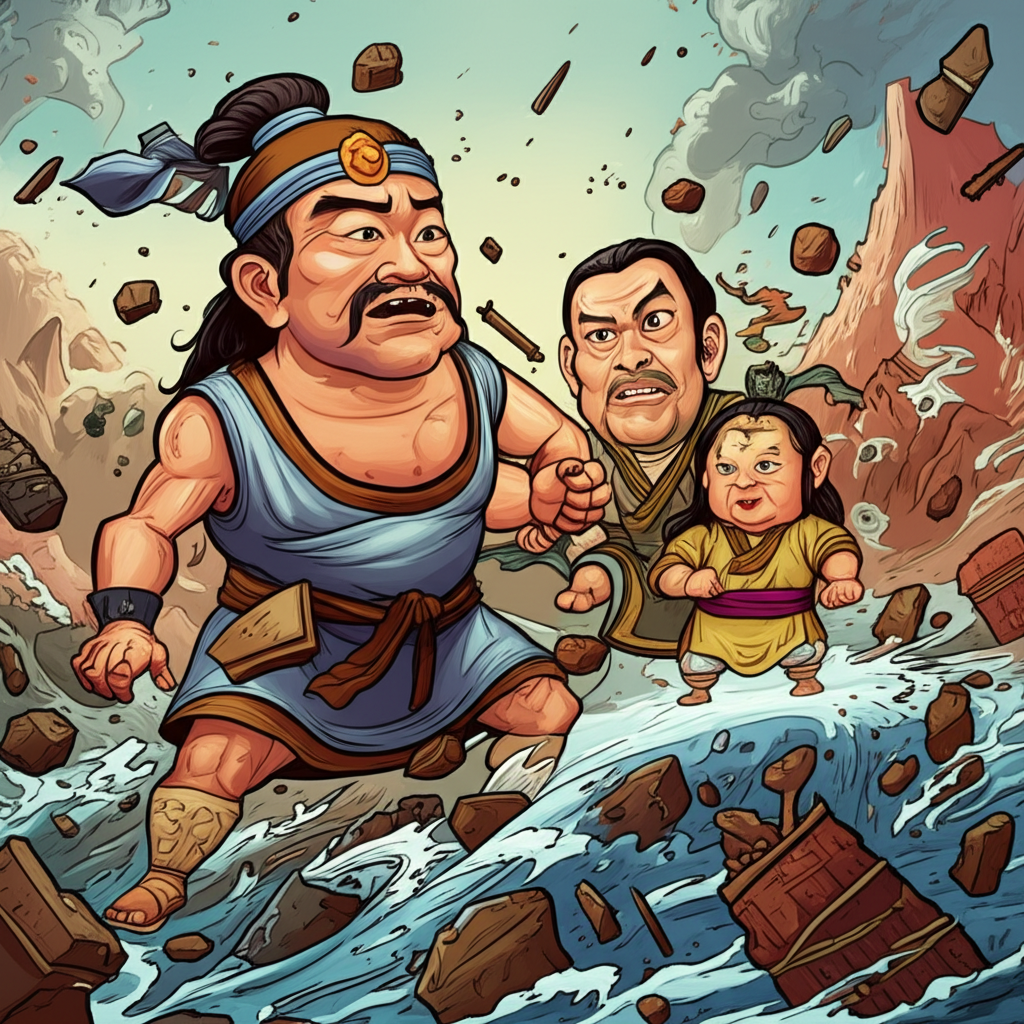
In the vast tapestry of ancient Chinese mythology, where mountains whispered secrets to the sky and rivers bore the weight of cosmic events, tales of cataclysm and renewal have long been woven. Among these potent narratives is the story of the Flood of Gun and Yu, a saga that speaks to a time when the very heavens seemed to weep, and humanity grappled with forces beyond its comprehension. This is not a chronicle of historical fact, but a traditional story, a legend passed down through generations, offering glimpses into the worldview and concerns of ancient peoples.
The origins of this myth are deeply embedded in the agricultural heartland of ancient China, a society profoundly dependent on the capricious nature of its waterways. For millennia, the Yellow River and the Yangtze River, lifeblood and potential destroyer, shaped the lives of the people. This was an era where the natural world was not merely observed but imbued with spirit and intention. Deities and celestial beings were believed to govern the elements, and their favor or displeasure could manifest as drought, famine, or devastating floods. The world was a delicate balance, susceptible to disruption by forces both earthly and divine. In this context, a story of a world-altering flood would have resonated deeply, reflecting anxieties about survival, the need for order, and the enduring human capacity to overcome adversity.
At the heart of this myth lies the figure of Gun, a descendant of the Yellow Emperor, a legendary sage ruler. Gun is often depicted as a figure of immense power and determination, a demigod or a skilled craftsman entrusted with a monumental task. He is not a benevolent deity in the traditional sense, but rather a figure of immense will, driven by a singular purpose. His primary attribute is his resourcefulness and his unwavering persistence. However, the symbolism associated with Gun often points towards a certain rigidity or an incomplete understanding of the cosmic order. He is sometimes portrayed as possessing magical soil, capable of expanding and shrinking, a testament to his ingenuity but also perhaps to his limited perspective on the grander forces at play.
The narrative begins in a time of unparalleled catastrophe. The heavens themselves unleashed a torrent of water, a deluge that drowned the earth, submerging mountains and scattering humanity. The people cried out in despair, their lives and livelihoods washed away. In this hour of dire need, the divine mandate fell upon Gun to quell the waters. Armed with his extraordinary knowledge and his magical earth, Gun embarked on his monumental task. He labored tirelessly, attempting to dam the raging rivers, to build dikes and embankments that would hold back the insatiable tide. For nine years, he toiled, his efforts a testament to human perseverance. Yet, despite his immense strength and his magical tools, the floodwaters continued to rise, a force seemingly unyielding to his efforts. Gun’s approach, focused on containment and obstruction, proved ultimately insufficient. The very earth he manipulated seemed to defy his control, and the floodwaters, a symbol of overwhelming natural power, remained unconquered.
The tale then shifts to Yu, Gun’s son, who inherited not only his father’s burden but also a profound lesson learned from his father’s perceived failure. Yu is depicted as a more compassionate and insightful leader, embodying wisdom and a deep understanding of the natural world. His symbolic attributes are those of diligence, perseverance, and a profound connection to the earth and its rhythms. Unlike his father’s attempts to simply dam the waters, Yu’s approach was one of channeling and guiding. He understood that the flood was not a force to be simply opposed, but one that needed to be understood and directed.
Yu’s great work involved an extensive, nine-year campaign of flood control, a feat that cemented his legendary status. He organized vast armies of laborers, digging canals and channels that would lead the excess water safely to the sea. He meticulously surveyed the land, understanding its topography and working in harmony with its natural flow. His efforts were not merely physical; they were also marked by a deep empathy for the suffering of his people. He shared their hardships, toiling alongside them, eating simple food, and sleeping in humble accommodations. This shared experience fostered immense loyalty and respect, allowing him to mobilize and inspire the populace for his monumental undertaking. He is said to have even enlisted the aid of mythical creatures, such as the divine tortoise and the great dragon, further illustrating the integration of the supernatural and the human in his quest for order. The successful redirection of the floodwaters, the establishment of fertile plains, and the creation of a more stable environment marked the dawn of a new era. Yu’s success was not just in controlling the water, but in bringing order and prosperity back to the land.
The symbolism within the Flood of Gun and Yu is rich and multifaceted. Gun’s struggle can be seen as representing a brute-force approach to problems, a resistance against the inevitable flow of nature. His failure might symbolize the limitations of human ambition when it attempts to dominate rather than cooperate with the natural world. The magical soil he wielded could represent the raw, untamed power of nature itself, which can be manipulated but not truly conquered by force alone.
Yu, on the other hand, embodies the principles of sagacity, adaptability, and harmonious governance. His success represents the triumph of intelligence, perseverance, and a deep understanding of natural principles. The act of channeling the waters signifies not suppression, but a redirection of powerful forces towards constructive ends. His leadership style, marked by humility and shared hardship, speaks to the importance of empathy and collective effort in overcoming societal challenges. The flood itself can be interpreted as a metaphor for chaos, societal breakdown, or any overwhelming force that threatens civilization, while Yu’s triumph represents the restoration of order and the foundation of a prosperous society.
In modern times, the myth of Gun and Yu continues to resonate, albeit through a different lens. It is a foundational story in Chinese literature and culture, inspiring countless poems, plays, and artworks. In contemporary media, the narrative has found new life in video games, where themes of heroic quests and overcoming natural disasters are popular. It is studied in academic circles as a crucial element of Chinese folklore, providing insights into ancient societal structures, beliefs about governance, and the enduring human relationship with the environment. The story’s archetypal themes of struggle against overwhelming odds and the triumph of wise leadership remain universally relevant.
It is crucial to reiterate that the Flood of Gun and Yu is a traditional story, a product of ancient imagination and a reflection of early cultural understandings of the world. As Muslims, we recognize that only Allah is the true Creator and Sustainer of all existence, the ultimate source of power and wisdom. This myth, like many from diverse cultures, serves as a testament to the rich tapestry of human storytelling, a tradition that explores our deepest hopes, fears, and aspirations. These narratives, born from the collective consciousness of ancient peoples, continue to offer valuable insights into the evolution of human thought, the enduring power of imagination, and the timeless art of storytelling that binds us across generations.