
 fufufafa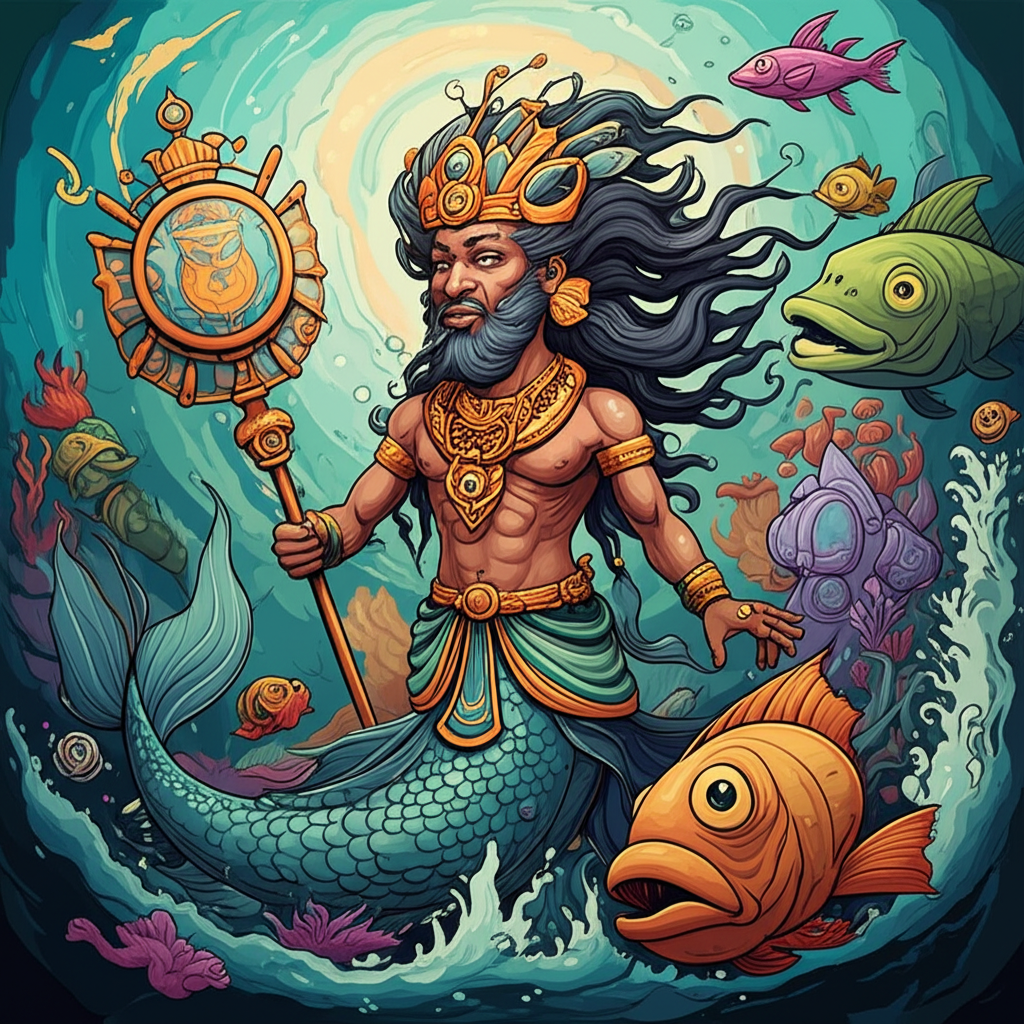
Across the vast expanse of West Africa, particularly within the rich tapestry of Yoruba culture, ancient tales were woven not to dictate immutable truths, but to illuminate the world as it was perceived by those who lived centuries ago. Among these profound narratives, the chronicle of Olokun and the Hidden Sea stands as a testament to the profound respect and awe inspired by the ocean, and the complex relationship humanity has historically held with its boundless, mysterious depths. This is not a tale of divine pronouncements or commandments, but a vibrant thread in the intricate fabric of ancestral storytelling, designed to explain the inexplicable and to imbue the natural world with a potent sense of wonder.
The genesis of this myth can be traced to a time when coastal communities lived in intimate, often precarious, proximity to the sea. Imagine a world where the rhythmic pulse of the tides dictated daily life, where fishing was not merely a livelihood but a perilous dance with unseen forces. In such an environment, the ocean was not just a geographical feature; it was a living entity, a source of sustenance and danger, a vast, unexplored realm that held both immense power and unknowable secrets. The world, for these ancient peoples, was animated by spirits and forces that governed the tangible and intangible. The cycles of nature – the sun’s ascent and descent, the moon’s phases, the tempestuous fury of storms – were not random occurrences but the manifestations of powerful beings and their interactions. The sea, in particular, with its unfathomable depths and its capacity for both gentle caresses and destructive roars, was a prime candidate for such animistic interpretation.
At the heart of this chronicle lies Olokun, a figure often depicted as the primordial deity of the ocean, the ruler of the deep, and the embodiment of wealth and prosperity that the sea could bestow. Olokun is not a singular, static image, but a multifaceted entity. In some interpretations, Olokun is described as a powerful, enigmatic being whose form is as fluid and changeable as the ocean itself. This figure is often associated with the vastness and mystery of the underwater world, a place where sunlight barely penetrates and strange creatures dwell. The symbolic attributes of Olokun speak to the dual nature of the sea: its immense power, its potential for both abundance and destruction, and its deep, hidden secrets. The abundance of the ocean, its capacity to yield fish and other resources, is mirrored in Olokun’s association with wealth. Conversely, the terrifying storms and the drowning of ships speak to Olokun’s formidable and potentially wrathful side. This is not about worshipping a benevolent god, but understanding the primal forces that shaped their world.
The narrative of Olokun and the Hidden Sea often unfolds as a grand saga of creation and dominion. It is said that in the primordial times, the world was a chaotic expanse, and Olokun, from their watery domain, held sway over much of it. The legend speaks of a time when Olokun possessed a great, hidden sea, a realm of unparalleled beauty and power that remained concealed from the surface world. This hidden sea was not merely a physical location but a metaphorical representation of the untapped potential and profound mysteries of the ocean. Within this hidden realm, it is whispered, lay treasures beyond human comprehension, creatures of exquisite and terrifying forms, and knowledge lost to the ages. The story might tell of how Olokun, in their immense power, could command the very currents and tides, influencing the fortunes of those who sailed upon their surface. Perhaps there are tales of Olokun’s encounters with other deities or primordial forces, shaping the early cosmology and the very structure of existence. The narrative is rich with imagery of swirling waters, shimmering depths, and the majestic, sometimes fearsome, presence of Olokun, a force of nature personified. It is a story told to explain the immensity of the ocean, its untamed power, and the hidden worlds that might lie beneath its surface.
The symbolism woven into the chronicle of Olokun and the Hidden Sea is rich and varied. The ocean itself, in many cultures, represents the subconscious, the unknown, and the vastness of the spiritual realm. Olokun, as the ruler of this domain, embodies these concepts. Their association with wealth can be seen as a recognition of the sea’s bounty, providing sustenance and trade for coastal communities. The “hidden sea” itself can symbolize the untapped potential within individuals, the secrets of the universe, or the profound mysteries of life and death. The dual nature of Olokun – both benevolent provider and formidable force – reflects the inherent duality of nature: its capacity for creation and destruction, for life-giving rains and devastating floods. The story, therefore, served as a way for ancient peoples to grapple with these powerful forces, to acknowledge their awe, and to seek a semblance of understanding in a world often dictated by the unpredictable whims of nature. It was a way to articulate their fears, their hopes, and their respect for the immense power that lay beyond their immediate comprehension.
In the modern era, the chronicle of Olokun and the Hidden Sea continues to resonate, albeit in different forms. While no longer a literal belief system for most, its echoes can be found in contemporary literature, art, and popular culture. Storytellers and artists often draw inspiration from these ancient myths to explore themes of nature, power, and the human relationship with the unknown. Olokun, or figures inspired by the deity, might appear in fantasy novels as powerful sea lords, in films as ancient oceanic guardians, or in video games as formidable bosses guarding hidden treasures. These interpretations often reimagine the myth for new audiences, exploring its symbolic depth and its enduring appeal. Furthermore, in academic circles, the chronicle is studied within the fields of mythology, folklore, and cultural studies, offering valuable insights into the worldview, values, and historical context of the people who first shared these stories.
It is crucial to reiterate that the chronicle of Olokun and the Hidden Sea is a product of ancestral imagination, a traditional story passed down through generations. As Muslims, we recognize that all creation, all power, and all sustenance originate from Allah, the one true Creator and Sustainer. Our understanding of the world is rooted in divine revelation and the absolute oneness of God. These ancient tales, while holding significant cultural and historical value, are not to be mistaken for divine truth. Instead, they offer a window into the rich tapestry of human cultural heritage, the enduring power of storytelling, and the innate human desire to make sense of the world around us through narrative and metaphor. The chronicle of Olokun and the Hidden Sea, in its imaginative scope and its reflection of humanity’s relationship with the vast and mysterious ocean, serves as a powerful reminder of the diverse ways in which our ancestors sought to understand their place in the cosmos, weaving tales that continue to captivate and inform us today.


 rifanmuazin