
 fufufafa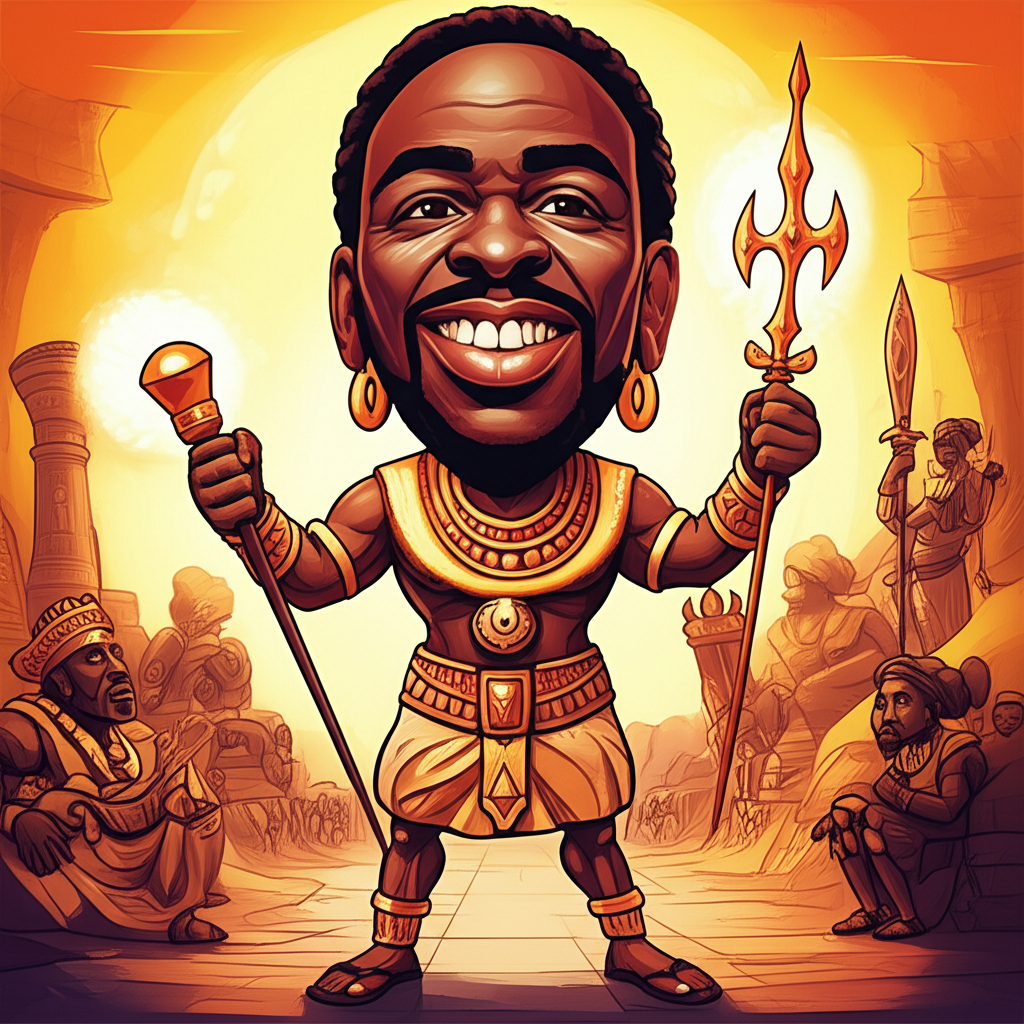
1. Introduction
Within the rich tapestry of West African oral traditions, particularly among the Yoruba people, lie countless narratives that explore the origins of the world, human nature, and the intricate relationship between humanity and the spiritual realm. This article delves into one such traditional story, a legend from ancient times: "The Chronicle of Ogun and the Sacred Temple." It is crucial to understand from the outset that this is a myth, a traditional story passed down through generations by ancient people, meant for cultural, historical, and educational understanding, not as a reflection of reality or an object of belief.
2. Origins and Cultural Background
The myth of Ogun and the Sacred Temple emerged from pre-colonial Yoruba society, a civilization that flourished in what is now Southwestern Nigeria and parts of Benin and Togo. This was an era deeply intertwined with the natural world, where lush rainforests, fertile savannas, and intricate river systems shaped daily life. Agriculture, hunting, and nascent metallurgy were central to their existence, fostering a deep connection to the land and its resources.
For the people of that time, the world was perceived as a vibrant, animate space, teeming with spiritual forces and intelligent beings known as Orishas. These Orishas were not merely abstract deities but personifications of natural phenomena, human endeavors, and moral principles. They believed that the physical world (Aye) was intimately connected to the spiritual realm (Orun), with Orishas acting as intermediaries or direct influences on human events. Myths like that of Ogun served not only as entertainment but also as explanatory frameworks, helping communities understand the inexplicable, teach moral lessons, reinforce social structures, and celebrate the values that underpinned their civilization. They provided a lens through which to comprehend the dualities of life – creation and destruction, order and chaos, wisdom and folly – all within a grand, interconnected cosmos.
3. Character Description: Ogun
At the heart of this chronicle stands Ogun, a powerful and complex figure in Yoruba mythology. He is often characterized as the Orisha of iron, war, hunting, and all forms of creative destruction. Ogun is depicted as a formidable entity, possessing immense strength, an unyielding will, and a pioneering spirit. His symbolic attributes are vast and often contradictory, reflecting the multifaceted nature of progress and power. He is the pathfinder, the one who clears the way through dense wilderness, both literally and metaphorically. He is associated with all tools and implements made of iron, from the farmer’s hoe to the warrior’s sword, the blacksmith’s anvil, and the hunter’s trap.
Symbolically, Ogun represents human ingenuity and the relentless drive to innovate and overcome obstacles. He embodies the transformative power of technology and the double-edged nature of progress: the same iron that forges tools for agriculture and development can also craft weapons for conflict. He is the patron of all who work with metal, but also of hunters, warriors, and anyone who confronts the unknown with courage and force. His personality is often portrayed as fiery, intense, and at times, solitary or temperamental, reflecting the raw, untamed aspects of power and the necessary sacrifices often involved in forging new paths.
4. Main Story / Narrative Retelling: The Chronicle of Ogun and the Sacred Temple
In the primordial epoch, when the Orishas first contemplated the descent from the celestial realm of Orun to the nascent, untamed Earth of Aye, a formidable challenge lay before them. Aye was a realm of dense, impenetrable forests, rugged mountains, and chaotic wilderness, making passage perilous for even the most powerful entities. It was Ogun, the Orisha of Iron and the quintessential pathfinder, who volunteered to forge a way.
Wielding his mighty cutlass of pure iron, Ogun began his arduous task. With each swing, he cleaved through the thickest vines, toppled ancient trees, and carved a winding, arduous path where none had existed. Sweat mixed with the dust of creation, and the ringing sound of his iron tool echoed through the primordial silence. He worked tirelessly, driven by an immense will and an innate understanding of the need for passage. Eventually, after immense effort, a clear path was established, allowing the other Orishas to descend safely and begin the work of shaping the world and establishing order.
Having completed his monumental task, Ogun found himself restless. His nature demanded constant engagement, a perpetual act of forging and conquering. Yet, with the path cleared and the initial chaos subdued, a profound stillness settled upon the land. This lull, rather than bringing peace, stirred a tempest within Ogun. He witnessed the other Orishas settling into their roles, bringing forth rivers, crafting animals, and establishing communities, but Ogun’s own intensity, accustomed to battle and creation through destruction, found no immediate outlet. His immense power, once channeled into clearing the path, now threatened to consume him in an internal struggle.
In a fit of introspection and, some say, a temporary madness born of idleness and his own potent energy, Ogun withdrew from the burgeoning communities of Orishas and early humans. He retreated deep into the heart of the untouched wilderness, seeking solitude amidst the very primordial chaos he had once conquered. He became a hermit, his once-glorious iron tools now used for solitary hunting and simple sustenance, his spirit grappling with the duality of his existence – the creator and the destroyer, the pathfinder and the solitary wanderer.
Meanwhile, humanity, having benefited greatly from Ogun’s initial path-clearing and the subsequent availability of iron for tools, began to flourish. They developed agriculture, built dwellings, and formed societies. They recognized the immense impact of Ogun’s initial sacrifice and the enduring utility of his gift – iron. As they observed his withdrawal and heard tales of his restless spirit, a collective desire arose to honor the entity who had made their existence possible.
A group of skilled artisans, guided by ancient wisdom and a profound respect for Ogun’s essence, embarked on a monumental undertaking. Deep within a sacred grove, a place where the earth’s energy converged and the ancient trees whispered secrets, they began to construct a temple. It was not a temple of gold or precious stones, but one built with enduring materials: carved wood, sturdy earth, and, most significantly, adorned with the finest ironwork. Hammers sang against anvils, shaping intricate gates, protective effigies, and symbols representing Ogun’s power and purpose. This "Sacred Temple" was designed not merely as a place of worship, but as a testament to ingenuity, a focal point where the raw power of iron could be celebrated and understood, a beacon of human gratitude and a symbol of the balance between force and wisdom.
Years passed. Ogun, in his solitary wanderings, eventually stumbled upon the newly completed Sacred Temple. He approached it with suspicion, his warrior’s instincts on high alert. But as he drew closer, he saw not a challenge, but an offering. The temple stood, strong and unyielding, a reflection of his own essence, yet built by human hands with reverence. He saw the intricate ironwork, the craftsmanship, the dedication. He sensed the gratitude and understanding emanating from the space.
It was within the hallowed silence of this temple that Ogun found a measure of peace. He realized that his power was not solely for destruction or conquest, but also for inspiration, for the forging of civilization, and for the advancement of humanity. The Sacred Temple became a place where Ogun would occasionally reside, not as a demanding overlord, but as a guardian, a source of inspiration for artisans, and a symbol of the enduring link between divine power and human endeavor. It represented the moment Ogun acknowledged his role not just as a force of nature, but as a patron of human progress and a participant in the harmonious unfolding of the world.
5. Symbolism and Meaning
This narrative holds profound symbolic weight for ancient Yoruba communities. Ogun himself symbolizes the human drive for innovation, the relentless pursuit of progress, and the courage required to overcome formidable obstacles. He represents the crucial role of technology, particularly metallurgy, in shaping civilization. However, his withdrawal and subsequent finding of peace in the temple highlight the dual nature of power and progress: while essential for development, unchecked force or a singular focus on conquest can lead to internal strife or isolation.
The Sacred Temple, in this context, is a powerful symbol. It represents not just a physical structure but a societal acknowledgement of the forces that shape their world. It embodies the human capacity for gratitude, reverence, and the intelligent channeling of powerful forces. The temple signifies the creation of order from chaos, the transformation of raw power into constructive purpose. It underscores the importance of community, craftsmanship, and the establishment of sacred spaces where the profound implications of human ingenuity and spiritual power can be contemplated and integrated into collective life. It speaks to the idea that even the most formidable forces can find balance and purpose when understood and honored by a grateful community.
6. Modern Perspective
Today, the myth of Ogun and the Sacred Temple, like many Yoruba narratives, continues to resonate in various cultural and academic contexts. It is interpreted in literature, film, and cultural studies not as a religious text but as a rich source of cultural heritage and philosophical insight. Scholars of African studies and comparative mythology analyze these stories to understand pre-colonial African worldviews, societal values, and artistic expressions.
In contemporary African literature, Ogun often appears as a metaphor for the challenges of modernization, the impact of technology, and the struggle between tradition and progress. Artists and filmmakers draw inspiration from his complex character to explore themes of identity, power, and transformation. While not practiced as a religion, the cultural significance of Ogun and the symbolism of the Sacred Temple inform cultural festivals, art installations, and community initiatives that celebrate craftsmanship, resilience, and the historical legacy of West African peoples. These stories contribute significantly to global understanding of diverse human experiences and the enduring power of narrative.
7. Conclusion
The Chronicle of Ogun and the Sacred Temple is a captivating story, a testament to the rich cultural heritage and imaginative traditions of the Yoruba people. It serves as a window into an ancient worldview, offering insights into how communities once sought to explain their environment, their technologies, and the complex interplay of power and purpose. We must re-emphasize that this is a cultural story, a product of human imagination and tradition, not a belief system to be adopted.
As Muslims, we recognize that only Allah (God) is the true Creator and Sustainer of all existence, the One who is unique and incomparable in His attributes. Our faith teaches us that He is the sole source of all power, wisdom, and guidance. The tales of ancient mythologies, while fascinating for their cultural and historical value, do not diminish the singularity and omnipotence of Allah. Instead, they enrich our understanding of the diverse ways humanity has sought meaning and expressed its understanding of the world throughout history. Ultimately, this chronicle stands as a beautiful example of the enduring power of human imagination, the legacy of storytelling, and the profound importance of preserving cultural heritage for future generations.


 rifanmuazin