fufufafa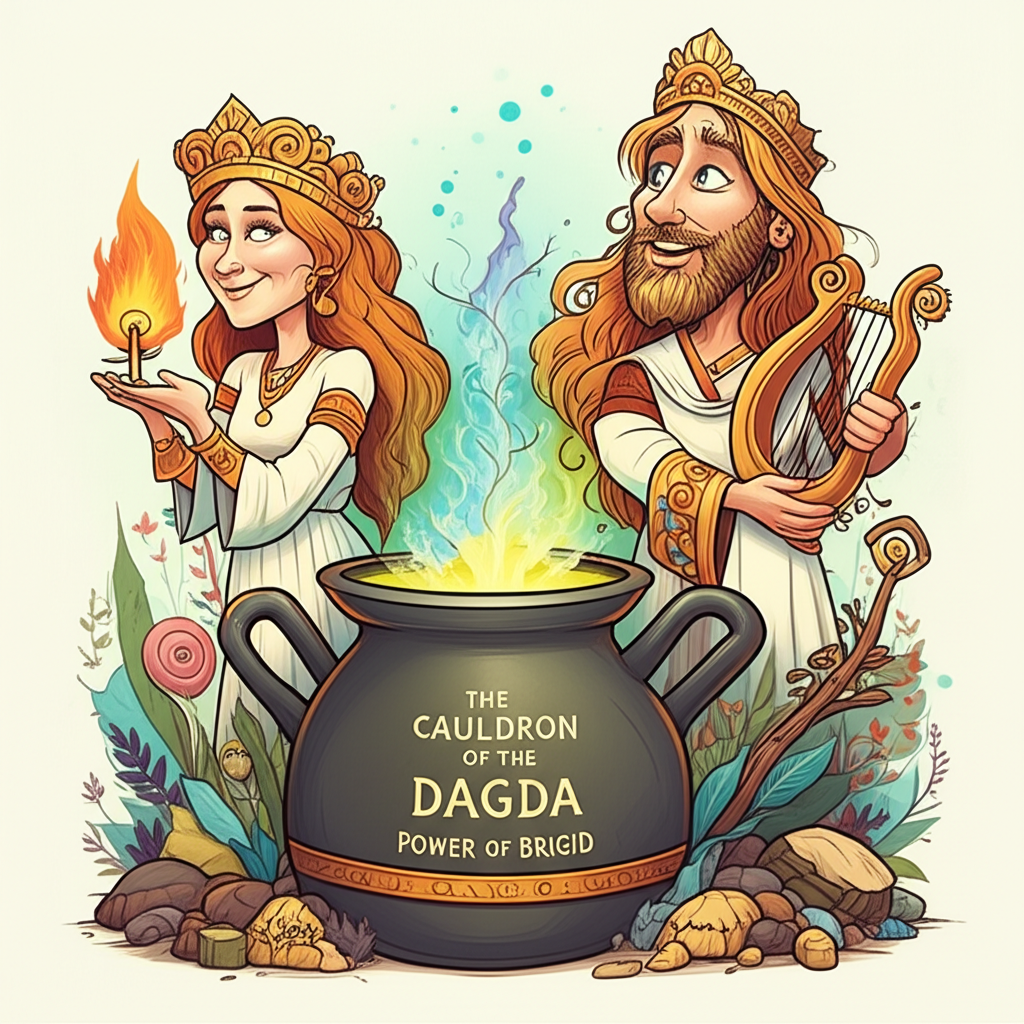
The mists of Ireland, ancient and deep, have long cradled tales of powerful beings and mystical artifacts, woven into the very fabric of its cultural heritage. Among these enduring narratives is the story of the Cauldron of the Dagda, an object intricately linked to the multifaceted goddess Brigid. This is not a chronicle of factual events, but rather a traditional story passed down through generations by the ancient peoples of Ireland, offering a glimpse into their worldview and imaginative landscape.
Origins and Cultural Background: A Land of Gods and Spirits
The myths surrounding the Dagda and Brigid originate from the Celtic period of Ireland, a time roughly spanning from the Iron Age into the early centuries of the Common Era. This was a society deeply intertwined with the natural world. The seasons dictated life, the forests held mystery, and the elements were seen as powerful forces, often personified and revered. Their understanding of the world was animistic, believing that spirits resided in all things – trees, rivers, mountains, and the sky.
The Tuatha Dé Danann, the mythical race of gods and goddesses who populated Irish folklore, were central to their belief system. These beings were not distant deities in the Abrahamic sense, but rather powerful figures who walked the land, intervened in human affairs, and embodied various aspects of life and nature. It was within this rich tapestry of animism and divine beings that stories of the Dagda’s Cauldron and Brigid’s influence took root.
Character Descriptions: Embodiments of Life and Abundance
The Dagda, whose name translates to "the Good God," was a prominent figure among the Tuatha Dé Danann. He was often depicted as a powerful, benevolent, and somewhat paternalistic deity. His attributes included immense strength, a magic club that could kill with one end and restore life with the other, and a harp that could charm both mortals and immortals. He was seen as a provider and a protector, embodying the abundance and well-being of the land.
Brigid, a goddess of immense importance, is frequently associated with the Cauldron. She was a complex figure, embodying a trinity of powers: poetry and inspiration, healing and smithcraft, and hearth and home. Her presence signified creativity, nurturing, and the vital spark of life. She was revered as a protector of warriors, a patron of poets, and a source of comfort and warmth. Her association with fire, a symbol of purification, transformation, and domesticity, further cemented her role as a nurturing and life-giving force.
The Narrative: The Cauldron’s Unending Feast
The legend of the Cauldron of the Dagda tells of an extraordinary vessel, a symbol of ultimate sustenance and generosity. This cauldron, belonging to the Dagda, possessed a remarkable quality: it could never be emptied. Regardless of how many people gathered around it, it would always provide enough food and drink to satisfy every single one. Imagine a grand feast, stretching for days and nights, with a single cauldron at its heart, continuously bubbling with the finest fare.
The story often places this cauldron within the dwelling of the Dagda, a place of warmth and hospitality. It was said to be so vast that a person could lie down inside it. During times of celebration or hardship, it would be brought forth, its presence a beacon of hope and a testament to the Dagda’s power to provide for his people. The aroma of its endless bounty would waft through the air, drawing all who were hungry and weary.
While the cauldron itself is attributed to the Dagda, its connection to Brigid is often implicit. Brigid, as the goddess of hearth and home, embodies the very spirit of nourishment and sustenance that the cauldron represents. The act of cooking and sharing food is a fundamental aspect of community and well-being, domains strongly associated with Brigid. The cauldron, in this context, can be seen as a material manifestation of her life-affirming energies, a constant source of the warmth and sustenance she bestows. Some retellings might even suggest Brigid’s direct involvement in its creation or enchantment, highlighting her role in ensuring abundance and preventing famine. The cauldron, therefore, becomes a powerful symbol of the interconnectedness of the divine and the earthly, of the ability of benevolent forces to ensure the survival and prosperity of a community.
Symbolism and Meaning: A Reflection of Life’s Essentials
To the ancient Irish, the Cauldron of the Dagda, and by extension the influence of Brigid, likely represented several profound concepts. Foremost among these was abundance and provision. In a time when survival was often precarious, the idea of an inexhaustible source of food was a powerful antidote to fear and scarcity. It spoke to the desire for security and the hope for a prosperous future.
Secondly, the cauldron symbolized community and hospitality. Its ability to feed everyone fostered a sense of unity and shared experience. It was a place where all were welcome, regardless of their station, and where the bonds of kinship and belonging were strengthened. This aligns perfectly with Brigid’s role as a patron of the hearth, the center of family and social life.
Furthermore, the cauldron could be seen as a representation of transformation and renewal. The act of cooking itself is a transformation of raw ingredients into sustenance. The idea of the cauldron always being full, never depleted, suggests a perpetual cycle of renewal, mirroring the cyclical nature of the seasons and life itself. This connects to Brigid’s association with healing and smithcraft, both processes of transformation and restoration.
Modern Perspective: Echoes in Culture and Imagination
Today, the myth of the Cauldron of the Dagda and the legends of Brigid continue to resonate in various forms. In literature, they serve as rich source material for fantasy novels and historical fiction, offering a glimpse into the imaginative world of ancient Ireland. Their stories are explored in academic studies of folklore and mythology, providing insights into the cultural values and spiritual beliefs of past societies.
In popular culture, elements of these myths can be found in video games, where powerful artifacts and divine beings often play a role. The concept of an unending source of power or sustenance can be a compelling narrative device. While these modern interpretations may not carry the same weight of spiritual significance as they did for ancient peoples, they demonstrate the enduring power of these stories to capture the human imagination.
Conclusion: A Tapestry of Ancient Storytelling
The Cauldron of the Dagda and the power attributed to Brigid are fascinating threads in the rich tapestry of Irish mythology. It is crucial to reiterate that these are traditional stories, born from the imagination and cultural understanding of ancient peoples. They are not to be taken as factual accounts or as directives for belief or practice.
As Muslims, we recognize that the true Creator and Sustainer of all existence is Allah (SWT). He alone possesses ultimate power and provision. These ancient narratives, however, offer a valuable window into the human desire for abundance, community, and well-being, and the ways in which people historically sought to understand and express these fundamental aspects of life through storytelling and symbolic representations. The enduring legacy of these myths speaks to the power of cultural heritage and the timeless human impulse to weave tales that explore the mysteries of existence and the aspirations of the human heart.