fufufafa
The sands of time, wind-swept and ancient, hold countless tales whispered from one generation to the next. Among these, few are as compelling and enduring as the myths woven by the people of ancient Egypt. This article delves into one such traditional story, an imaginative narrative from antiquity that describes the origins and significance of the Canopic Jars, entwined with the tragic saga of Osiris, often interpreted as the "Curse of Osiris." It is crucial to understand that this is a product of human storytelling from a bygone era, presented here purely for its cultural, historical, and educational value, and not as a factual account or a basis for belief.
Origins and Cultural Background: A World Shaped by the Nile
To truly grasp the essence of the Osiris myth and the role of the Canopic Jars, one must first step into the world of ancient Egypt, a civilization that flourished for millennia along the life-giving banks of the Nile River. This was a society profoundly influenced by the cycles of nature – the annual flooding of the Nile, the rebirth of vegetation, and the relentless journey of the sun across the sky. These natural phenomena instilled in the ancient Egyptians a deep reverence for cyclical existence, death, and rebirth, themes that permeated their worldview and religious beliefs.
During the Pharaonic era, particularly from the Old Kingdom through the New Kingdom (roughly 2686 BCE to 1077 BCE), the concept of the afterlife was paramount. Egyptians believed that a person’s physical body, or at least its preserved form, was essential for their Ka (life force) and Ba (personality/soul) to journey successfully into the Duat (underworld) and attain eternal life. This conviction led to the elaborate and meticulous practice of mummification, a process designed to safeguard the body from decay. It was within this context of profound belief in the afterlife and the sanctity of the preserved body that the myth of Osiris took root, providing a divine precedent for their mortuary practices, including the use of Canopic Jars. Their world was alive with gods and goddesses, each embodying aspects of nature, human experience, and cosmic order, guiding the destinies of both mortals and the divine.
The Divine Players and Their Vessels
At the heart of this ancient Egyptian drama are several key figures, whose actions set the stage for the creation of the Canopic Jars:
- Osiris: A benevolent and wise pharaoh, credited with bringing civilization to Egypt. He was revered as a god of fertility, agriculture, and the underworld, embodying order and the promise of rebirth. His symbolic attributes often include green skin, a pharaoh’s crown (Atef crown), and a crook and flail, representing kingship and dominion.
- Isis: Osiris’s devoted sister-wife, a powerful sorceress and mother goddess. She symbolizes unwavering love, magic, and protection. Often depicted with a throne on her head or wings, she is a figure of nurturing and resilience.
- Set: Osiris’s younger brother, a jealous and chaotic deity. He represented the wild, untamed desert, storms, and disorder, a stark contrast to Osiris’s reign of peace. Set is often depicted with the head of a mysterious, unidentifiable animal, a symbol of his wild and unpredictable nature.
- Horus: The posthumous son of Osiris and Isis, who embodies divine kingship, justice, and vengeance. He is typically shown as a falcon or a man with a falcon’s head, representing his sharp vision and swift action.
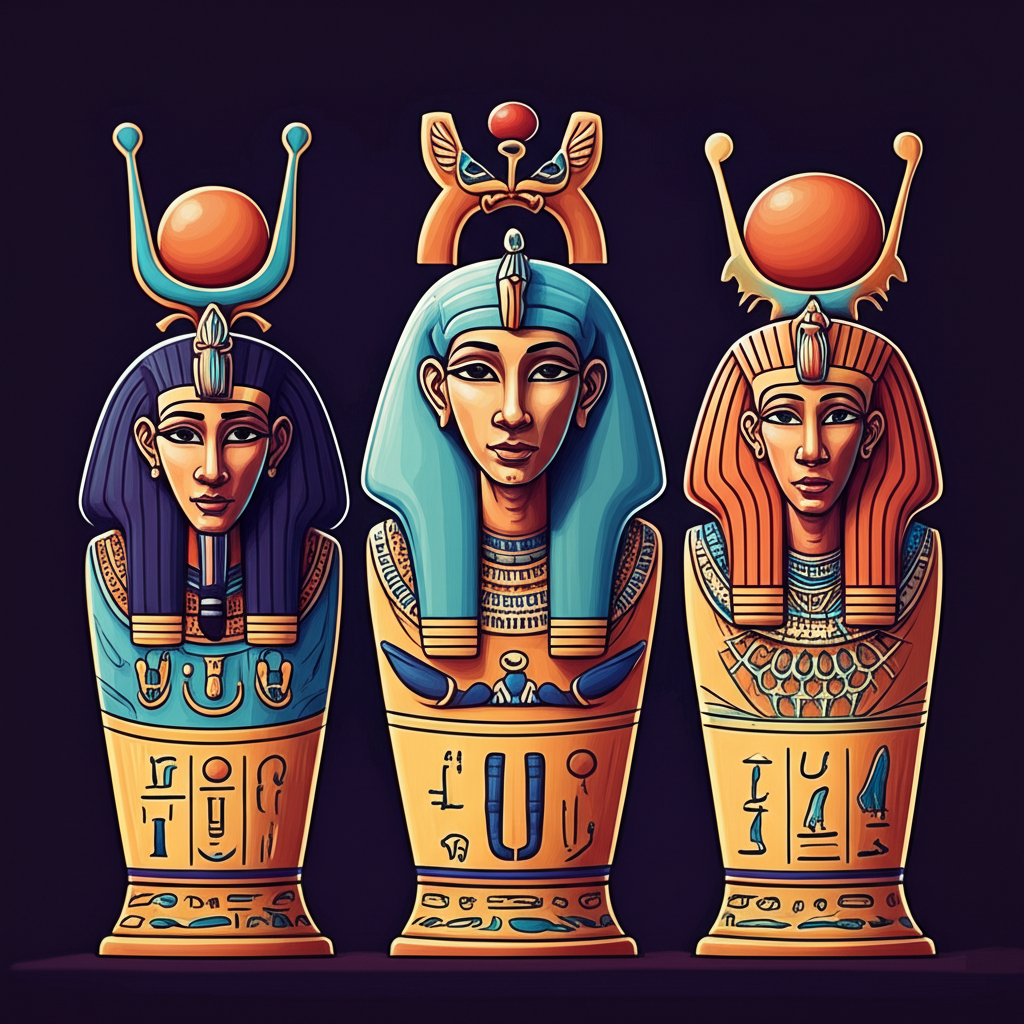
The Canopic Jars themselves are not characters but are central to the narrative’s resolution. These were four ornate vessels, typically made of limestone, alabaster, or pottery, designed to hold the internal organs removed during mummification. Each jar was dedicated to one of the four sons of Horus, who served as protective deities for specific organs:
- Imsety: With a human head, protected the liver.
- Hapi: With a baboon head, protected the lungs.
- Duamutef: With a jackal head, protected the stomach.
- Qebehsenuef: With a falcon head, protected the intestines.
These jars, adorned with their respective heads, were not merely containers; they were sacred guardians, ensuring the integrity of the deceased for their journey through the afterlife.
The Curse of Osiris: A Tale of Betrayal and Resurrection
The narrative begins in an age when gods walked among men, and Osiris ruled Egypt with wisdom and grace, ushering in an era of prosperity and enlightenment. His reign was marked by justice, the cultivation of crops, and the establishment of laws, earning him the love and adoration of his people. However, his benevolent rule stirred a festering jealousy in his younger brother, Set, who harbored a dark desire for the throne.
Set, consumed by envy, devised a treacherous plot. He secretly commissioned a magnificent chest, crafted precisely to Osiris’s measurements. During a grand feast, Set presented the chest as a gift, proclaiming that it would belong to anyone who could fit inside it perfectly. One by one, the guests tried, but none succeeded. Finally, Osiris, unsuspecting of the trap, lay down in the chest, only to find it a perfect fit. Before he could rise, Set and his co-conspirators slammed the lid shut, sealed it with molten lead, and cast the chest into the Nile. Osiris, the beloved king, drowned within his gilded coffin.
The news of Osiris’s disappearance plunged Egypt into mourning and chaos. Isis, distraught by the loss of her husband, embarked on a tireless quest to find him. Her unwavering love and powerful magic guided her across lands and waters until she eventually discovered the chest, which had washed ashore in Byblos, embedded within a mighty tree. She retrieved her husband’s body and brought it back to Egypt, intending to perform the necessary rituals to restore him.
But Set’s malice knew no bounds. Discovering Isis’s success, he seized Osiris’s body while she was away, brutally dismembering it into fourteen pieces. These fragments of the divine king, scattered across Egypt, were a profound desecration, a ‘curse’ upon Osiris, threatening his very ability to enter the afterlife whole. Once again, Isis, heartbroken but resolute, began her arduous search. With the help of her sister Nephthys, and the jackal-headed god Anubis (who later became the god of mummification), she painstakingly gathered all the pieces of Osiris’s body, save for one – his phallus, which had been swallowed by a fish in the Nile.
Despite the missing piece, Isis, with her formidable magical powers and the aid of Anubis, meticulously reassembled Osiris’s body. It was during this sacred and sorrowful ritual, the very first mummification, that the internal organs of Osiris – his liver, lungs, stomach, and intestines – were carefully removed. These vital organs, essential for his continued existence in the afterlife, were not simply discarded but were placed into specially crafted vessels: the Canopic Jars. Each jar, consecrated to one of the four sons of Horus, ensured the preservation and protection of its precious contents. This act, born from tragedy and divine intervention, symbolically mitigated the ‘curse’ of dismemberment, offering a path to wholeness in the spiritual realm. Through her magic, Isis briefly revived Osiris, conceiving their son, Horus, before Osiris descended to become the eternal Lord of the Underworld, ruling over the deceased and judging their souls.
Symbolism and Profound Meaning
For the ancient Egyptians, the myth of Osiris and the subsequent creation of the Canopic Jars held profound symbolism. It was not merely a fantastical tale but a narrative that encapsulated their understanding of life, death, and the cosmic order:
- Cycle of Life, Death, and Rebirth: Osiris’s death and resurrection mirrored the annual flooding of the Nile and the rebirth of vegetation, symbolizing the eternal cycle of nature and the promise of renewal after destruction.
- Order vs. Chaos: The conflict between Osiris (order, civilization) and Set (chaos, desert) represented the perpetual struggle between these opposing forces in the cosmos and within human society.
- Devotion and Resilience: Isis’s relentless search and her unwavering love for Osiris embodied the power of devotion, loyalty, and the extraordinary strength found in grief and determination.
- Justice and Vengeance: The eventual triumph of Horus, who avenged his father’s death and reclaimed the throne, symbolized the restoration of cosmic order and the ultimate triumph of justice.
- The Importance of Mummification: The story provided a divine precedent for mummification, reinforcing its critical role in ensuring the deceased’s ability to transition into the afterlife whole and complete. The Canopic Jars, holding the preserved organs, became potent symbols of this vital preservation, guardians of the body’s integrity.
- Royal Succession: The myth also legitimized the pharaoh’s rule, positioning him as the living Horus, the rightful successor to Osiris.
Modern Perspectives on an Ancient Tale
Today, the myth of Osiris and the Canopic Jars continues to resonate, albeit through a different lens. No longer a framework for religious belief, it has transitioned into the realm of cultural heritage and academic study. In modern literature, films, and video games, ancient Egyptian mythology often serves as a rich source of inspiration. The mummy genre, for instance, frequently draws upon themes of resurrection, curses, and the sanctity of tombs, echoing the core narrative of Osiris. Adventure stories like those of Indiana Jones often feature expeditions into ancient Egyptian ruins, where artifacts like Canopic Jars might be discovered, imbued with mystical significance.
Academically, this myth is a cornerstone in the study of ancient religions, anthropology, and art history. Scholars analyze its narratives to understand ancient Egyptian psychology, societal values, and their complex relationship with death and the afterlife. Archaeologists meticulously excavate tombs, often unearthing actual Canopic Jars, which provide invaluable insights into mummification practices and the artistic expressions of the era. The story reminds us of the universal human quest to understand mortality and the enduring power of storytelling to grapple with profound existential questions.
Conclusion: A Legacy of Imagination
The tale of Osiris and the Canopic Jars, often referred to through the lens of the "Curse of Osiris," stands as a powerful testament to the imaginative prowess of the ancient Egyptians. It is a traditional story, a product of human creativity from a specific time and place, woven to explain their world, their rituals, and their hopes for the afterlife. This narrative, like countless others from diverse cultures, offers a window into the minds and hearts of people who lived millennia ago, reflecting their concerns, their values, and their profound understanding of the cyclical nature of existence.
As Muslims, we recognize that only Allah is the true Creator and Sustainer, the One without peer or partner, and the source of all existence. Our faith affirms the singularity of God and the ultimate reality of His creation, distinct from the polytheistic mythologies of ancient civilizations. Yet, we can appreciate the rich tapestry of human cultural heritage, including these ancient stories, for their historical and educational value. They remind us of the universal human impulse to seek meaning, to explain the inexplicable, and to pass down wisdom through narrative. The enduring legacy of the Canopic Jars and the tragic saga of Osiris continues to captivate, inspiring reflection on the power of imagination and the timeless tradition of storytelling that binds humanity across epochs and civilizations.