
 fufufafa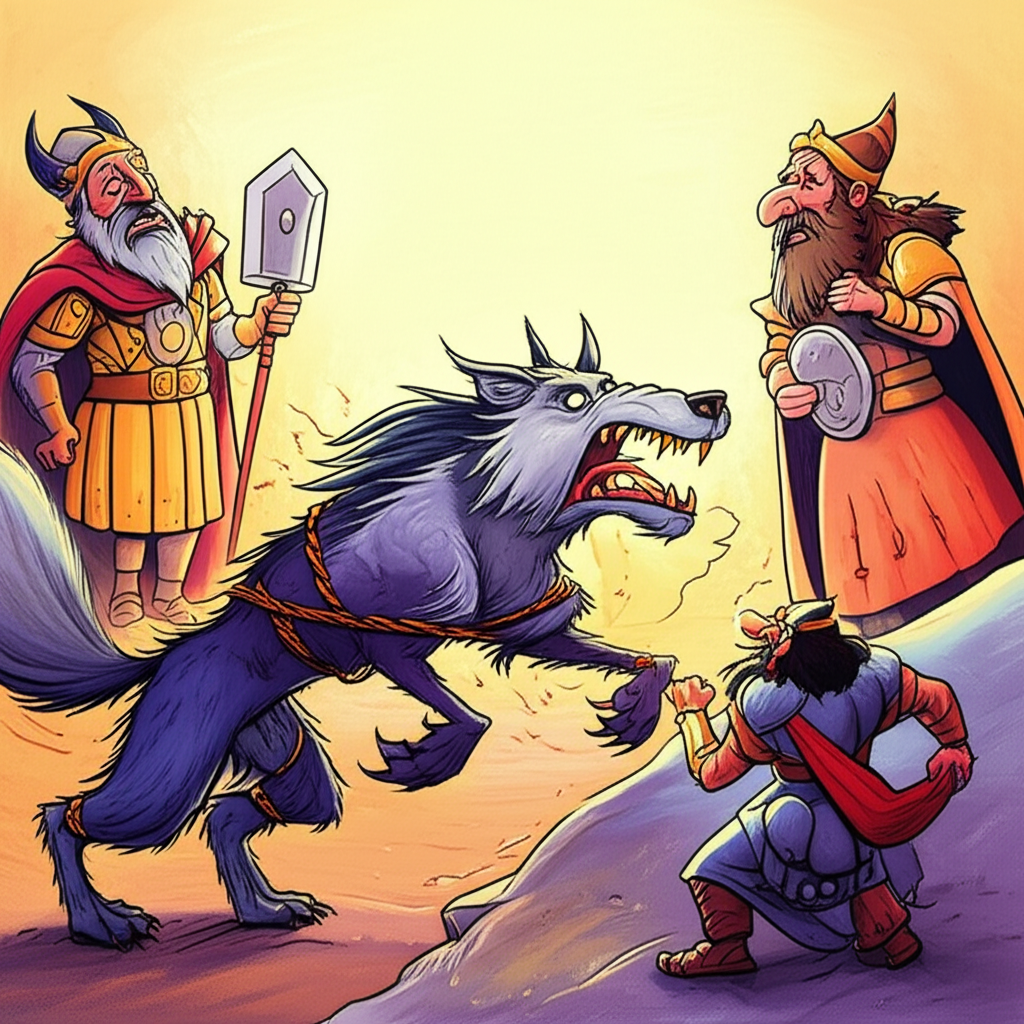
In the hushed whispers of the wind across snow-laden fjords and the crackling hearths of longhouses, ancient tales were woven, stories passed down through generations of Norse peoples. These were not mere fables, but the very fabric of their understanding of the world, explaining the unfathomable forces of nature, the triumphs and tragedies of existence, and the delicate balance between order and chaos. Among these profound narratives, the story of Fenrir, the monstrous wolf, and his eventual binding, stands as a stark and unforgettable testament to the primal fears and the desperate hopes that shaped the Norse worldview. This is a tale from the rich tapestry of Germanic mythology, a story told by ancient people to grapple with the mysteries of their existence.
The era in which these myths took root was one of harsh beauty and constant struggle. The Norse peoples, primarily dwelling in Scandinavia during the Viking Age and the preceding centuries, lived in a land of dramatic contrasts: the searing sun of summer giving way to the biting cold of winter, fertile valleys nestled beside formidable mountains, and the vast, unpredictable ocean that was both a highway and a devourer. Their world was perceived as a cosmic entity, a grand structure called Yggdrasil, the World Tree, connecting realms of gods, giants, humans, and the underworld. They viewed the forces of nature not as benevolent providers, but as potent, often capricious powers that demanded respect, appeasement, and constant vigilance. Life was precarious, and the concept of fate, or wyrd, was deeply ingrained, suggesting a predetermined destiny that even the gods could not entirely escape. It was within this framework of a dynamic, often dangerous cosmos that the story of Fenrir emerged.
Central to this narrative is Fenrir himself, a creature of immense power and terrifying potential. He is not merely an animal, but a personification of destructive chaos, a wolf of colossal size, whose jaws are said to be capable of swallowing the sun and the moon. His lineage is steeped in darkness; he is a son of the trickster god Loki and the giantess Angrboda. Fenrir’s symbolic attributes are those of untamed ferocity, insatiable hunger, and an inherent, destructive nature that poses an existential threat to the established order. He represents the primal, anarchic forces that lie just beneath the surface of civilization, the potential for absolute ruin that could engulf the cosmos. His growls were said to shake the earth, his eyes to burn with an unquenchable fire, and his very presence a harbinger of doom.
The narrative of Fenrir’s binding is a dramatic chronicle of escalating fear and desperate measures. It begins with the gods, the Aesir, residing in their magnificent hall of Valhalla, becoming increasingly aware of the growing threat posed by Fenrir. Despite his monstrous nature, he was initially a cub, a being that could, in theory, be managed. However, as he grew, so did his strength and his malevolent intent. His continued growth became a source of profound anxiety for the gods, who foresaw a prophecy of his eventual role in Ragnarok, the twilight of the gods, a cataclysmic battle that would lead to the destruction of the world.
The gods, in their wisdom and perhaps their fear, decided that Fenrir must be bound. Their first attempts were met with frustration and growing unease. They tried to shackle him with the strongest chains and fetters they could forge, but Fenrir, with his prodigious strength, simply broke them as if they were threads. Each time he snapped his bonds, his laughter echoed, a chilling sound that further solidified the gods’ apprehension. He boasted that no one could contain him.
Desperate, Odin, the chief of the gods, sought a solution beyond the mortal realm of craftsmanship. He commanded the dwarves, renowned for their magical prowess and their ability to create the impossible, to forge a magical fetter. This new binding was called Gleipnir, and it was described as being made from six mythical ingredients: the sound of a cat’s footfall, the beard of a woman, the roots of a mountain, the sinews of a bear, the breath of a fish, and the spittle of a bird. These seemingly disparate and intangible elements were woven together to create a chain of unparalleled strength, a silken ribbon that was impossibly strong.
When Gleipnir was presented to Fenrir, he was suspicious. He could sense its magical potency and the ill intent behind it. He refused to be bound by it, warning the gods that if they could not break it themselves, it meant he was doomed to remain in chains forever. It was Tyr, the god of war and justice, who bravely stepped forward. He offered his hand as a pledge, placing it within Fenrir’s jaws. The gods then fastened Gleipnir around the wolf’s paws, and as Fenrir struggled, the silken cord tightened, becoming unbreakable. The more he thrashed, the more secure the binding became. In his rage and his realization of his entrapment, Fenrir bit off Tyr’s hand.
The gods then secured Fenrir with a mighty chain called Jörmungandr, driven into the earth. They placed a sword in his open jaws, its hilt pointing upwards, so that when he roared in his eternal agony, the sword would gag him, preventing him from closing his jaws. There, Fenrir remained, bound and awaiting his prophesied release at Ragnarok, when he would finally break free and consume Odin himself.
To the ancient Norse people, this story likely represented a multitude of things. Fenrir embodied the terrifying potential for destruction that existed in the natural world – the storms that could obliterate settlements, the harsh winters that brought famine, and the inherent unpredictability of life itself. His binding could be seen as a symbolic act of humanity and the gods attempting to impose order upon chaos, to establish boundaries against the primal, destructive forces that threatened to consume them. Tyr’s sacrifice, placing his hand into the wolf’s maw, spoke to the ideals of courage, justice, and the personal cost of upholding order, even in the face of overwhelming odds. The story also served as a stark reminder of the inevitability of certain events, the foreboding sense of Ragnarok casting a long shadow, suggesting that even the most powerful beings could not escape their ultimate destiny.
In modern times, the myth of Fenrir continues to capture the imagination. It has been reinterpreted and adapted across various forms of media. In literature, it serves as inspiration for tales of epic battles and the struggle between good and evil. In popular culture, Fenrir appears in video games as formidable antagonists, in fantasy novels as ancient beasts of immense power, and in films as symbols of primal destruction. Academically, scholars of mythology and folklore study the story to understand the cultural anxieties, moral frameworks, and worldview of the ancient Norse peoples.
It is important to reiterate that the Binding of Fenrir is a traditional story, a product of the rich imagination and cultural heritage of ancient peoples. As Muslims, we recognize that only Allah (God) is the true Creator and Sustainer of the universe, the sole possessor of ultimate power and authority. This ancient narrative, while fascinating and historically significant, is understood within the framework of human storytelling and cultural expression, not as a literal or divine truth. The enduring power of such myths lies not in their factual claims, but in their ability to reflect human experiences, fears, and aspirations, offering a glimpse into the minds of those who came before us and a testament to the timeless human need to tell stories and make sense of the world around us. The Songs of Midgard, like the tale of Fenrir, continue to resonate, reminding us of the power of imagination and the enduring legacy of cultural heritage.


