
 fufufafa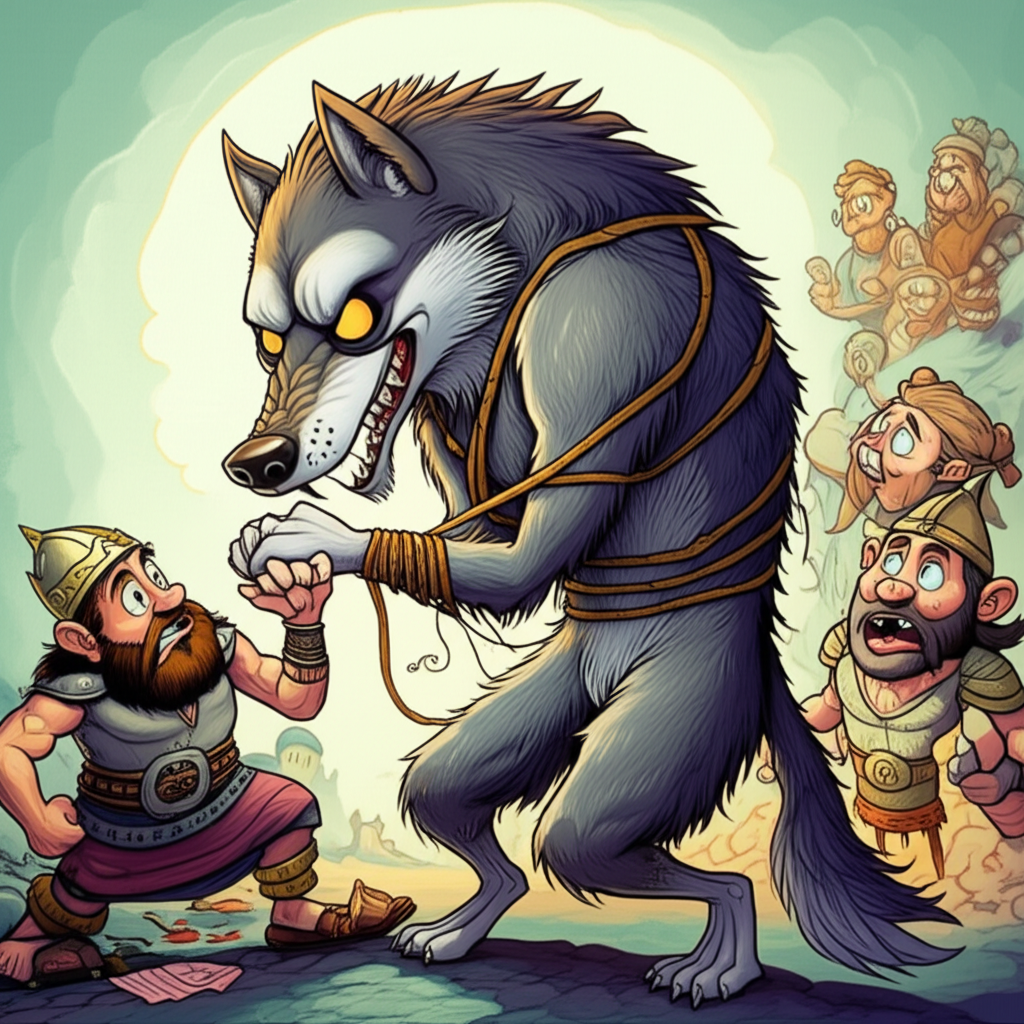
The ancient Germanic peoples, whose sagas and myths have echoed through centuries, painted a vivid tapestry of a world brimming with gods, giants, and fearsome creatures. Among these tales, none perhaps captures the raw power of untamed nature and the desperate struggle for order quite like the myth of Fenrir, the monstrous wolf, and his eventual binding. This is not a historical account of events, nor a divine decree, but a traditional story, a product of the human imagination wrestling with the profound mysteries of existence, shared by our ancestors in the frigid landscapes of Northern Europe.
To understand the genesis of such a myth, we must cast our minds back to the early medieval period, a time when the Norse and Germanic tribes navigated a world both beautiful and brutal. Their environment was one of stark contrasts: the long, dark winters gave way to brief, vibrant summers; the vast, untamed forests teemed with both life and unseen dangers; and the unpredictable forces of nature – storms, ice, and the very earth itself – were ever-present reminders of their vulnerability. In this setting, life was often a struggle for survival, and the world was perceived as a dynamic, often chaotic place, governed by powerful, often capricious, supernatural forces. Their worldview was steeped in a cyclical understanding of time, where creation, destruction, and renewal were inherent parts of existence. Deities were not distant, ethereal beings, but rather powerful entities deeply intertwined with the natural world and human affairs, capable of both great boons and terrible wrath.
At the heart of this particular saga lies Fenrir, a creature of immense and terrifying proportion. He is not merely a wolf, but the embodiment of primal, destructive power. His lineage is itself steeped in myth, being the offspring of the mischievous god Loki and the giantess Angrboda. This unholy union produced not only Fenrir but also the Midgard Serpent, Jormungandr, and Hel, the ruler of the underworld. Fenrir, in particular, is described as growing at an alarming rate, his jaws capable of stretching from the earth to the heavens, his teeth sharp enough to rend iron. He is a symbol of unchecked ferocity, of the wild, untamable forces that threaten to consume the ordered world. His ever-increasing size and insatiable hunger represent the growing chaos and the existential threat that such power poses to the established order.
The narrative of Fenrir’s binding is a desperate saga, a testament to the fear and awe he inspired. The gods, growing increasingly concerned by Fenrir’s prodigious growth and the prophecies foretelling his role in the world’s destruction at Ragnarok, the twilight of the gods, decided they must find a way to restrain him. Their initial attempts were futile. They forged chains of iron and steel, but Fenrir easily broke them as if they were mere threads. His strength seemed to defy any earthly restraint.
It was then that the dwarves, master craftsmen of the mythical realm, were tasked with creating a magical fetter. They labored in the heart of the earth, weaving together the sound of a cat’s footfall, the breath of fish, the roots of a mountain, the sinews of a bear, the spittle of a bird, and the beard of a woman. This impossibly delicate and potent mixture was spun into a silken ribbon called Gleipnir. It possessed an otherworldly strength, imbued with enchantments that no creature, however powerful, could break.
When Gleipnir was presented to Fenrir, he was suspicious. He sensed the magic within it and refused to be bound unless one of the gods would place their hand in his mouth as a pledge of good faith. Fear gripped the gods; none dared to make such a sacrifice. Finally, the god Tyr, known for his courage and justice, stepped forward. He placed his right hand between Fenrir’s massive jaws, and the gods proceeded to bind the wolf with Gleipnir.
As Fenrir struggled and thrashed, his immense strength testing the magical bonds, he realized he was trapped. In his rage and betrayal, he bit off Tyr’s hand, severing it at the wrist. The gods then secured the other end of Gleipnir to a great stone, Gygr, and cast the stone deep into the earth, anchoring Fenrir in the icy darkness of Niflheim, a primordial realm of mist and cold. There, he was left to howl and rage, awaiting the prophesied day of Ragnarok.
The symbolism woven into this tale is rich and multifaceted. Fenrir himself can be seen as a representation of the destructive forces of nature – the raging storm, the devouring wolf pack, the sheer, untamed power that can overwhelm human endeavors. His growth and insatiable hunger speak to the ever-present threat of chaos and the potential for even the most ordered societies to be consumed by their own internal or external pressures. The binding, on the other hand, represents the human desire for order, control, and security. The gods’ attempts to restrain Fenrir reflect the efforts of civilization to tame the wild, to establish laws and boundaries to prevent societal collapse. Tyr’s sacrifice is a potent symbol of the personal cost of leadership and the need for courage and integrity in the face of overwhelming odds. The creation of Gleipnir by the dwarves highlights the power of wisdom, ingenuity, and the harnessing of subtle, almost magical, forces to overcome brute strength. Niflheim, the cold, dark realm where Fenrir is imprisoned, can be interpreted as the underworld, the place of the dead, or simply the forgotten, primal depths from which such destructive forces can emerge.
In the modern world, the myth of Fenrir continues to resonate. It has found new life in literature, from epic fantasy novels that draw inspiration from Norse mythology to children’s stories that retell these ancient tales. Fenrir appears in video games as formidable bosses, in films and television series exploring themes of destiny and heroism, and in academic studies of folklore, mythology, and comparative religion. These interpretations often explore the timeless themes of good versus evil, order versus chaos, and the sacrifices made in the name of protecting society.
It is crucial to reiterate that the Binding of Fenrir is a cultural narrative, a testament to the storytelling traditions of ancient peoples. It is a reflection of their worldview, their fears, and their aspirations. As Muslims, we understand that only Allah, the Almighty, is the true Creator and Sustainer of all existence. These ancient stories, while fascinating for their cultural and historical significance, are products of human imagination, not divine revelation. They offer a window into the minds of our ancestors, their understanding of the world around them, and their enduring quest to make sense of its mysteries. The power of these myths lies not in their literal truth, but in their ability to spark imagination, to preserve cultural heritage, and to remind us of the enduring human impulse to tell stories and to seek meaning in the vast expanse of existence.


