
 fufufafa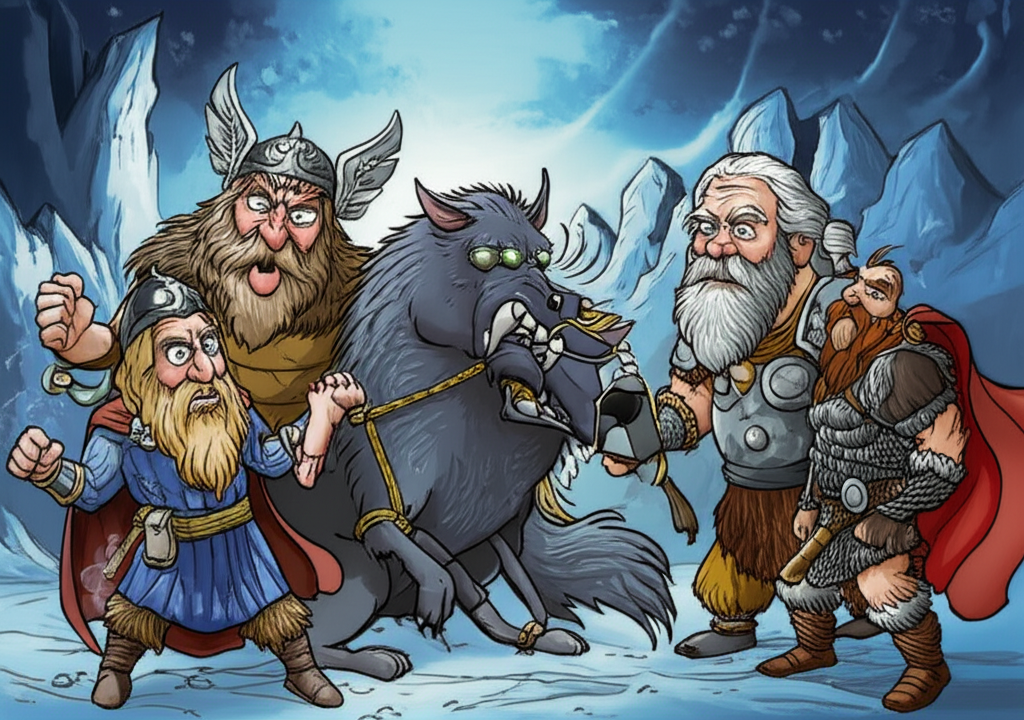
In the frigid north, where the winds howl like ancient spirits and the ice grips the land with an unyielding hand, a tapestry of myths and legends was woven by the ancient Norse peoples. These were not merely tales spun for amusement, but profound narratives that attempted to explain the world, to grapple with the raw forces of nature, and to navigate the complex tapestry of human existence. Among these compelling stories, the prophecy of Fenrir, the monstrous wolf, and his eventual binding stands as a potent symbol of dread, fate, and the precarious balance of power. This is a story passed down through generations, a whisper from a time when the world felt both magnificent and terrifyingly untamed.
The era from which these tales emerged was one shaped by the harsh realities of Scandinavia. Life was a constant negotiation with the elements. The long, dark winters brought scarcity and danger, while the fleeting summers offered a brief respite. The Norse people, often seafaring warriors and farmers, lived in close proximity to the untamed wilderness. Their worldview was deeply animistic, believing that spirits and powerful beings inhabited the natural world – the roaring thunder, the crashing waves, the silent, watchful mountains. They saw a constant interplay between creation and destruction, order and chaos, light and darkness. Their gods, while powerful, were not distant, perfect beings, but rather figures who, like mortals, experienced struggle, loss, and even death. This was a universe where fate, or wyrd, was a palpable force, a current that pulled all beings, gods and mortals alike, towards an inevitable conclusion.
Central to the prophecy of Fenrir is the creature himself. Fenrir, often depicted as a wolf of colossal proportions, is not merely a beast of fang and claw. He embodies the destructive potential that lies dormant within the world, a primal force of chaos. His lineage is itself a testament to his terrifying nature, being the offspring of the god Loki, a trickster and embodiment of mischief, and the giantess Angrboda. This unholy union birthed not only Fenrir but also the Midgard Serpent, Jörmungandr, and Hel, the ruler of the underworld. Fenrir, in particular, is said to possess a hunger that knows no bounds, a strength that grows with each passing day, and a capacity for destruction that threatens to unravel the very fabric of existence. His symbolic attributes lie in the untamed, the uncontrollable, and the ultimate manifestation of primal chaos. He represents that which cannot be reasoned with, that which must be contained through sheer force, and the ultimate threat to the established order.
The narrative of Fenrir’s binding unfolds as a chilling prelude to Ragnarök, the twilight of the gods. The Æsir, the gods of Asgard, grew increasingly fearful of Fenrir’s burgeoning power. They observed his relentless growth and the malevolent glint in his eyes, and a prophecy foretold that he would be the instrument of their doom. The gods, driven by a desperate desire to avert this cataclysm, devised a plan. They approached Fenrir, not with weapons, but with a challenge: a series of tests of strength. They claimed to wish to bind him, not as a prisoner, but as a testament to his unparalleled might, a demonstration of a strength so great that no chain could hold him.
Fenrir, perhaps with a cunning arrogance born of his own immense power, agreed to these trials. The gods presented him with progressively stronger fetters. First, they brought forth a chain called Læðingr, a formidable thing, yet Fenrir, with a mighty heave and a surge of his burgeoning strength, shattered it with ease. The Æsir, their fear deepening, then produced a stronger chain, Dromi, even more robust than the first. Again, Fenrir strained, his muscles bulging, and with a roar that shook the heavens, he broke Dromi into fragments.
The gods, now truly desperate, knew that a more cunning solution was required. They consulted with the dwarves, master craftsmen of the underworld, who forged a magical fetter named Gleipnir. This was no ordinary chain; it was described as being woven from six seemingly impossible ingredients: the sound of a cat’s footfall, the beard of a woman, the roots of a mountain, the sinews of a bear, the breath of a fish, and the spittle of a bird. These elements, combined with sorcery, created a ribbon so thin and smooth that it appeared to be mere silk, yet it possessed an unbreakable strength.
When the gods presented Gleipnir to Fenrir, the wolf was suspicious. The ethereal nature of the fetter seemed to mock the very concept of binding. He sensed deception, and his powerful instincts screamed danger. He refused to be bound by such a delicate-looking strand. The Æsir, feigning hurt and frustration, urged him on, questioning his courage, his true strength. They declared that if he could not break Gleipnir, then he was not the truly invincible creature they had feared.
This taunt, this challenge to his pride, was too much for Fenrir to bear. He agreed, but with a condition: one of the gods must place their hand within his jaws as a pledge, a sign of good faith. If he could not break free, the god would be consumed. Tyr, the god of law and justice, the bravest of the Æsir, stepped forward. With a stoic resolve that belied the immense fear he must have felt, Tyr placed his right hand between Fenrir’s formidable jaws.
The gods then set to work, binding Fenrir with Gleipnir. The wolf struggled, testing the seemingly fragile ribbon with all his might. He thrashed and roared, his immense power straining against the magical bonds. But Gleipnir held firm, its impossible strength proving greater than his boundless fury. As Fenrir realized he was truly trapped, his rage turned to despair. In his final, desperate struggle, he snapped shut his jaws, severing Tyr’s hand. The god, without a cry of pain, bore witness to the immolation of his limb, a sacrifice to contain the encroaching chaos.
The gods then took a sharp rock and drove it into Fenrir’s throat, preventing him from opening his jaws further, and chaining him down with an iron chain called Járngreipr. There he was left, bound and raging, in the desolate lands of Niflheim, a place of primordial mist and eternal cold, a fitting prison for a creature of such primal darkness. He was condemned to lie there until Ragnarök, the prophesied end of days, when he would finally break free and unleash his fury upon the gods.
The symbolism embedded within the binding of Fenrir is multifaceted and deeply resonant. The wolf himself can be seen as representing the untamed forces of nature – the ferocity of storms, the destructive power of winter, the primal instincts that lie beneath the veneer of civilization. His immense hunger symbolizes the insatiable desire for power and destruction that can consume individuals and societies. The prophecy of his role in Ragnarök speaks to the ancient human understanding of cycles of creation and destruction, of the inevitable end that often precedes a new beginning. The binding itself, particularly the seemingly fragile yet unbreakable Gleipnir, highlights the idea that true strength and control may not always lie in brute force, but in cunning, wisdom, and the harnessing of seemingly insignificant elements. Tyr’s sacrifice is a poignant representation of the cost of maintaining order, the willingness of individuals to suffer for the greater good, and the inherent risks involved in confronting and containing dangerous forces. Niflheim, as Fenrir’s prison, symbolizes a place of utter desolation, a realm where chaos is contained but never truly extinguished, awaiting its moment of release.
In the modern world, the myth of Fenrir continues to capture the imagination. He appears as a formidable antagonist in literature, from epic fantasy novels to reinterpretations of Norse sagas. In video games, his immense power and terrifying presence often make him a challenging boss or a significant plot element. Academically, the story is studied within the fields of comparative mythology, folklore, and cultural studies, offering insights into the values, fears, and worldview of ancient Norse societies. Fenrir serves as a potent archetype of the monstrous threat, the embodiment of uncontrollable chaos that humanity must strive to understand and, if possible, contain.
It is important to reiterate that the Binding of Fenrir is a traditional story, a product of ancient imagination and a cultural narrative passed down through generations. As Muslims, we recognize that only Allah is the true Creator and Sustainer of all existence. These ancient tales, while rich in symbolism and offering valuable insights into human thought and cultural heritage, are not to be interpreted as literal truth or divine pronouncements. The enduring power of such stories lies in their ability to spark our curiosity, to encourage reflection on universal themes of courage, sacrifice, and the eternal struggle between order and chaos, and to remind us of the vast and diverse landscape of human storytelling traditions. The whispers from the shadow of Niflheim, in their own way, contribute to the enduring legacy of human imagination and our continuous quest to understand our place within the grand, unfolding narrative of existence.


