fufufafa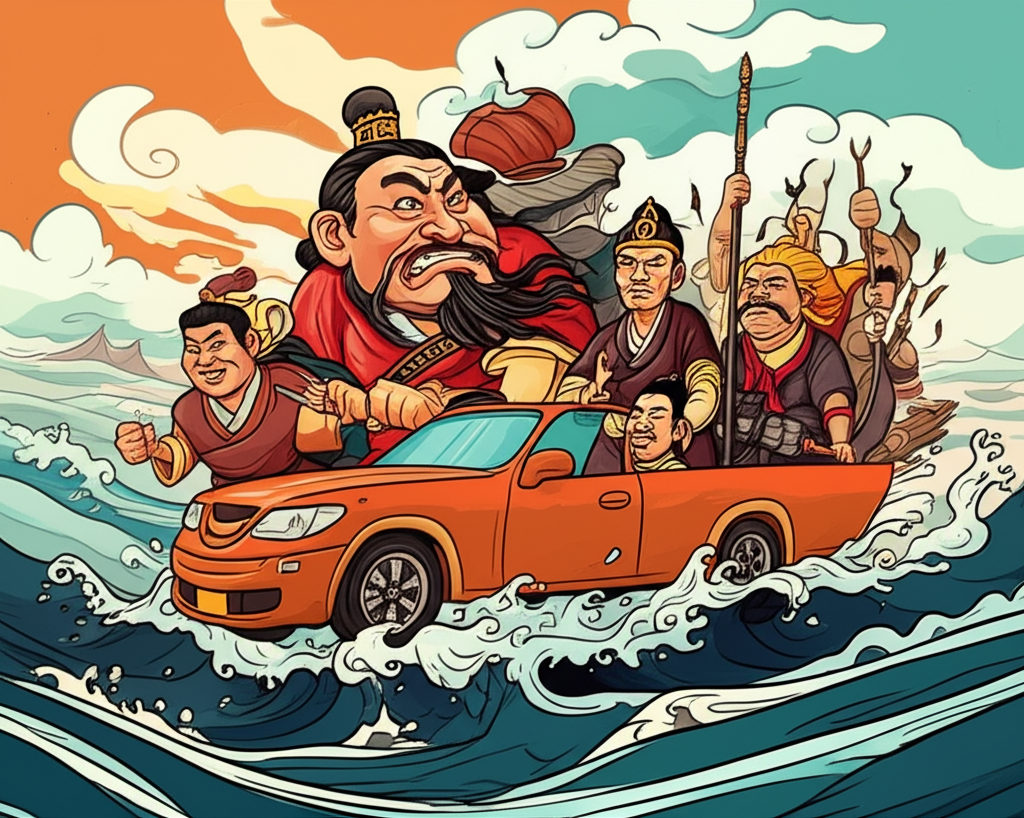
Songs of the Heavenly Court: The Great Flood and the Legacy of Gun and Yu
An Important Note: The following article explores a foundational myth from Chinese folklore. This story is a product of ancient human imagination, created to explain the world and convey cultural values. It is presented here for educational, cultural, and historical understanding and is not intended to be regarded as factual or to be practiced or believed.
Introduction
From the fertile, and often ferocious, river valleys of ancient China comes a story etched into the very bedrock of its civilization: the myth of the Great Flood. This is not merely a tale of disaster, but an epic saga of failure, persistence, and the profound difference between opposing nature and harmonizing with it. Passed down through millennia, this traditional narrative, centered on the tragic figure of Gun and his heroic son, Yu the Great, was a way for ancient peoples to grapple with their environment, define the qualities of true leadership, and articulate their understanding of the cosmic order. It is a song of humanity’s struggle against chaos, a story born from the mud and water of the Yellow River basin.
Origins and Cultural Background
To understand the myth of Gun and Yu, one must imagine the world of its creators. This story took shape in a society intrinsically tied to the land, likely during the Neolithic and early Bronze Age periods in China. Life revolved around the great rivers, particularly the Yellow River, known as both the "mother river" for the life-giving loess soil it deposited and the "sorrow of China" for its catastrophic, unpredictable floods.
For these early agricultural societies, a flood was not just an inconvenience; it was an existential threat that could wipe out entire communities, destroy harvests, and plunge the world into chaos. Their worldview was one of deep connection between the earthly realm and a celestial one. Natural disasters were often interpreted as signs of disharmony between heaven, earth, and humanity. A good ruler was expected to maintain this balance, and a cataclysm like a world-engulfing flood was a sign of a fundamental crisis that required a hero of immense capability and virtue to resolve. This story, therefore, became a powerful vehicle for exploring themes of governance, engineering, and the proper relationship between humankind and the forces of nature.
Character Description
The saga is dominated by two central figures, a father and son whose approaches to the same crisis could not be more different.
Gun (鯀): Often portrayed as a well-intentioned but tragic figure, Gun is Yu’s father. He is a nobleman, perhaps a minor deity himself in some tellings, who steps forward when others falter. His defining characteristic is his method: confrontation. He sees the flood as an enemy to be walled off and contained. His symbolic attribute is the Xirang (息壤), a mythical self-expanding soil. This magical earth represents a powerful, almost miraculous solution, but Gun’s acquisition and use of it—through theft and brute force—symbolize a reliance on shortcuts and a hubristic attempt to dominate nature rather than understand it.
Yu the Great (大禹): Born miraculously from his executed father’s body, Yu is the archetypal hero of Chinese culture. Where his father was confrontational, Yu is wise and adaptive. He embodies the virtues of perseverance, humility, self-sacrifice, and ingenuity. His symbolic attributes are not magical items but his actions: his tireless surveying of the land, his invention of tools to dredge rivers, and his 13-year-long labor. The most famous detail of his legend is that he passed by his own home three times during his quest without once stopping to see his family, symbolizing his complete devotion to the public good over personal comfort. He represents the ideal of working with the natural flow of the world, not against it.
Main Story: The Retelling of a Deluge
In the age of the sage-emperor Yao, the world was drowning. The chronicles of that time, woven from memory and myth, tell of waters that swelled without end, swallowing fields, villages, and hills. The floodwaters, it was said, "assailed the very heavens," and the people were forced into high mountain caves, living like birds in nests, their civilization on the brink of collapse.
Emperor Yao, his heart heavy with the suffering of his people, called upon his advisors to find a hero capable of taming the deluge. After much deliberation, a name was put forth: Gun. Confident and determined, Gun accepted the monumental task. He observed the rising waters and decided on a simple, direct strategy: he would build dams. He would erect barriers so high and strong that the water would have no choice but to retreat.
But ordinary earth was not enough. The water always rose higher, eroding his efforts. In his desperation, Gun learned of a celestial treasure in the Heavenly Court: the Xirang, the self-expanding soil. A single handful of this magical earth could grow into a mountain. Believing the ends justified the means, Gun stole the Xirang and began his great work. For nine long years, he toiled. Wherever the floodwaters surged, he threw the Xirang, and massive dikes and dams would spring up. Yet, the water, constrained and enraged, only grew more powerful, rising higher and higher until, with a final, catastrophic surge, it shattered Gun’s earthen walls. The resulting backlash of water was even more devastating than before.
The Heavenly Emperor was furious at Gun’s theft and his ultimate failure. He was captured and executed on the remote Feather Mountain, his body left exposed as a warning. It seemed that all hope was lost. But the story did not end there. For three years, Gun’s body did not decay. When it was finally cut open, a new being emerged in the form of a powerful dragon or, in other tellings, a human child: Yu.
Inheriting his father’s task but not his methods, Yu approached the problem with humility and wisdom. He understood that the water’s power could not be blocked; it had to be guided. For thirteen years, Yu journeyed across the devastated lands, studying the terrain, charting the courses of rivers, and marking the mountains. He worked alongside the common people, eating their coarse food and sleeping in the open. With his knowledge, he devised a new plan: dredging channels to give the water a path to the sea. He and his workers dug nine great riverbeds, guiding the floodwaters away from the central plains and out into the eastern ocean.
The narrative of his labor is one of pure selflessness. Legend says he passed the door of his own house on three separate occasions. The first time, he heard his wife in labor but did not enter, knowing his work was too critical. The second time, his son was old enough to call out to him, but still, he pressed on. The third time, his son was a young boy who ran to greet him, but Yu only waved and continued his journey.
After thirteen years of relentless effort, the floodwaters were tamed. The land was drained, the fields could be cultivated once more, and the people could descend from the mountains to rebuild their lives. Yu then organized the reclaimed land into the Nine Provinces, laying the foundation for a unified kingdom. For his wisdom and sacrifice, he was hailed as a hero and eventually succeeded the throne, becoming Yu the Great, the celebrated founder of the Xia Dynasty, China’s first (though mythologically-based) dynasty.
Symbolism and Meaning
For the ancient people who told this story, the myth of Gun and Yu was a rich tapestry of meaning.
- Nature and Order: The flood represented primordial chaos, the terrifying power of an untamed natural world. The success of Yu symbolized the establishment of order, civilization, and a harmonious relationship with the environment.
- Leadership and Governance: The story is a powerful political allegory. Gun’s failure served as a cautionary tale against brute force, arrogance, and ruling without understanding the natural way of things. Yu’s success, in contrast, defined the ideal ruler: one who is selfless, intelligent, persistent, and who leads by working with the natural order and for the good of the people.
- Perseverance and Sacrifice: Yu’s thirteen-year struggle became a cultural touchstone for the virtues of hard work, dedication, and putting the community’s needs before one’s own. It taught that no obstacle is insurmountable with the right approach and unwavering resolve.
Modern Perspective
Today, the story of Gun and Yu remains a vital part of Chinese cultural identity. The idiom Da Yu Zhi Shui (大禹治水), "Yu the Great Controls the Waters," is a household phrase signifying perseverance and success in a monumental task. The tale is taught in schools, depicted in art, opera, and television series, and referenced in literature. In a modern context, it is sometimes invoked metaphorically to celebrate China’s massive engineering feats, such as the Three Gorges Dam, framing them as a continuation of Yu’s legacy of taming the country’s powerful rivers for the benefit of the nation. For scholars, it offers a window into the environmental anxieties, political philosophies, and social values of ancient China.
Conclusion
The myth of the Great Flood of Gun and Yu is a profound cultural narrative, a testament to the storytelling traditions that shaped a civilization. It is a story that, while born of a specific time and place, speaks to universal themes of struggle, leadership, and our relationship with the world around us. It is a product of human imagination, a way of making sense of a world filled with both peril and promise.
As Muslims, our faith teaches us that the sole Creator and Sustainer, who holds power over all things, including the winds and the waters, is Allah alone. These ancient myths, therefore, are not seen as descriptions of reality but as valuable artifacts of human culture. They show us how different societies have sought to understand their place in the cosmos, and they remind us of the enduring power of storytelling to preserve history, impart wisdom, and inspire generations. The song of Gun and Yu is a timeless echo of humanity’s journey from chaos to order, a story not of gods and magic, but of the virtues that build a world.