fufufafa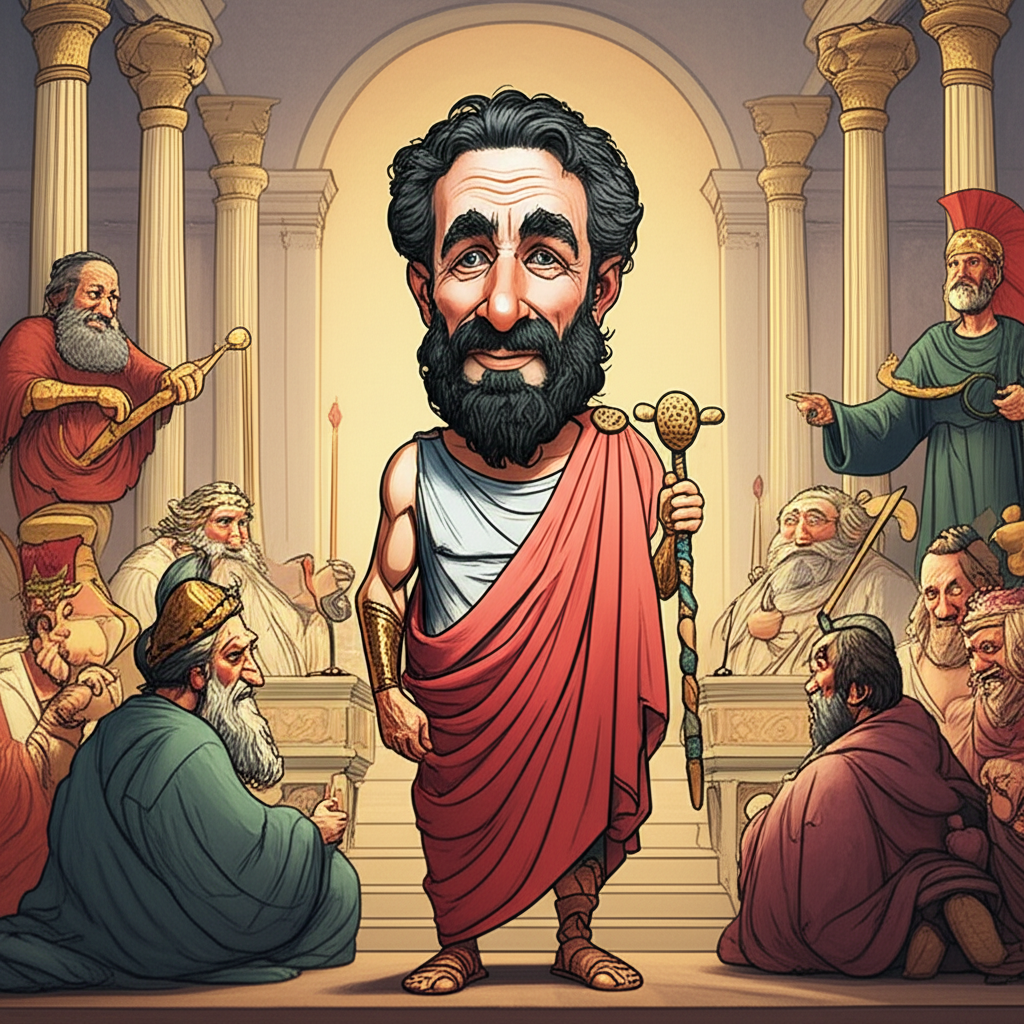
The Final Judgment: Oedipus and the Trial of Elysium
Introduction
From the sun-drenched islands and rocky mainland of ancient Greece comes a rich tapestry of myths and legends. These stories, populated by powerful gods, formidable heroes, and strange creatures, were not just entertainment for the ancient Hellenic people; they were a way to explore the deepest questions of human existence: fate, justice, pride, and suffering. Among the most profound and unsettling of these figures is Oedipus, the tragic king of Thebes. While the ancient plays of Sophocles detail his rise and catastrophic fall, a lesser-known, imaginative postscript can be envisioned in the afterlife: the trial of his soul before the judges of the Underworld. This narrative is a cultural exploration, a traditional story style used to ponder whether a man is defined by his deeds or by his intentions.
Origins and Cultural Background
This story is rooted in the cultural environment of Classical Greece, particularly the 5th century BCE, a period of great intellectual and artistic achievement centered in Athens. It was the age of philosophers like Socrates and playwrights like Sophocles, Euripides, and Aeschylus. The ancient Greeks viewed the world as a stage where the lives of mortals were often influenced, and sometimes cruelly manipulated, by the gods of Mount Olympus. They believed in a powerful, often inescapable force called moira, or fate. A prophecy was not a warning of what might happen, but a declaration of what would happen. This belief created a deep philosophical tension: if a person’s destiny is pre-written, can they truly be held responsible for their actions? This question is at the very heart of the Oedipus myth, which was famously performed in outdoor amphitheaters as a way for the community to collectively grapple with these complex moral dilemmas.
Character Description
Oedipus is the archetypal tragic hero. In his mortal life, he was a man of immense talent and virtue. He was intelligent, having solved the famously difficult riddle of the Sphinx to save the city of Thebes from her terror. He was a just and beloved king, dedicated to the well-being of his people. However, he was also burdened by a terrible prophecy foretelling that he would kill his father and marry his mother. Symbolically, Oedipus represents the pinnacle of human achievement brought low by forces beyond his control. His defining characteristic is his relentless, almost obsessive, pursuit of truth. He is a man who would rather face a horrifying reality than live in blissful ignorance. His physical blindness at the end of his life is a powerful symbol of his inner sight; only when he could no longer see the world around him did he finally understand the full truth of his own identity and destiny.
Main Story: The Trial in the Asphodel Meadows
The spirit of Oedipus, weary from a life of unparalleled suffering, drifted across the shadowy waters of the River Styx. The grim ferryman, Charon, poled the skiff in silence, his ancient eyes having seen countless kings and paupers reduced to the same pale, whispering form. After a lifetime spent as an outcast, wandering the land in blind exile, death had been a quiet release. But his journey was not over. All souls, upon entering the realm of Hades, had to face the three judges—Minos, Rhadamanthus, and Aeacus—who would weigh their lives and decree their eternal destination: the sunlit paradise of Elysium, the endless drudgery of the Asphodel Meadows, or the abyssal torment of Tartarus.
Oedipus was led to a great, bleak chamber where the three judges sat upon thrones carved from obsidian. Minos, the stern lawgiver of Crete, held a scroll detailing the deeds of the deceased. Rhadamanthus, known for his unbending fairness, watched with a piercing gaze that seemed to see not just actions, but the reasons behind them. Aeacus, guardian of the keys to the Underworld, remained a silent observer, his face a mask of solemn duty.
Minos unrolled his scroll, and his voice echoed in the vast, silent hall. "Oedipus of Thebes," he began, his tone cold and factual. "The charges against you are the gravest in the mortal code. You are accused of patricide, for you struck down your own father, King Laius, at a crossroads. You are accused of incest, for you took your own mother, Jocasta, as your wife and queen. These acts brought a great plague upon your city, a stain of corruption that poisoned the very land."
A murmur rippled through the gallery of silent shades who watched the proceedings. The facts were undeniable, the sins heinous. Tartarus seemed an inevitability.
Rhadamanthus then turned his gaze to Oedipus. "You have heard the charges. What say you in your defense?"
Oedipus’s shade did not tremble. He had faced a truth far more terrible than this judgment while he still had breath and blood. He spoke, his voice clear and filled not with defiance, but with a profound, echoing sorrow.
"Judges of the dead," he began, "I do not deny the deeds. My hands are stained with my father’s blood. My life was entangled with my mother’s in a way that mocks nature itself. I was the source of the Theban plague. These are the facts of my life, the stones upon which my story is built."
He paused, letting the weight of his confession settle. "But I ask you to judge the man, not merely the vessel of a cursed fate. A prophecy from Apollo’s oracle declared my destiny before I was born. To prevent it, my father ordered me left to die on a mountainside. To escape it, after I was raised by the king and queen of Corinth, I fled the only home I had ever known the moment I learned of that same prophecy. My entire life was a flight from the very sins I am accused of committing."
He recounted the encounter at the crossroads, where he was accosted by an arrogant nobleman and his retinue, defending himself in a moment of anger, never knowing the man was Laius, his father. He spoke of arriving at Thebes, a stranger, and saving the city by solving the Sphinx’s riddle, being offered the throne and the widowed queen’s hand as a reward.
"I ruled with honor," Oedipus continued. "I loved my people. When the plague came, I did not rest. I sought the cause with every fiber of my being. I swore I would find the killer of Laius and exile him. I was the detective in the mystery of my own ruin. And when all the threads led back to me, when the horrifying truth was laid bare, I did not hide. I did not shift blame to the gods or to fate. I accepted the judgment."
His voice grew stronger. "I passed a sentence upon myself more severe than any court would have decreed. I blinded my own eyes, for they had looked upon the world’s light but had failed to see the truth before them. I condemned myself to a life of wandering, a beggar and an outcast, to cleanse Thebes of my presence. My punishment was lived, not decreed after death."
The judges were silent. Minos’s stern face was unreadable. It was Rhadamanthus who finally spoke, his voice softer now. "You claim your intent was noble, that you were a victim of a divine plot."
"I claim only this," Oedipus concluded. "A man’s worth is not measured by the destiny he is given, but by the courage with which he bears it. I sought truth, and I accepted it. The rest was beyond my power."
The three judges conferred in low tones. Minos argued for the letter of the law; the sins were committed, the consequences absolute. But Rhadamanthus saw a different kind of justice. After a long silence, he delivered their verdict.
"Oedipus, your life was a tragedy woven by the Fates and the gods. The crimes you committed are undeniable. However, the law of the Underworld judges the soul. Your relentless pursuit of truth, even at the cost of your own happiness, and your unflinching acceptance of your horrific penance, have scoured the stain from your spirit. Your earthly suffering served as your Tartarus. You have been tried by life itself and found to be, at your core, a man who chose agonizing knowledge over blissful ignorance. Therefore, we find you worthy. You may pass into the fields of Elysium."
And for the first time since his birth, the heavy chains of fate fell away from the soul of Oedipus, and he moved toward a light he had never known, a peace he had never imagined possible.
Symbolism and Meaning
To the ancient Greeks, the story of Oedipus was a powerful exploration of the themes of fate versus free will, the danger of hubris (excessive pride), and the limitations of human knowledge. This imagined trial in the afterlife extends those themes. It symbolizes a desire for a higher form of justice, one that looks beyond actions to consider intent, circumstance, and character. It suggests that while humans may be powerless against a divine plan, their moral worth is determined by how they confront their destiny. Oedipus’s self-inflicted blindness and exile were his way of taking control of his own punishment, an assertion of his will even in the face of utter defeat. The trial’s verdict represents a hope for ultimate redemption, suggesting that true justice is found not in condemnation, but in understanding.
Modern Perspective
The myth of Oedipus has had a profound and lasting impact on Western culture. Sophocles’ play Oedipus Rex is still considered a masterpiece of dramatic literature, studied for its perfect structure and themes of irony and discovery. In the 20th century, the story was famously reinterpreted by Sigmund Freud, who used the name for his theory of the "Oedipus complex," a concept in psychoanalysis describing a child’s feelings toward their parents. While this interpretation is very different from the myth’s original focus on fate, it shows the story’s incredible adaptability. Oedipus endures as the quintessential tragic hero in literature and film—a noble but flawed protagonist whose downfall evokes both pity and fear, reminding us of the fragility of human fortune.
Conclusion
The trial of Oedipus in Elysium is not a canonical myth passed down from antiquity but an imaginative exploration built upon the foundation of a timeless story. It serves as a testament to the power of mythology to provide a framework for discussing enduring human questions. These tales from ancient cultures are not presented as truths to be believed, but as part of our shared human heritage, offering insight into the values, fears, and hopes of the people who first told them.
As Muslims, we hold the clear and unwavering belief that only Allah is the true Creator and Sustainer, the sole Judge of all souls on the Day of Judgment. These ancient myths are products of human imagination, attempts by people of a different time to make sense of the world through storytelling. By studying them, we can appreciate the rich diversity of human culture and the timeless power of narrative to explore the complexities of the human condition, from the heights of kingly pride to the depths of tragic understanding.