fufufafa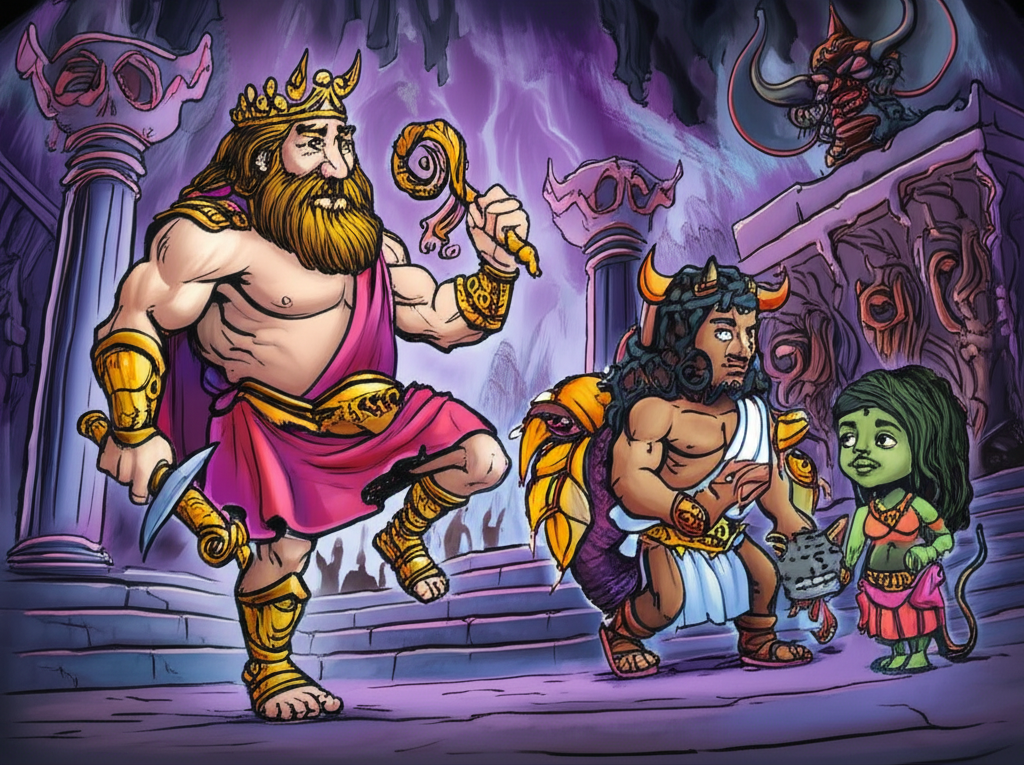
The Final Trial: Heracles and the Guardian of the Underworld
Among the grand tapestries of ancient Greek mythology, few tales are as enduring as the epic trials of Heracles, the son of Zeus and the mortal Alcmene. These stories, woven by poets and storytellers thousands of years ago, form a cornerstone of Western cultural heritage. Of his twelve legendary labors, none was more daunting, more final, than the command to descend into the shadowy realm of the dead and retrieve its fearsome guardian. This is the traditional story of Heracles’ journey into the Underworld, a narrative that explores the ancient Greek understanding of life, death, and the limits of human potential.
Origins and Cultural Background
This myth originates from ancient Greece, a civilization that flourished from roughly the 8th to the 4th centuries BCE. The ancient Greeks lived in a world they sought to explain through stories. Their environment, a rugged land of mountains and sea under a brilliant sun, was seen as the playground of powerful, often capricious gods and goddesses who resided on Mount Olympus. For them, the world was a place of divine intervention, where fate was a powerful force and mortals could achieve everlasting fame—kleos—through heroic deeds.
Their view of the afterlife was not one of heavenly reward or fiery punishment as understood in many modern religions. The Underworld, ruled by the stern god Hades, was a dim, joyless place for most souls. It was a realm of shades and silence, a final, inescapable destination that was feared not for its torment, but for its permanence and loss of life’s vibrancy. To enter this realm and return was considered impossible, a violation of the fundamental order separating the living from the dead. The story of a hero who could cross that boundary was therefore a tale of ultimate power and transcendence.
The Hero and the Beast
Heracles (known as Hercules to the Romans) stands as the archetypal hero of Greek mythology. Blessed with superhuman strength from his divine parentage, he was also cursed by the jealousy of the goddess Hera. His life was one of perpetual struggle, not only against monstrous beasts but also against his own inner turmoil. Symbolically, Heracles represents the pinnacle of human endurance and perseverance. His labors are often interpreted as an allegory for humanity’s struggle against the overwhelming forces of nature and fate. He is a figure of immense power, yet he is also deeply human, driven by a need for atonement for a past tragedy.
Cerberus, the creature at the heart of this labor, was the monstrous watchdog of the Underworld. Ancient poets described him as a colossal hound with three heads, each capable of a deafening roar that echoed like thunder. His tail was said to be a living serpent, and his back was writhing with a mane of snakes that hissed and dripped venom. Cerberus was not an agent of evil; he was a functionary, a guardian. His symbolic role was to enforce the unbreachable law of the Underworld: souls could enter, but none could leave. He represented the finality of death, the terrifying and immovable barrier between the known world and the great unknown.
The Main Story: A Descent into Darkness
After completing eleven seemingly impossible tasks, Heracles stood before his cousin and taskmaster, King Eurystheus. With a cruel smile, born of Hera’s influence, the king delivered the twelfth and final labor, one he believed would finally rid him of the hero. "Go to the Underworld," he commanded, "and bring back to me its guardian, Cerberus. Show me that you can conquer death itself."
A mortal could not simply walk into the land of the dead. Heracles knew he needed divine aid and spiritual preparation. He traveled to Eleusis, where he was initiated into the sacred Eleusinian Mysteries, rites that were believed to grant initiates a form of wisdom about the afterlife. Fortified by this knowledge, he was met by the gods Hermes, the messenger who guided souls to the Underworld, and Athena, his loyal protector. Together, they led him to a dark cavern in the earth, a hidden entrance to the kingdom of Hades.
The air grew cold and thin as Heracles descended. He crossed the River Styx, paying the silent ferryman Charon to carry him across the murky water that separated the living from the dead. The shores of the Underworld were not filled with fire, but with a profound and sorrowful silence, broken only by the faint whispers of countless shades—the ghostly figures of those who had passed. They drifted like leaves on an autumn wind across the ashen plains.
Heracles, a figure of vibrant life and immense power, was a stark contrast to this gloomy landscape. He journeyed onward until he stood before the obsidian throne of Hades, Lord of the Dead, and his queen, Persephone. Hades was not a malevolent ruler but a stern and unyielding one. He listened to Heracles’ plea with an impassive gaze. Perhaps he had heard a prophecy of this moment, or perhaps he was simply intrigued by the audacity of this mortal hero.
"You may take my hound," Hades decreed, his voice like the grinding of stone. "But you must do so without the aid of weapons. You must overpower him with your bare hands alone. If you succeed, you may show him the light of the sun. But you must promise to return him, unharmed, to his post."
Heracles agreed. He ventured deeper into the darkness until he reached the Gates of the Underworld, where the ground trembled with a low, guttural growl that shook the very souls of the dead. There stood Cerberus. The three-headed beast lunged, its roars echoing through the cavernous realm. Snakes hissed from its back, and its serpent-tail whipped furiously.
The hero did not flinch. He met the creature’s charge, relying on his legendary strength. He dodged the snapping jaws and the venomous fangs, wrapping his powerful arms around the beast’s necks. It was a contest of pure force. Cerberus thrashed and struggled, but Heracles’ grip was like iron. He squeezed until the monstrous hound, deprived of air, began to weaken. He did not seek to harm the beast, only to subdue it. Finally, the great monster whimpered and fell still, acknowledging its master.
Heracles slung the immense creature over his shoulders and began the arduous journey back to the world of the living. When he emerged from the darkness into the sunlight, Cerberus, who had never before seen the day, howled and struggled in terror. Heracles presented the beast to King Eurystheus, who, upon seeing the terrifying guardian of the dead, shrieked in fear and hid in a large bronze jar. The labor was complete. Heracles had faced death and returned victorious. True to his word, he then journeyed back to the Underworld and respectfully returned the humbled Cerberus to his master, Hades, restoring the natural order of the cosmos.
Symbolism and Meaning
To the ancient Greeks, this story was rich with meaning. Heracles’ victory over Cerberus was a powerful symbol of humanity’s ability to confront its greatest fear: death. By descending into the Underworld and returning, he accomplished a feat that blurred the line between mortal and god, demonstrating that courage and strength could overcome even the most fundamental laws of nature. The requirement to use no weapons signified that this was a victory of inner strength and will, not of technology or trickery. Furthermore, by returning Cerberus, the story reinforced the Greek value of order and balance. Heracles did not seek to permanently disrupt the world; he proved his mastery over it and then restored its rightful structure.
Modern Perspective
The myth of Heracles and Cerberus continues to resonate in modern culture. The "katabasis," or descent into the underworld, has become a foundational trope in literature and film, representing a character’s journey into their own psyche to confront their deepest fears. We see echoes of this in Dante’s Inferno and in countless fantasy novels. In popular media, Heracles and Cerberus appear frequently. Disney’s animated film Hercules presented a lighthearted version, while video games like Hades and God of War offer grittier, more complex interpretations of these mythological figures, allowing modern audiences to interact with these ancient stories in new and dynamic ways.
Conclusion
The tale of Heracles’ final labor is a profound piece of cultural heritage, a story crafted by an ancient people to explore themes of perseverance, courage, and the human relationship with mortality. It stands as a testament to the power of mythology to capture the fears and aspirations of a civilization.
It is essential to remember that these are foundational myths, not statements of fact. As Muslims, we recognize that only Allah is the true Creator and Sustainer of the universe, the sole arbiter of life and death. The gods and monsters of Greek mythology are products of human imagination. By studying these stories, we do not engage in belief, but rather in a respectful exploration of history and the timeless human tradition of storytelling, which seeks to make sense of the world and our place within it.