
 fufufafa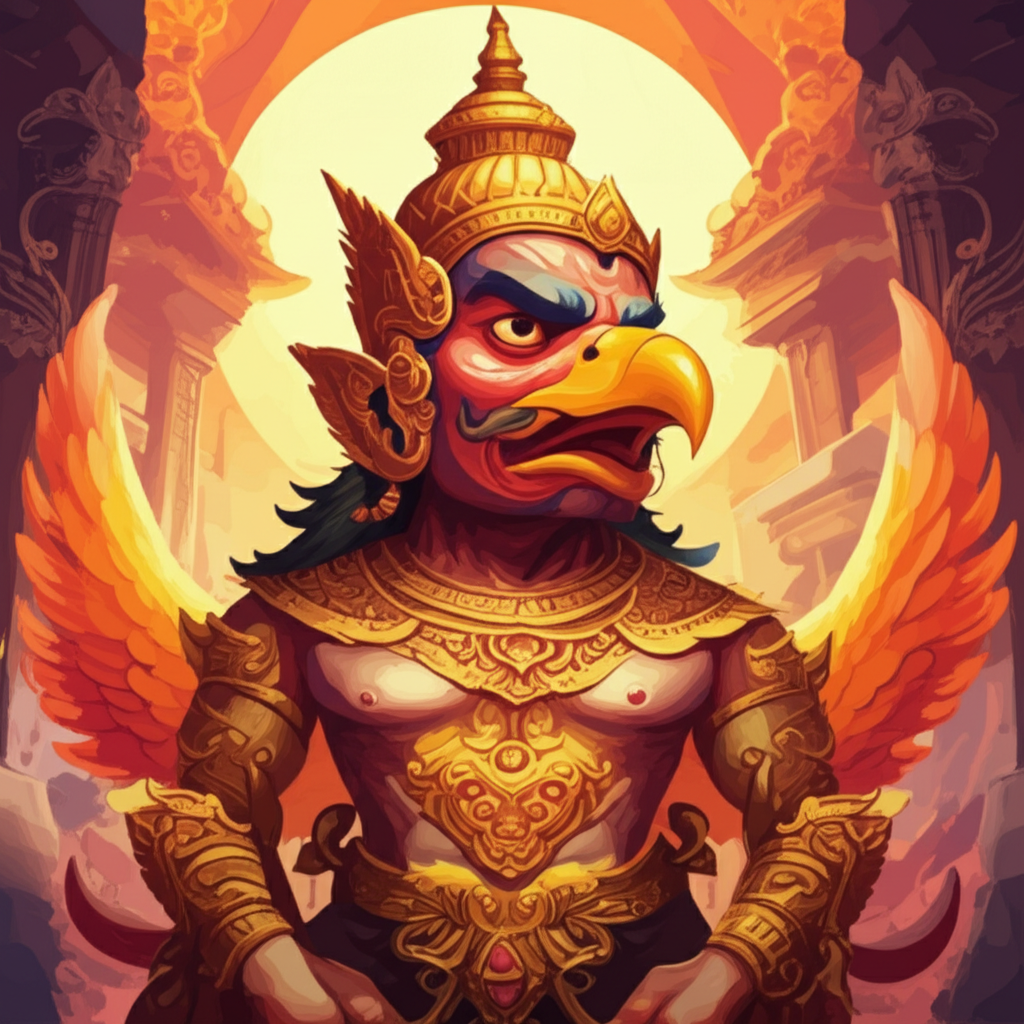
Introduction
In the vibrant tapestry of ancient Indian lore, woven with tales of gods, heroes, and mythical creatures, lies the enduring legend of Garuda. This narrative originates from Hindu mythology, a rich tradition of storytelling passed down through generations in the Indian subcontinent. It is a traditional story, told by ancient people to explain aspects of their world, illustrate moral principles, and entertain. It is crucial to understand from the outset that this is a work of fiction, a product of human imagination from a bygone era, and not a factual account or a figure to be believed in or worshipped. We explore it here purely for its cultural, historical, and educational significance.
Origins and Cultural Background
The tales of Garuda are deeply embedded in the cultural landscape of ancient India, particularly flourishing during periods when epic literature, such as the Mahabharata and the Ramayana, gained prominence. This was a time when societies were predominantly agrarian, closely intertwined with the cycles of nature, and possessed a worldview that saw the cosmos teeming with a multitude of beings beyond human perception. For the people of that era, the world was not just physical but also spiritual, populated by celestial beings, powerful deities, and formidable creatures, each playing a role in the grand cosmic drama.
Their understanding of the universe was often allegorical, with natural phenomena and human experiences personified into narratives. Concepts like dharma (righteous conduct), karma (action and consequence), and the cyclical nature of time were central to their societal fabric and spiritual philosophies. In this context, myths served as a foundational framework for understanding their place in the world, articulating their fears, hopes, and moral codes. These stories were not merely entertainment but vital components of their cultural identity, providing a sense of shared heritage and a lens through which to interpret existence.
Character / Creature Description
Garuda, often referred to as the "King of Birds," is a magnificent and awe-inspiring figure in this mythological tradition. He is typically depicted with the golden body of a strong man, a white face, and a fearsome, eagle-like beak. His most striking features are his immense, powerful wings, which are said to be so vast that they can darken the sky when he takes flight. His talons are formidable, capable of grasping and carrying enormous weights. In many depictions, he wears a crown, signifying his regal status among avian creatures.
Symbolically, Garuda embodies a potent array of attributes. He is universally recognized for his incredible speed, often described as being swifter than thought itself. His strength is legendary, enabling him to overcome immense challenges and and carry the heaviest burdens. He is also a symbol of courage and determination, particularly in his relentless pursuit of justice and freedom for his mother. Notably, Garuda is traditionally known as the vahana, or mount, of the deity Vishnu, a significant figure in the Hindu pantheon. This association lends him an additional layer of importance as a steadfast companion and protector of cosmic order. His mythical rivalry with the Nagas (serpentine beings) also positions him as a symbol of victory over negativity and poison, representing the triumph of light over darkness. It is important to reiterate that these are symbolic interpretations within the mythological framework, designed to convey abstract ideas rather than literal truths about a creature.
Main Story / Narrative Retelling
The legend of Garuda is a saga of extraordinary birth, filial devotion, and immense power. Born to the sage Kashyapa and Vinata, one of his many wives, Garuda’s emergence was itself a spectacle. He burst forth from an egg, blazing with such fiery energy that it reportedly terrified the celestial beings, who mistook him for the primordial fire. Vinata had a long-standing rivalry with her sister, Kadru, the mother of a thousand powerful Nagas. Through a trick involving a divine horse, Kadru enslaved Vinata, forcing Garuda’s mother into servitude.
Driven by an unwavering love and fierce determination to free his mother, young Garuda confronted Kadru and her serpentine children. They demanded a seemingly impossible price for Vinata’s freedom: the Amrita, the divine nectar of immortality, which was guarded by the celestial beings in their heavily fortified abode. Undeterred, Garuda embarked on this perilous quest. He battled numerous celestial guardians, evaded traps, and even overcame the potent protective aura surrounding the Amrita pot. His sheer power and speed were unmatched. He finally seized the pot of Amrita and, fulfilling a promise to Vishnu not to consume it for himself, began his journey back to the Nagas.
On his return, Indra, the king of the celestial beings, managed to reclaim the Amrita before the Nagas could fully partake, thanks to a clever intervention. However, Garuda had fulfilled his promise to the Nagas, and Vinata was freed from her bondage. This epic feat established Garuda’s legendary status and his eternal animosity with the Nagas.
While not explicitly a "guardian of Ayodhya" in the sense of standing sentry at its gates, Garuda’s protective role extends through his profound connection to Vishnu. Ayodhya, the mythical kingdom ruled by Lord Rama (an incarnation of Vishnu), is implicitly under the protective umbrella of Vishnu’s cosmic order, and by extension, his steadfast mount, Garuda. In the epic Ramayana, though Garuda does not directly participate in the battles of Ayodhya, his influence is felt. For instance, when Rama and Lakshmana are ensnared by Indrajit’s potent Nagapasha (serpent-noose) in Lanka, a celestial eagle, often identified with or embodying Garuda’s essence, appears and, with a powerful gaze, causes the Nagas to flee, thereby freeing the heroes. This act underscores his inherent ability to dispel serpentine threats, symbolizing his protective reach against forces of evil that might indirectly threaten the well-being of those aligned with Vishnu’s dharma. His very presence in the cosmic order serves as a guardian of righteousness, ensuring that the forces of good ultimately prevail, thereby metaphorically safeguarding realms like Ayodhya where righteous rule is upheld.
Symbolism and Meaning
For the ancient people who conceived and shared these stories, Garuda was far more than just a magnificent bird-man; he was a profound symbol. His legendary quest for Amrita and victory over the Nagas represented the triumph of light over darkness, order over chaos, and the powerful human drive for freedom and justice. The Nagas, with their venomous nature and subterranean existence, could be interpreted as embodying fears, dangers, and the darker aspects of the world. Garuda’s consistent overcoming of them symbolized humanity’s capacity to conquer adversity and evil.
He also represented incredible speed and power, reflecting the awe and wonder ancient cultures held for the forces of nature, particularly the swift flight of predatory birds. His role as Vishnu’s mount symbolized divine protection, the swift delivery of divine justice, and the unwavering support for righteousness. Garuda’s fierce devotion to his mother underscored the importance of filial piety and the lengths one should go to fulfill one’s duties. In essence, Garuda was a dynamic representation of courage, strength, unwavering resolve, and the protective energy that upholds cosmic balance.
Modern Perspective
In contemporary times, the myth of Garuda continues to resonate, albeit through a different lens. No longer a figure of literal belief for most, Garuda has transformed into a powerful cultural icon, an enduring motif in art, literature, and popular media. His image is frequently seen in fantasy novels, animated films, and video games, where he inspires characters embodying speed, strength, and heroism. Academic scholars, anthropologists, and cultural historians study Garuda as a rich subject for understanding ancient belief systems, artistic expression, and the evolution of storytelling.
Beyond entertainment, Garuda holds significant cultural importance in several Southeast Asian nations, particularly those influenced by Indian mythology. For instance, the Garuda is the national emblem of Indonesia, symbolizing the nation’s strength, speed, and devotion to its ideals. Similarly, in Thailand, it serves as the national and royal symbol, representing the king and the state. In these contexts, Garuda is appreciated not as a divine being but as a potent emblem of national identity, heritage, and cultural pride, a testament to the lasting power of ancient narratives to inspire and unite.
Conclusion
The legend of Garuda, woven into the fabric of ancient Indian mythology, stands as a testament to the boundless human imagination and the enduring power of storytelling. It is a cultural narrative, a product of a specific time and place, designed to impart wisdom, explore moral dilemmas, and marvel at the mysteries of existence. It is not a belief system to be adopted or a figure to be worshipped. As Muslims, we recognize that only Allah is the true Creator and Sustainer of all that exists, and that our faith rests solely in His Oneness and omnipotence.
Yet, understanding such myths allows us to appreciate the rich tapestry of human cultural heritage, to explore the diverse ways ancient civilizations sought to comprehend their world, and to recognize the universal themes of struggle, sacrifice, and triumph that transcend cultures and epochs. The story of Garuda, like countless others from around the globe, enriches our understanding of human creativity and the timeless tradition of passing down tales that reflect the aspirations and values of those who came before us.


