fufufafa
In the rich tapestry of ancient Slavic folklore, stretching across the vast plains and deep forests of Eastern Europe, lies a treasure trove of mythical beings and enchanted places. Among these captivating legends, few resonate with as much mystery and allure as the tales surrounding Buyan Island and its ethereal inhabitant, the Rusalka. This article delves into one such traditional story, presenting it purely as a cultural narrative passed down through generations by ancient peoples, offering a glimpse into their imaginative world and the stories they told to understand their surroundings. It is crucial to remember that this is a product of human creativity and a historical account of pre-Islamic beliefs, not a factual claim or an endorsement of mythological beings.
Origins and Cultural Background
The myth of the Rusalka and Buyan Island finds its roots in the pre-Christian era of Slavic societies, a time when pagan beliefs dominated the spiritual landscape. These ancient communities were deeply connected to the natural world, living as agrarian peoples whose lives were dictated by the cycles of seasons, the flow of rivers, and the bounty of the land. Their worldview was animistic, meaning they believed that all natural elements—trees, rivers, lakes, mountains, and even the wind—possessed spirits or a divine essence. The world was seen as a living, breathing entity, teeming with unseen forces, both benevolent and malevolent.
People of this era observed the raw power of nature: the life-giving rain, the destructive flood, the calm surface of a lake, and the dangerous depths beneath. They sought to explain the inexplicable, personifying these forces into deities and spirits. The Rusalka, for instance, emerged from this deep reverence and fear of water, a vital yet perilous element. Buyan Island itself was a mythical, sacred place in Slavic cosmology, often described as a hidden, magical isle central to the world’s weather and the source of various magical objects and creatures. It was a place beyond mortal reach, representing the ultimate mystery and power of the natural world, a concept born from a profound respect for the wild, untamed forces that shaped their existence.
Character / Creature Description
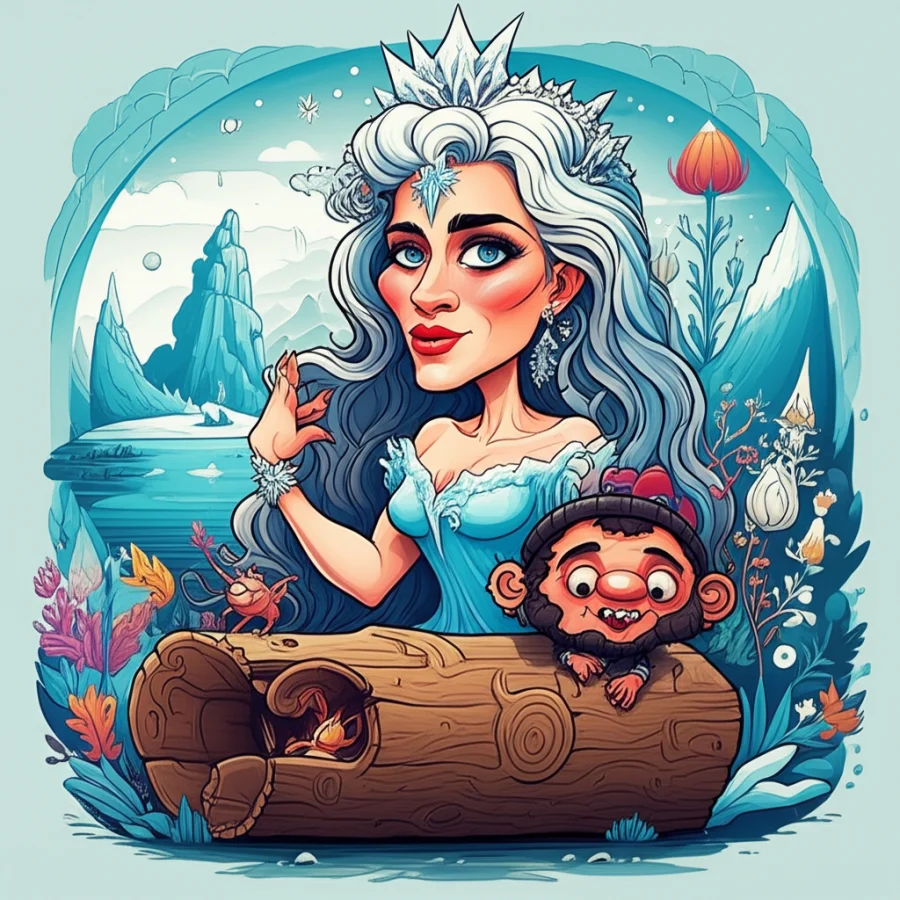
The Rusalka, central to this narrative, is one of the most iconic figures in Slavic mythology. She is typically depicted as a beautiful, seductive water nymph or spirit, often with long, flowing green hair, reminiscent of river weeds, and pale, almost translucent skin. Her eyes are said to hold a mesmerizing, melancholic depth, and her voice can be either a haunting melody or a deceptive, alluring song. In some traditions, Rusalki are believed to be the spirits of young women who met an untimely end by drowning, often due to tragic circumstances or betrayal, forever bound to the watery domains where their lives ended.
Symbolically, the Rusalka embodies the dual nature of water itself: its captivating beauty and life-sustaining properties, alongside its inherent dangers and destructive potential. She represents the irresistible allure of the unknown, the sorrow of lost souls, and the profound, sometimes perilous, connection between humans and the wild elements. Her beauty serves as a warning, a metaphor for temptation that can lead to danger, rather than an entity to be worshipped or feared in a literal sense. She is a cultural archetype, a narrative device through which ancient people explored themes of attraction, peril, and the untamed aspects of nature.
Main Story / Narrative Retelling
Legend whispers of Buyan Island, not a fixed point on any map, but a shifting, ethereal land veiled in mists, accessible only to those deemed worthy or cursed by fate. It was a place where ancient trees, older than time itself, touched the sky, and the very air hummed with a quiet, primal magic. Here, it was said, the forces of wind and weather were born, and the mythical Stone Alatyr, the "father of all stones," pulsed with untold power.
Our story begins with Ilya, a young, inquisitive scholar from a village nestled beside a vast, winding river. Ilya was known for his insatiable curiosity, always seeking out forgotten tales and ancient lore. One moonless night, by the flickering light of a hearth, an elder recounted the legend of Buyan Island and its elusive guardian, the Rusalka. The tale spoke of a woman of unparalleled beauty who dwelled in the island’s deepest, most secluded spring, her voice a siren’s call to those who dared to venture near.
Driven by a thirst for knowledge and a spark of youthful bravado, Ilya resolved to seek out this fabled island. He journeyed for weeks, guided by obscure clues from ancient scrolls and the whispers of the wind. Finally, one dawn, as the mist lifted from a glassy lake, a distant landmass emerged, shrouded in an unnatural green glow. Buyan Island, he realized, stood before him.
Stepping onto its shores, Ilya felt a profound sense of stepping into another world. The trees were gargantuan, their branches draped with luminous moss. Strange flowers bloomed in impossible colors, and the air carried the scent of ancient earth and unearthly blossoms. Deeper into the island, he discovered a hidden spring, its water impossibly clear, shimmering with an inner light. It was here, by the moss-covered banks of this mystical pool, that he first saw her.
She rose from the depths, her form slender and graceful, her skin luminous like moonlight on water. Her hair, the color of emeralds, cascaded down her back, interwoven with delicate water lilies. Her eyes, pools of deep, forest green, fixed upon Ilya with an expression that was both alluring and profoundly sorrowful. It was the Rusalka, more breathtaking than any legend had described.
A haunting melody, softer than the rustle of leaves, flowed from her lips, weaving itself into the very fabric of the air. It spoke of ancient sorrows, of beauty and loss, and of the cold embrace of the water. Ilya felt an irresistible pull, a yearning to step closer, to reach out and touch her ethereal form. His legs felt heavy, drawn towards the shimmering spring. He knew, deep in his heart, that to succumb would mean to join her in her watery realm, to become another lost soul in the island’s embrace.
Yet, amidst the captivating enchantment, a flicker of ancestral wisdom stirred within him. He remembered the old tales, not just of her beauty, but of her tragic nature, and the fate of those who yielded to her song. He closed his eyes, clenching his fists, focusing on the rough bark of a nearby tree, grounding himself in the tangible world. With immense effort, he turned his back, not out of fear of her as a real entity, but out of a recognition of the symbolic danger she represented—the danger of temptation, of losing oneself to the unknown. The song intensified, a desperate, mournful plea, but Ilya pressed on, his heart pounding, until the melody faded into the whispers of the ancient trees. He left Buyan Island, shaken but alive, carrying not just a memory, but a profound understanding of the power of ancient stories and the wisdom they imparted.
Symbolism and Meaning
The encounter with the Rusalka of Buyan Island, within its mythological context, served as a potent symbolic narrative for ancient Slavic peoples. The Rusalka herself represented the perilous beauty of the natural world, particularly water. Rivers and lakes were sources of life—for fishing, irrigation, and travel—but also sites of danger, capable of drowning, flooding, and concealing unseen hazards. The Rusalka personified this duality: the life-giving and the life-taking aspects of water.
Furthermore, the story acted as a cautionary tale. It warned against the dangers of succumbing to temptation, of venturing too far into the unknown, or of being swayed by superficial beauty without understanding its underlying perils. For a community whose survival depended on prudence and respect for nature, such stories instilled a sense of caution and highlighted the importance of self-control and adherence to communal wisdom. It also touched upon themes of sorrow and tragedy, reflecting the understanding that beauty can be intertwined with pain and loss, particularly in the context of the Rusalka often being a spirit of a drowned woman.
Modern Perspective
Today, the myth of the Rusalka and Buyan Island continues to captivate imaginations, though its interpretation has evolved significantly. In contemporary literature, these figures often appear in fantasy novels and poetry, where they are re-imagined as complex characters exploring themes of environmentalism, feminism, or psychological depth. Movies and television series draw inspiration from Slavic folklore, depicting Rusalki with stunning visual effects, sometimes as tragic heroines, other times as malevolent forces, but always as figures of powerful allure.
Video games frequently feature Rusalki as mythical creatures, quest-givers, or formidable adversaries, integrating them into rich, immersive fantasy worlds. Beyond entertainment, cultural studies and academic research delve into these myths to understand ancient belief systems, the psychology of storytelling, and the enduring power of archetypes. The Rusalka is now viewed as a fascinating cultural artifact, a testament to human creativity and a window into the pre-scientific understanding of the world, rather than a literal being.
Conclusion
The encounter with the Rusalka of Buyan Island remains a vibrant and compelling narrative from ancient Slavic folklore. It is a testament to the profound imagination of early peoples and their intricate ways of understanding and interacting with the world around them. As Muslims, we recognize that only Allah is the true Creator and Sustainer of all existence, and these stories are products of human imagination and ancient worldviews, reflecting the cultural and historical contexts in which they emerged. They are not to be taken as truth or worshipped, but rather appreciated for their cultural, historical, and educational value. The enduring legacy of tales like the Rusalka of Buyan Island reminds us of the universal human tradition of storytelling, its power to preserve cultural heritage, and its ability to inspire wonder and reflection across generations.