fufufafa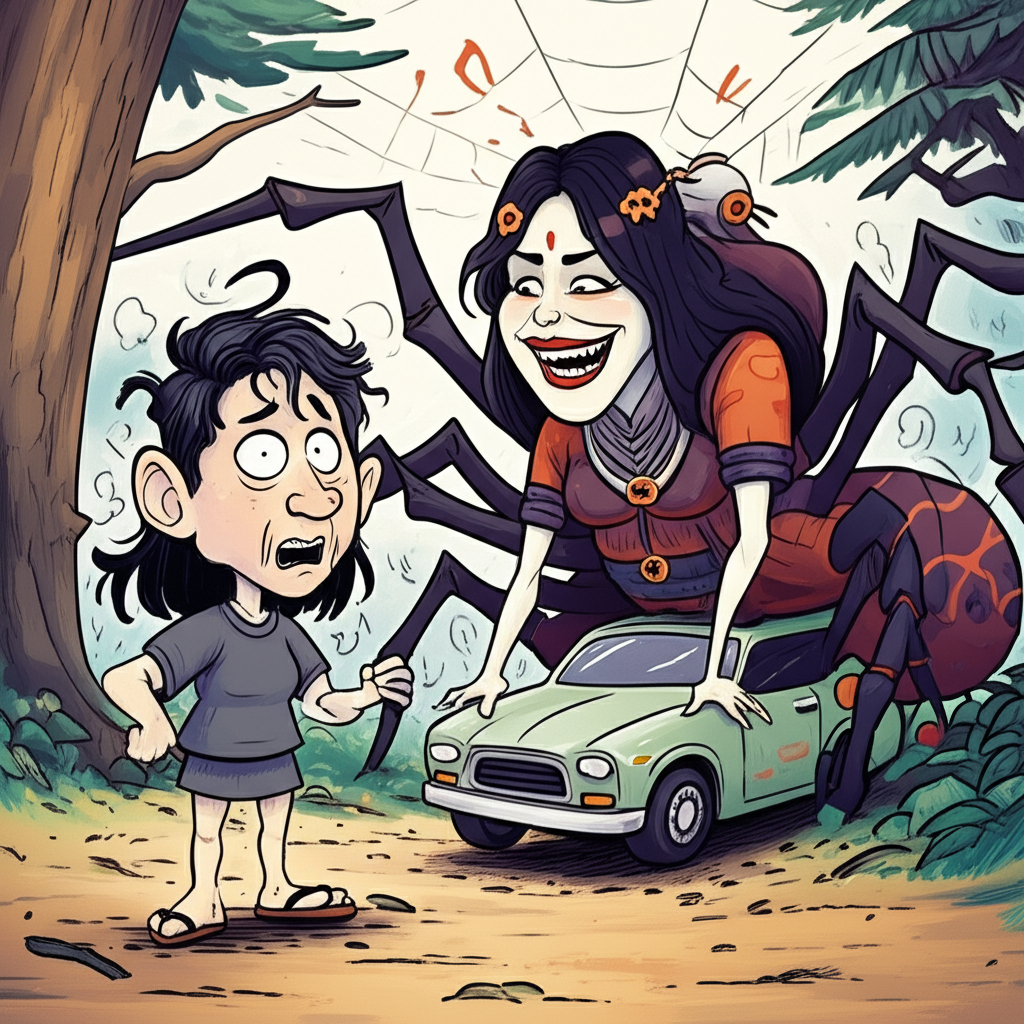
1. Introduction:
The tale of the Jorogumo is a chilling narrative spun from the rich tapestry of Japanese folklore. Rooted deep within the mountainous regions and ancient forests of Japan, it speaks of a spider-like yokai, a supernatural creature that blends the terrifying with the alluring. This is not a story of divine truth, but a traditional legend passed down through generations, a reflection of the fears and beliefs of ancient Japanese society. We explore it as a cultural artifact, a window into the imagination of a people long past.
2. Origins and Cultural Background:
The legend of the Jorogumo likely emerged during the Edo period (1603-1868) in Japan. This era, characterized by relative peace and stability under the Tokugawa shogunate, saw a flourishing of arts and culture, but also a deep-seated fear of the unknown wilderness. The vast, untamed forests and mountains were seen as the domain of spirits and monsters, places where the rules of the human world did not apply. Society was largely agrarian, deeply connected to the natural world, and therefore acutely aware of its potential dangers. The people’s worldview was heavily influenced by Shinto and Buddhist beliefs, which emphasized the interconnectedness of all things and the existence of unseen forces. Natural phenomena were often attributed to the actions of spirits, both benevolent and malevolent. The Jorogumo, therefore, served as a personification of the dangers lurking in the shadows, a manifestation of the fear and respect that the Japanese held for the natural world. It was a cautionary tale, a reminder of the consequences of straying too far from the safety of human settlements.
3. Character / Creature Description:
The Jorogumo, literally translated as "binding bride" or "entangling woman," is depicted as a spider yokai capable of transforming into a beautiful woman to lure unsuspecting victims. In its spider form, it is often described as being enormous, with a body the size of a calf or even larger. Its web is said to be incredibly strong, capable of ensnaring even the strongest prey. However, it is in its human guise that the Jorogumo truly becomes terrifying. She appears as a captivating woman, often dressed in elegant kimonos, her beauty masking her true nature. Her voice is said to be hypnotic, her eyes filled with a captivating allure.
Symbolically, the Jorogumo represents the dangers of unchecked desire and the deceptive nature of appearances. The spider form symbolizes primal instincts, cunning, and the patient hunter. The human form represents the ability to manipulate and deceive, highlighting the seductive power of illusion. The Jorogumo’s web represents the traps we set for ourselves, the entanglements that can bind us to our desires and lead to our downfall. It’s a metaphor for the dangers of succumbing to temptation and the importance of discerning true intentions from deceptive facades.
4. Main Story / Narrative Retelling:
The air hung heavy with the scent of cedar and damp earth as Kenji, a young woodcutter, ventured deep into the forest surrounding the Ise Grand Shrine. He was searching for a rare type of wood, prized for its strength and beauty, which grew only in the most remote parts of the forest. He’d been warned by the village elders to stay away from the deeper woods, whispers of strange happenings and disappearances lingering in the air. But Kenji, driven by ambition and a desire to prove himself, ignored their warnings.
As the sun began to dip below the horizon, casting long, eerie shadows, Kenji stumbled upon a hidden glade. In the center stood an ancient, gnarled tree, its branches reaching towards the sky like skeletal fingers. And beneath the tree, bathed in the fading light, sat a woman of extraordinary beauty. She wore a shimmering silk kimono, and her long, black hair cascaded down her back like a waterfall.
"Greetings, traveler," she said, her voice as smooth as silk. "You seem lost. Can I offer you some rest and refreshment?"
Kenji, captivated by her beauty, readily accepted her offer. He sat beside her, and she offered him sake from a delicate porcelain flask. As he drank, she told him stories of the forest, of its hidden wonders and ancient secrets. He found himself drawn to her, mesmerized by her voice and her captivating gaze.
As the night deepened, Kenji felt a strange drowsiness creeping over him. He looked down and noticed the woman gently playing a biwa, its haunting melody resonating through the forest. He soon noticed a thin strand of silk, almost invisible, wrapped around his ankle. He felt it tighten, gently, yet inescapably.
Panic surged through him. He tried to stand, but his legs felt heavy, unresponsive. He looked at the woman, and her beautiful face began to distort, her eyes glowing with an unnatural light. From beneath the kimono, he saw them: eight long, hairy legs, clicking against the forest floor.
He struggled to break free, but the silken thread was too strong. He saw her spider mandibles extending. He realized with chilling clarity the stories of the elders were true. This was no ordinary woman; this was the Jorogumo, the spider demon of the forest.
Kenji’s screams were swallowed by the darkness as the Jorogumo dragged him into her lair beneath the ancient tree, a fate shared by many who had dared to trespass too deeply into her domain.
5. Symbolism and Meaning:
To the ancient Japanese, the story of the Jorogumo served as a powerful cautionary tale. It highlighted the dangers of unchecked ambition, the allure of the unknown, and the importance of respecting the boundaries between the human world and the natural world. The Jorogumo represented the untamed forces of nature, the consequences of greed, and the seductive power of illusion. It was a reminder to be wary of appearances, to trust one’s instincts, and to heed the wisdom of elders. The story also touched upon societal anxieties regarding female sexuality, portraying the Jorogumo as a dangerous and deceptive figure who used her beauty to ensnare men, reflecting perhaps a patriarchal fear of female power and independence.
6. Modern Perspective:
The Jorogumo continues to fascinate and terrify audiences in modern Japanese literature, anime, manga, video games, and films. She often appears as a formidable villain, a symbol of the dangers lurking in the shadows of modern society. She also appears in cultural studies as an example of a yokai, a Japanese monster, and is used to explore themes of gender, sexuality, and the relationship between humanity and nature. Her presence in modern media demonstrates the enduring power of folklore and its ability to adapt and resonate with contemporary audiences.
7. Conclusion:
The legend of the Jorogumo is a testament to the power of storytelling and the enduring fascination with the supernatural. It is a cultural artifact, a window into the beliefs and fears of ancient Japanese society. It is important to remember that this is a story, a work of imagination, and not a statement of divine truth. As Muslims, we recognize that only Allah is the true Creator and Sustainer of the universe.
The tale of the Jorogumo serves as a reminder of the rich cultural heritage that exists throughout the world and the importance of preserving and understanding these traditions. It is through stories like these that we can gain insights into the human condition, explore the complexities of human nature, and appreciate the power of imagination.