
 fufufafa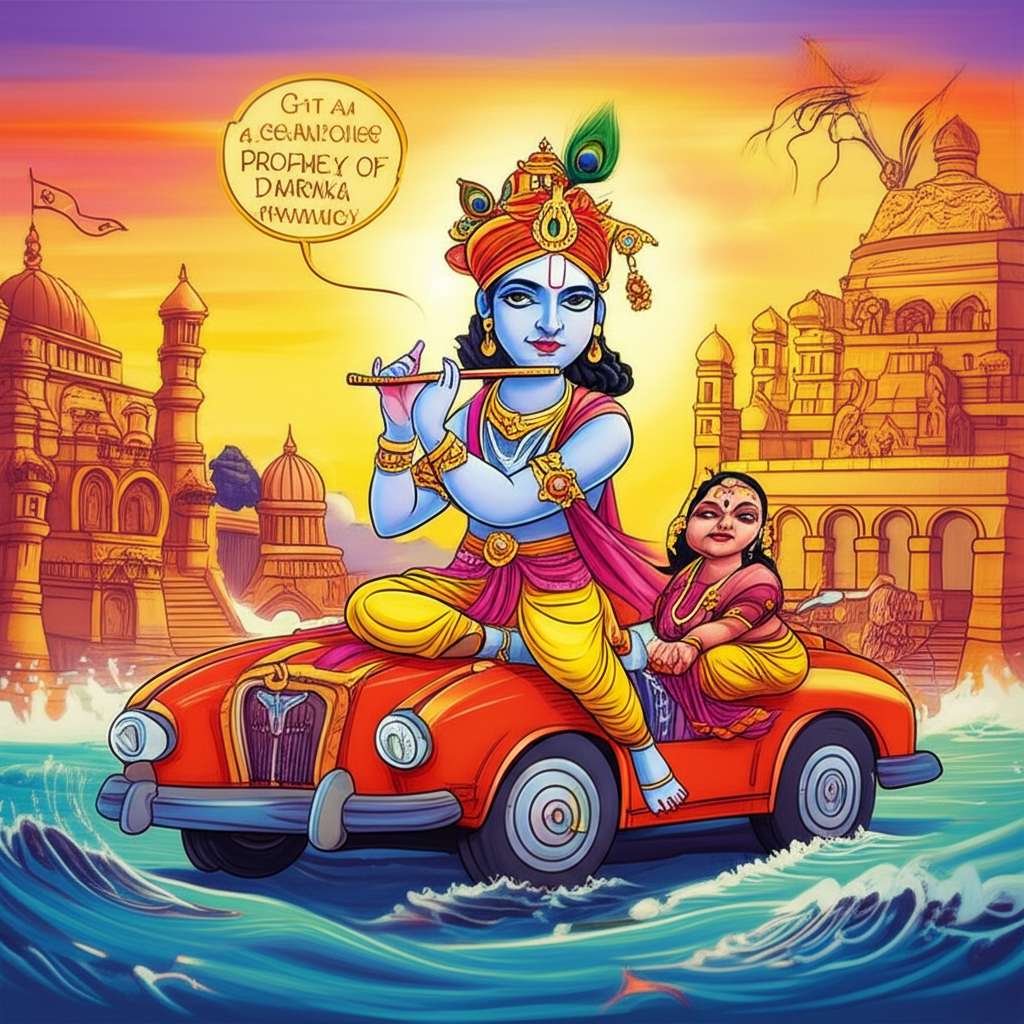
From the vibrant tapestry of ancient Indian mythology, a land steeped in tales of gods, heroes, and cosmic cycles, emerges the legend of Dvaraka. This is not a historical account but a rich narrative woven from the collective imagination of a civilization that sought to understand the universe and humanity’s place within it. The story of Dvaraka’s prophecy, and its eventual submersion, is a powerful myth passed down through generations, offering insights into the worldview and cultural values of its originators.
The era in which these stories took root was one where the lines between the divine and the mortal, the seen and the unseen, were fluid. Ancient Indian society, characterized by a deep reverence for nature and a philosophical inclination towards understanding cosmic order, often attributed extraordinary events to divine intervention or the actions of powerful beings. The world was viewed as a dynamic realm, subject to cycles of creation, preservation, and dissolution. Myths served as a vital means of transmitting moral lessons, explaining natural phenomena, and exploring profound philosophical concepts through engaging narratives. The tales of Dvaraka, therefore, emerged from a culture that valued allegory and symbolic storytelling as much as empirical observation.
At the heart of this particular prophecy lies the figure of Krishna. Within these traditional narratives, Krishna is depicted not merely as a king or a warrior, but as a divine manifestation, a being of immense power and wisdom, whose presence shaped the destinies of mortals and the very landscape around him. His symbolic attributes are manifold: he represents divine love, cosmic justice, and the ultimate reality. He is often portrayed with a serene countenance, a flute that can charm the universe, and a blue complexion, signifying the boundless expanse of the heavens and the ocean. His role in the prophecy of Dvaraka is that of a foreteller, a wise counselor who perceives the inevitable course of events, even those that signal destruction. He is the embodiment of foresight, a being who understands the impermanence of even the grandest human endeavors.
The narrative unfolds as a poignant prophecy delivered by Krishna himself. Imagine a bustling, magnificent city, Dvaraka, glittering like a jewel on the western coast of India. It was a city of unparalleled beauty, constructed by Vishwakarma, the celestial architect, under Krishna’s guidance. Its palaces were adorned with precious gems, its streets were paved with gold, and its harbors teemed with ships. It was a testament to human ingenuity and prosperity, a thriving metropolis that reflected the glory of its divine ruler.
However, even in this utopian setting, Krishna, with his divine insight, perceived the seeds of its eventual demise. He saw that as ages passed, the world would undergo transformations, and the righteousness that characterized his reign would wane. The prophecy, as recounted in these ancient texts, was not one of sudden, inexplicable doom, but a forewarning tied to the natural ebb and flow of cosmic time and human conduct. Krishna is said to have told his Yadava kinsmen, the descendants of his lineage who inhabited Dvaraka, that the time would come when the city, despite its splendor, would be reclaimed by the ocean. This was not a curse, but a declaration of a future event, a consequence of the shifting epochs and the changing nature of human society. He foresaw that the age would transition, and the spiritual and moral fabric of the world would weaken.
The prophecy spoke of a specific period, the end of Krishna’s earthly sojourn. It was said that after Krishna departed from the mortal realm, the ocean, a powerful force of nature often associated with primal energies and the cycles of renewal and dissolution, would rise and engulf the city. This was a symbolic representation of how even the most magnificent creations of humankind are ultimately subject to the greater forces of nature and time. The story emphasizes that Dvaraka’s destiny was intertwined with the cosmic order, and its submersion was a predetermined event, a natural conclusion to its era of prominence.
The symbolism embedded within the prophecy of Dvaraka is profound and multifaceted. On one level, it represents the impermanence of all material creations, no matter how grand or divinely inspired. It serves as a reminder that earthly kingdoms, wealth, and even magnificent cities are transient. The ocean, in this context, symbolizes the inexorable force of nature, the cyclical nature of existence, and the ultimate return of all things to their primordial state. It can also be interpreted as a metaphor for the cleansing and renewal that follows periods of decline, suggesting that destruction can pave the way for new beginnings. Furthermore, the prophecy might have been intended to instill humility and detachment in people, encouraging them to focus on spiritual pursuits rather than clinging to material possessions and worldly power. It speaks to the concept of karma – the idea that actions have consequences that ripple through time, and that even divine interventions are part of a larger, unfolding cosmic plan.
In the modern world, the legend of Dvaraka continues to captivate imaginations. It is a recurring theme in Indian literature, from classical epics to contemporary novels, where it is explored for its mythological, philosophical, and even speculative elements. In cinema and television, Dvaraka’s story has been retold in various adaptations, often focusing on its visual splendor and the dramatic climax of its submersion. Archaeological explorations and geological studies have also taken an interest in the legend, with some researchers investigating potential submerged structures off the coast of Gujarat, further blurring the lines between myth and potential historical resonance for some. The tale also finds its way into video games and other forms of digital storytelling, where its epic scope and dramatic narrative are leveraged for engaging experiences. These interpretations, while diverse, often highlight the enduring power of the narrative to provoke thought about history, faith, and the forces that shape our world.
It is crucial to reiterate that the story of Dvaraka and its prophecy is a traditional narrative, a product of ancient storytelling and cultural beliefs. It is a rich cultural artifact, offering a window into the imaginative world of its creators and the philosophical questions they grappled with. As Muslims, we recognize that only Allah is the true Creator and Sustainer of all existence. Our understanding of the world is guided by divine revelation and the teachings of Islam, which affirm the absolute sovereignty of God over all creation.
The legend of Dvaraka, therefore, stands as a testament to the enduring power of human imagination and the tradition of storytelling. It reminds us that myths, while not factual accounts, can hold profound cultural significance, shaping our understanding of ourselves, our history, and our place in the vast and mysterious universe. They are echoes of ancient voices, whispers from the past that continue to resonate, inviting us to reflect on the timeless themes of life, impermanence, and the cyclical nature of existence.

