fufufafa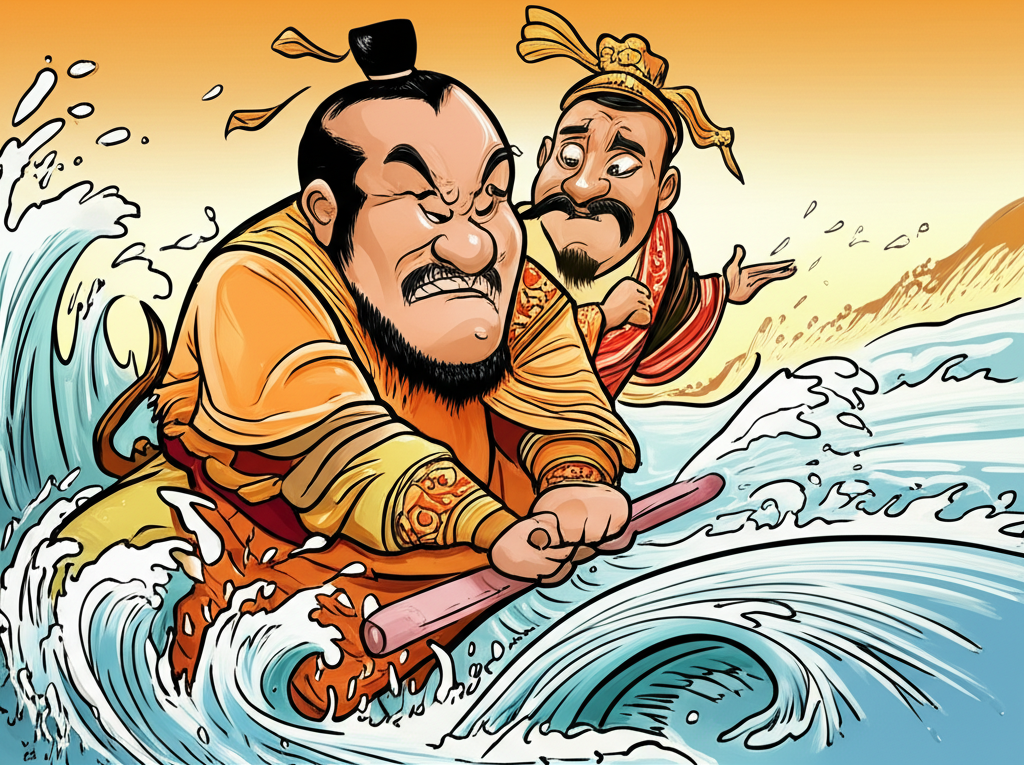
From the misty valleys and fertile river plains of ancient China, where the whispers of the Yellow River shaped civilizations, comes a captivating saga woven into the fabric of its earliest mythology. The story of the Flood of Gun and Yu, and the subsequent rise of the legendary Heavenly Court, is not a historical account but a vibrant tapestry of ancient beliefs, a testament to the imaginative power of a people grappling with the profound forces of nature and the complexities of societal order. These are tales passed down through generations, oral traditions that found their voice in written scrolls, offering a window into the worldview of those who lived millennia ago.
The era in which these myths were born was one deeply intertwined with the rhythms of the natural world. Life was largely agrarian, and the bounty of the land, as well as its destructive potential, dictated the lives of its inhabitants. The Yellow River, a lifeblood for agriculture, was also a capricious entity, prone to devastating floods that could sweep away villages and disrupt the delicate balance of existence. In such a world, the forces of nature were not merely phenomena to be observed but were often imbued with sentience, powerful beings or spirits that demanded respect and understanding. The cosmos was perceived as a dynamic and often precarious stage, where celestial powers influenced earthly affairs, and where order, once established, was a precious and hard-won achievement. It was within this context of awe, fear, and a deep-seated need for explanation that the story of Gun and Yu, and the divine intervention it implies, began to take shape.
Central to this narrative is the figure of Gun, often depicted as a man of immense skill and determination, sometimes even possessing a certain divine lineage or favor. He is not a god in the conventional sense, but a hero, a sage, or a demigod tasked with a monumental challenge. His primary attribute is his relentless endeavor, his unwavering commitment to overcoming the seemingly insurmountable. He is associated with the element of earth, with a deep understanding of its properties, and with the creation of materials. His symbolic meaning often lies in human ingenuity and the persistent, yet ultimately flawed, pursuit of solutions through brute force or stubborn will.
His son, Yu, emerges as the protagonist who inherits the mantle of his father’s task. Yu is characterized by his wisdom, his perseverance, and a more nuanced approach to problem-solving. He is often portrayed as patient, diligent, and deeply compassionate, embodying the ideal leader who works tirelessly for the welfare of his people. His association with water is paramount; he is the master of rivers, the one who understands their flow and how to channel their power. Yu symbolizes the triumph of intelligence, strategic planning, and collective effort over chaos. He represents the establishment of order, the taming of the wild, and the foundation of a civilization.
The narrative of the Flood of Gun and Yu unfolds as a cataclysmic event that threatened to engulf the nascent world. The ancient texts speak of a time when the heavens wept unending torrents, and the earth was submerged beneath a vast, churning expanse of water. Rivers overflowed their banks, mountains disappeared beneath the waves, and the land was reduced to a desolate, watery wasteland. Humanity, scattered and despairing, faced extinction.
In this desperate hour, it was Gun who was tasked with the monumental undertaking of controlling the deluge. Armed with a profound knowledge of the earth and a seemingly inexhaustible supply of a mystical, unyielding material known as Xirang (often translated as "self-expanding soil" or "stuff that grows"), Gun embarked on his mission. For nine years, he tirelessly worked, attempting to dam the raging waters, to erect barriers against the relentless tide. He piled up earth, creating mounds and dykes, striving to contain the chaos. However, his methods, though powerful, were ultimately insufficient. The waters continued to rise, his efforts proving to be a temporary respite rather than a permanent solution. His stubbornness and perhaps a reliance on his own formidable strength, without fully understanding the true nature of the forces he was confronting, led to his eventual failure. Some accounts suggest he was even banished or punished for his inability to succeed.
The mantle of this monumental task then fell to his son, Yu. Unlike his father, Yu approached the problem with a different philosophy. He recognized the futility of simply building dams against such an overwhelming force. Instead, he understood the necessity of working with the water, of guiding its destructive energy into channels that would benefit the land. For thirteen years, Yu dedicated himself to this new approach. He traveled across the ravaged land, personally surveying the terrain, digging canals, dredging rivers, and diverting the floodwaters towards the sea. He organized the people, mobilizing them for a collective effort, inspiring them with his own tireless dedication and his vision of a restored land. He enlisted the aid of various spirits and mythical creatures, demonstrating a broader understanding of the forces at play, both natural and supernatural.
Yu’s efforts were not about conquering the flood but about understanding and harmonizing with it. He carved out nine great rivers, creating pathways for the water to flow safely. He divided the land into nine provinces, establishing a sense of order and governance. His relentless labor, his strategic brilliance, and his ability to inspire his people ultimately brought the floodwaters under control. The land began to recede, revealing fertile plains once more. The people, saved from oblivion, looked to Yu not just as a hero but as the founder of a new era.
It is from this monumental achievement, this act of cosmic restoration, that the concept of the Heavenly Court is often interwoven. The successful taming of the flood and the establishment of order on Earth were seen as such profound accomplishments that they were believed to have merited divine recognition. Yu, having demonstrated unparalleled leadership, wisdom, and a profound understanding of both earthly and celestial principles, was elevated in the mythological narrative. He is often depicted as becoming a celestial ruler, the progenitor of a divine bureaucracy, the Emperor of Heaven. The Heavenly Court, in this context, represents the ultimate order, the divine administration that governs the cosmos, mirroring the earthly order Yu established. It is a place where deities and celestial beings reside, presiding over the universe with wisdom and justice, a testament to the belief that profound human achievements could resonate on a divine plane.
The symbolism embedded within the Flood of Gun and Yu is rich and multifaceted. Gun’s struggle can be interpreted as the early, often brute-force attempts of humanity to master nature, representing human ingenuity and perseverance, but also its limitations when faced with overwhelming forces. His failure highlights the need for a more profound understanding and adaptation. Yu, on the other hand, embodies the triumph of wisdom, strategic thinking, and collective action. His success signifies the establishment of order, the development of civilization, and the harmonious coexistence with nature. The flood itself symbolizes chaos, destruction, and the primal forces that threaten existence, while Yu’s channeling of the waters represents the triumph of human will and intelligence in shaping their environment for prosperity. The concept of the Heavenly Court, born from this narrative, signifies the ultimate cosmic order and the divine validation of exemplary leadership and societal construction.
In the modern world, the story of Gun and Yu continues to resonate, though no longer as a literal account of history or divine intervention. It is preserved and reinterpreted within literature, scholarly studies of Chinese mythology, and even within the realm of popular culture. In video games, these figures might appear as powerful characters, their legendary feats translated into epic quests. In academic circles, the myth serves as a crucial lens through which to understand ancient Chinese cosmology, early concepts of governance, and the enduring human relationship with the natural world. It is a narrative that speaks to timeless themes of overcoming adversity, the importance of leadership, and the quest for order in a chaotic universe.
It is vital to reiterate that the Flood of Gun and Yu and the concept of the Heavenly Court are profoundly rooted in mythology and folklore. These are ancient stories, creative interpretations by past societies to explain the world around them and to impart moral and societal values. As Muslims, we recognize that the true Creator and Sustainer of all existence is Allah (God) alone. Our understanding of the universe is guided by divine revelation and the teachings of Islam, which affirm the absolute sovereignty and uniqueness of Allah.
Yet, the enduring power of these ancient narratives lies in their ability to spark imagination and to connect us to the rich tapestry of human cultural heritage. The stories of Gun and Yu, with their epic scope and timeless themes, are a testament to the human capacity for storytelling, for weaving tales that explore our deepest fears, our noblest aspirations, and our persistent quest to understand our place in the vast expanse of existence. They are echoes from the first dawn of human consciousness, narratives that continue to captivate and inform, reminding us of the power of imagination and the enduring legacy of our ancestors’ stories.