fufufafa
The tapestry of human civilization is woven with countless threads of myth and legend, each stitch a reflection of how ancient peoples perceived their world. Among the most vibrant and enduring of these narratives are those from the vast, forested lands of Eastern Europe, where Slavic mythology blossomed. These traditional stories, passed down through generations around crackling hearths and under star-dusted skies, are not meant to be believed as literal truth, but rather to offer a profound window into the cultural, historical, and educational understanding of our ancestors. Our journey delves into a particular constellation of Slavic beliefs, exploring the powerful sky god Perun, the enigmatic water spirit Vodyanoy, and the mysterious realm of Nav, revealing a nuanced worldview shaped by nature and the unseen.
Origins and Cultural Background
Imagine a world centuries before the advent of widespread literacy, a world where the rhythm of life was dictated by the sun’s journey, the changing seasons, and the capricious moods of nature. This was the environment in which the early Slavic peoples thrived – agrarian societies deeply rooted in the land, living in close proximity to dense forests, winding rivers, and vast lakes. Their worldview was inherently animistic; every tree, every rock, every body of water was imbued with a spirit, a consciousness that could be benevolent or malevolent. The world was a living entity, constantly interacting with humanity. They saw cycles in everything: birth, growth, death, and rebirth. Fear of the unknown was balanced by a profound respect for the forces that sustained them, leading to a rich pantheon of deities and spirits who governed every aspect of their existence, from the highest heavens to the deepest underworld.
The Guardians of Realms: Perun, Vodyanoy, and Nav
Central to the Slavic cosmos stood Perun, the thunderer, a formidable sky god often envisioned as a strong, bearded warrior wielding an axe or hammer. He rode across the heavens in a fiery chariot, his thunderous voice heralding storms and his lightning bolts striking down evil. Perun was the keeper of cosmic order, associated with oak trees, fire, and the warrior class. He symbolized power, justice, fertility through rain, and the overarching authority of the heavens, a celestial patriarch maintaining the balance of the upper world.
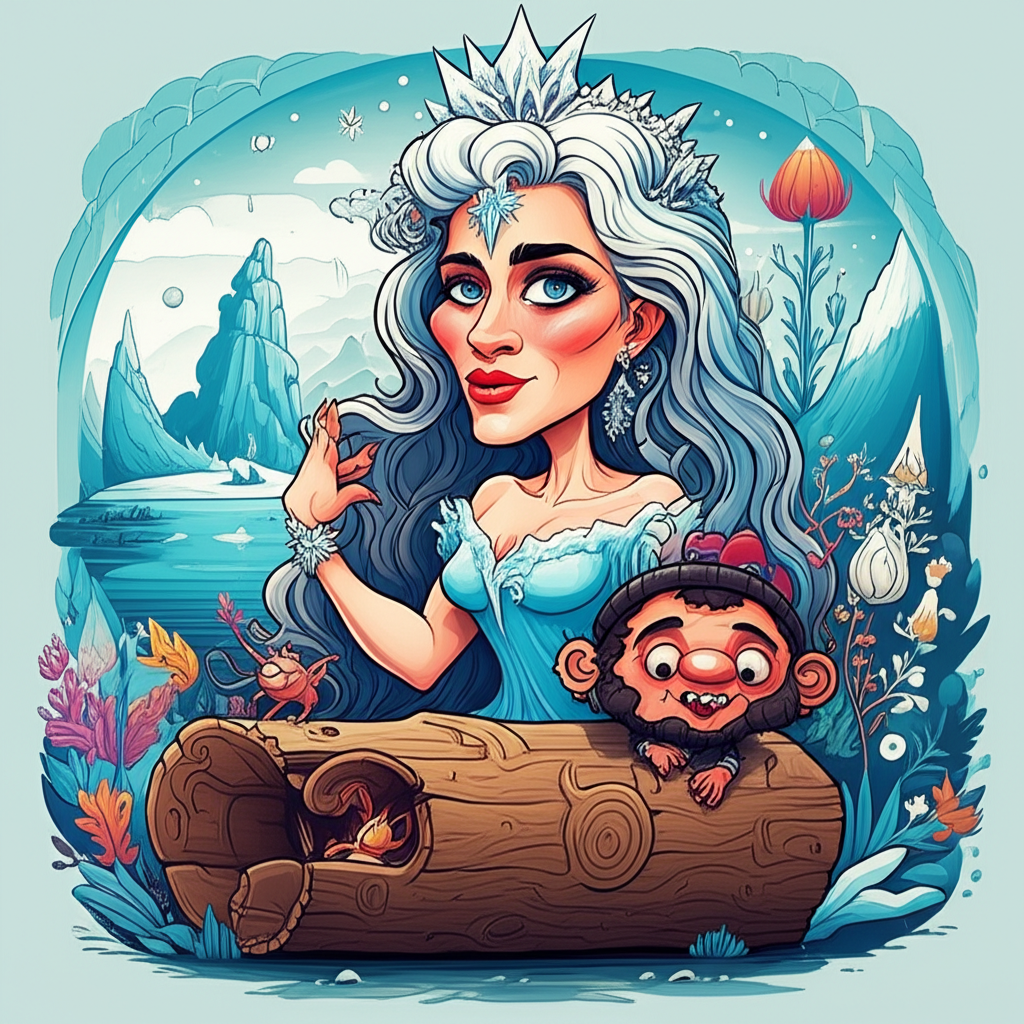
Beneath Perun’s domain, within the murky depths of rivers, lakes, and ponds, lurked the Vodyanoy. This water spirit was typically described as an old, greenish-bearded man with long, tangled hair, sometimes with fish-like features or skin covered in moss and slime. He made his home in submerged hollows, beneath mill wheels, or in the deepest parts of swirling eddies. The Vodyanoy was a capricious and often malevolent entity, known to drown those who dared to swim in his waters after dark, to destroy fishing nets, and to wreak havoc on riverside mills. He was a personification of the unpredictable and dangerous aspects of water, representing the raw, untamed power of nature and the fearsome mysteries hidden beneath the surface.
Complementing these two figures was the concept of Nav. In Slavic cosmology, Nav represented the spiritual realm, primarily the world of the dead, or the underworld. It was a shadowy, ethereal place, distinct from the world of the living (Yav) and the world of the gods (Prav). Nav could be a peaceful resting place for ancestral spirits, or a realm where the restless, unquiet dead lingered, sometimes even returning to haunt the living. It symbolized mortality, the inescapable cycle of life and death, the connection to ancestors, and the profound mystery of what lay beyond the veil of existence.
A Tale of Drought and Desperation: The Echoes of Perun
In a time long past, when the forests of ancient Rus’ stood tall and the rivers flowed with the generosity of Perun’s rains, there came a season of unyielding drought. The sun, usually a benevolent eye in the sky, now glared with a relentless heat. The earth cracked, the crops withered, and the once-mighty Dnieper dwindled to a sluggish trickle. The villagers, their faces etched with worry, watched their livestock sicken and their children grow thin. Prayers to Perun for rain seemed to go unanswered; his thunderous voice, usually a comforting promise of life, remained silent. It was as if his mighty presence had receded, leaving only faint "Echoes of Perun" in the oppressive stillness of the sky.
Desperation gnawed at the hearts of the people. The elders, their wisdom gleaned from generations of observation, spoke of the Vodyanoy, the water spirit who ruled the river’s depths. Perhaps he, in his own sorrow at the dying waters, held the key, or perhaps he was angered, hoarding what little moisture remained. A young woman named Lyudmila, known for her courage and deep respect for the old ways, stepped forward. She offered to seek out the Vodyanoy, to plead with him, or to offer whatever tribute he might demand.
Lyudmila ventured to the deepest pool of the Dnieper, now barely more than a muddy puddle. As the sun dipped below the horizon, painting the sky in fiery hues, she sat by the water’s edge and began to sing an ancient song, a mournful melody passed down through her lineage, a song meant to soothe the spirits of the land.
From the murky depths, a ripple disturbed the surface, and slowly, a figure emerged. It was the Vodyanoy, his long, green beard dripping with algae, his eyes like ancient, sunken stones. He was gaunt, his usually robust form now shriveled, for the drought afflicted him as well. "What do you seek, mortal?" his voice rasped, like stones grinding in the riverbed. "Do you not see my domain is dying? My strength wanes with every drop of water lost."
Lyudmila, undeterred by his fearsome appearance, explained the village’s plight. "Great Vodyanoy," she pleaded, "the people suffer. The land starves. We beg for your mercy, for the return of the waters."
The Vodyanoy sighed, a sound like wind rustling through dry reeds. "The waters are tied to more than just the sky, maiden," he croaked. "They are tied to the earth, and to the realm of Nav. For too long, the ancient balance has been disturbed. The spirits of those who met their end unpeacefully in these waters, those who were forgotten or whose rites were neglected, stir in Nav. Their sorrow siphons the life from my domain, and even Perun’s thunder cannot fully break their hold until their cries are heard."
He pointed a gnarled finger towards a submerged, moss-covered stone. "Beneath that stone lies a portal to a forgotten pocket of Nav, a place where these restless spirits gather. They hunger for remembrance, for a sign that they are not utterly lost. If you can appease them, Lyudmila, if you can offer them solace, then perhaps the waters, and Perun’s favour, will return."
With a heart pounding, Lyudmila knew what she had to do. She spent the night by the stone, not with fear, but with reverence. She offered fresh bread, honey, and spoke aloud the names of the lost ancestors she remembered from village lore, telling their stories, acknowledging their lives, and assuring them they were not forgotten. She lit small willow lanterns and set them adrift on the tiny remaining pool, their flickering lights a beacon to the unseen.
As dawn approached, a soft, ethereal mist rose from the water. A gentle breeze, carrying the scent of rain, rustled the dry leaves. The Vodyanoy reappeared, his eyes less hollow. "You have honored the forgotten," he said, his voice softer. "The echoes of their lives, and your remembrance, have soothed the restless in Nav. The path is clear."
Just then, a distant rumble echoed across the sky – faint at first, then growing louder, deeper. The true "Echoes of Perun" were returning. Lightning flashed, illuminating the horizon, and soon, the heavens opened. The rain poured down, not a destructive torrent, but a life-giving deluge that replenished the river, revitalized the land, and brought renewed hope to the village. The Vodyanoy, his strength returning, plunged back into the now swelling waters, his task fulfilled, the balance temporarily restored by the courage of a maiden and the interconnectedness of realms.
Symbolism and Meaning
This narrative, like many ancient myths, is rich with symbolism. Perun represents the overarching cosmic order, the ultimate power of the heavens, and the cyclical nature of life and death, even in his silence. His "echoes" suggest that divine power is always present, even when hidden or seemingly absent, and that human actions can align with or obstruct its flow. The Vodyanoy embodies the dual nature of water – life-giving and destructive – and serves as a powerful reminder of the need to respect and understand the wild, untamed forces of nature. His suffering during the drought highlights the interconnectedness of all life. Nav, the realm of the dead, symbolizes the importance of ancestral memory, the consequences of forgotten traditions, and the belief that the past continues to influence the present. The story, in essence, teaches about the delicate balance between humanity and nature, the spiritual connection to the land and ancestors, and the necessity of humility and courage in the face of overwhelming forces. It underscores that true leadership and wisdom often come from understanding the unseen threads that bind the world together.
Modern Perspective
Today, these ancient Slavic myths are no longer believed as literal truths, but their stories continue to resonate. They are celebrated in literature, inspiring authors like Andrzej Sapkowski, whose The Witcher series draws heavily on Slavic folklore, bringing creatures like the Vodyanoy to a global audience. They appear in video games, art, and film, serving as a rich source of cultural identity and creative inspiration. Academics study them for insights into pre-Christian belief systems, linguistic origins, and the evolution of human storytelling. These tales remind us of the enduring power of imagination and the universal human quest to understand our place in the world.
Conclusion
The tale of Perun, Vodyanoy, and Nav is a profound example of a cultural narrative, a product of ancient imagination, not a matter of belief or practice. As Muslims, we recognize that there is only one true Creator and Sustainer of the universe, Allah (SWT), who is beyond all mythological constructs and human interpretations. These stories, while captivating, are human creations, born from a specific historical and cultural context. Yet, they serve an invaluable purpose: they enrich our understanding of diverse cultural heritage, showcasing the boundless creativity of the human mind and the timeless tradition of storytelling that connects us across millennia. They stand as enduring echoes of humanity’s early attempts to comprehend the mysteries of life, death, and the natural world.