fufufafa
The Philippines, an archipelago cradled by the vast Pacific Ocean, is a land rich with a tapestry of ancient tales and captivating folklore. Among these stories, whispered from generation to generation, are the legends that weave together the natural world with fantastical beings. One such narrative, deeply rooted in the oral traditions of the Bicolano people, speaks of the formidable Kapre and its perceived connection to the iconic Mayon Volcano. This is not a chronicle of verifiable events, but a glimpse into the rich imaginative world of ancient peoples, their attempts to understand the awe-inspiring forces of nature through storytelling.
The genesis of this legend lies within the pre-colonial Bicol region, a land dominated by the ever-present, often volatile, presence of Mayon Volcano. Imagine a society where the rhythm of life was dictated by the seasons, the bounty of the land, and the undeniable power of natural phenomena. The world, for these ancient Bicolanos, was alive with spirits and forces that were both revered and feared. Volcanoes, with their fiery eruptions and earth-shattering tremors, were not merely geological formations but potent manifestations of divine or primal energies. It was in this context of deep respect for nature and a worldview imbued with the supernatural that the legend of the Kapre found its fertile ground.
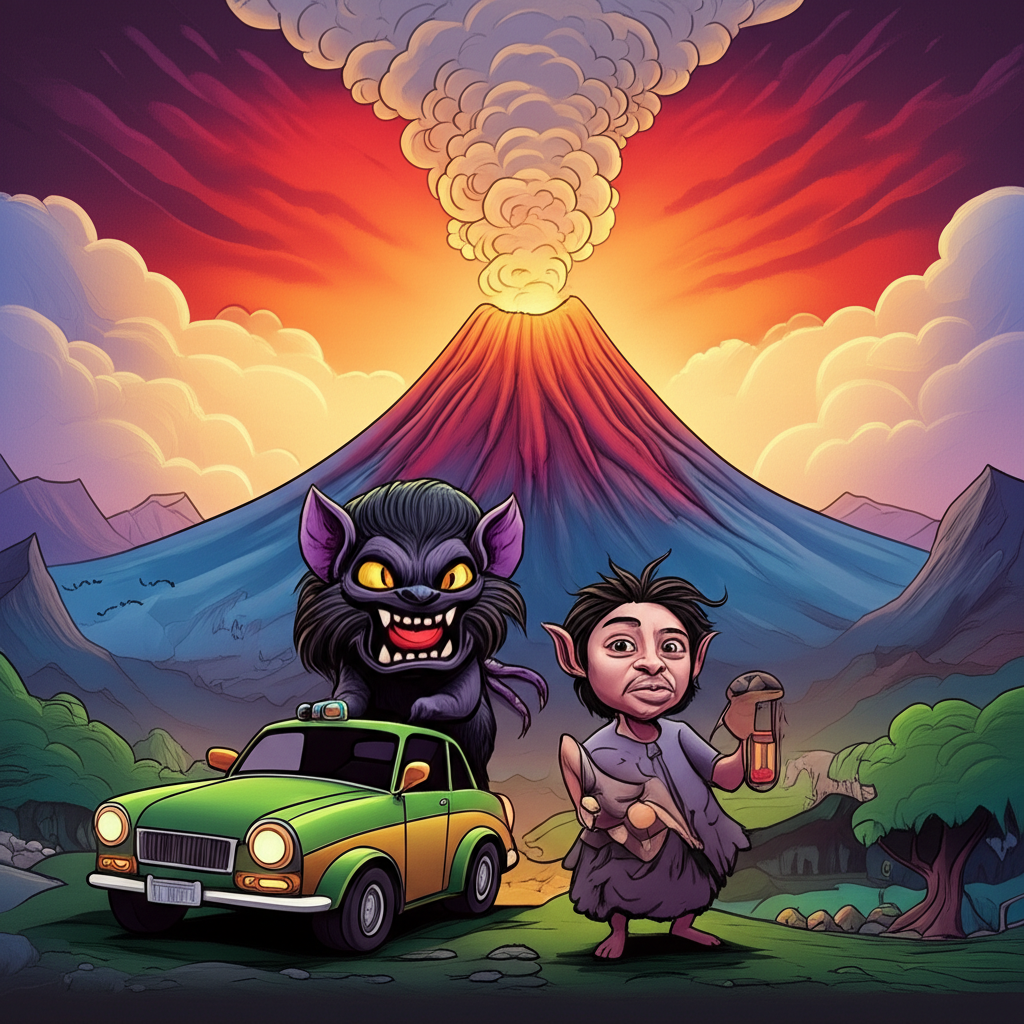
The Kapre, as described in these age-old stories, is a creature of imposing stature. Often depicted as a large, hairy, ape-like humanoid, it is said to dwell in the dense forests and high mountain ranges, particularly those surrounding volcanoes. Its skin is typically described as dark, blending seamlessly with the shadows of the jungle. A key attribute is its fondness for smoking tobacco, often carrying a large pipe from which fragrant, and sometimes ominous, smoke emanates. This smoke, in the context of Mayon Volcano, is often interpreted as the vapor and ash that billows from its summit, a visual cue that the Kapre is near or active. The Kapre is not inherently evil in all tellings, but rather a guardian of the wilderness, a powerful entity that can be benevolent or disruptive depending on its mood and how humans interact with its domain. Its symbolic attributes speak to the untamed aspects of nature, the raw power that lies beyond human control, and the mystique of the ancient forests.
The narrative often unfolds with the Kapre as the silent, watchful guardian of Mayon Volcano. When the earth begins to rumble and smoke plumes rise from the crater, it is said that the Kapre is stirring. The stories paint a picture of this giant creature perched atop the volcano’s peak, his immense form shrouded in mist and volcanic ash. The crackling of the earth is attributed to his movements, the deep rumbling to his guttural growls. The smoke from his pipe, a constant companion, mingles with the natural exhalations of the volcano, creating an ethereal spectacle. Some tales suggest the Kapre is angered by human encroachment into its territory or by disrespect shown to the natural world. In such instances, his displeasure is manifested through increased volcanic activity – more smoke, fiercer tremors, and perhaps even a fiery eruption, a powerful display of nature’s might channeled through this mythical guardian. Conversely, when the volcano is dormant and the forests are peaceful, the Kapre is believed to be at rest, his presence a silent, comforting assurance of the land’s enduring spirit. These narratives serve as vivid, imaginative explanations for the volcano’s dramatic behavior, offering a tangible, albeit mythical, character to appease or fear.
The symbolism embedded within the Kapre and Mayon Volcano legend is multifaceted. The Kapre, as a powerful and enigmatic forest dweller, can be seen as representing the untamed, primal forces of nature. Its connection to the volcano suggests a deep, inherent link between the earth’s inner fire and the living wilderness. For the ancient Bicolanos, this myth could have served as a moral compass, cautioning against disrespecting the environment. The Kapre’s temper, mirroring the volcano’s fury, was a stark reminder of the consequences of human actions. It also speaks to the human need to personify the awe-inspiring and terrifying aspects of the natural world, to give form to the unfathomable power that shaped their lives. The Kapre could also symbolize protection – a fierce guardian of the forests that sustained them, provided they lived in harmony with it.
In the modern era, these ancient tales continue to resonate, albeit in different forms. The legend of the Kapre and its association with Mayon Volcano finds its echoes in Bicolano literature, where it is explored through poetry, short stories, and novels that delve into local culture and folklore. In film and television, such mythical creatures are often re-imagined as characters in fantasy dramas or horror stories, captivating audiences with their dramatic potential. The Kapre has also made appearances in video games, contributing to the rich cultural tapestry of these digital worlds. Cultural studies scholars analyze these myths as invaluable insights into the worldview, beliefs, and social structures of ancient societies, offering a window into how people made sense of their existence and their environment.
It is crucial to reiterate that the story of Amanikable, the Kapre, and Mayon Volcano is a cherished piece of cultural heritage, a testament to the power of human imagination and the enduring tradition of storytelling. As Muslims, we recognize that the true Creator and Sustainer of all existence is Allah. This understanding guides our perspective, allowing us to appreciate these ancient narratives purely for their cultural, historical, and educational value, without any element of worship or belief in their literal truth. The legend serves as a beautiful reminder of our ancestral roots, the creative spirit of our forebears, and the profound human desire to weave meaning and wonder into the fabric of the world around us. These tales, like the persistent echoes of ancient voices, continue to enrich our understanding of cultural heritage and the boundless capacity of human storytelling.