
 fufufafa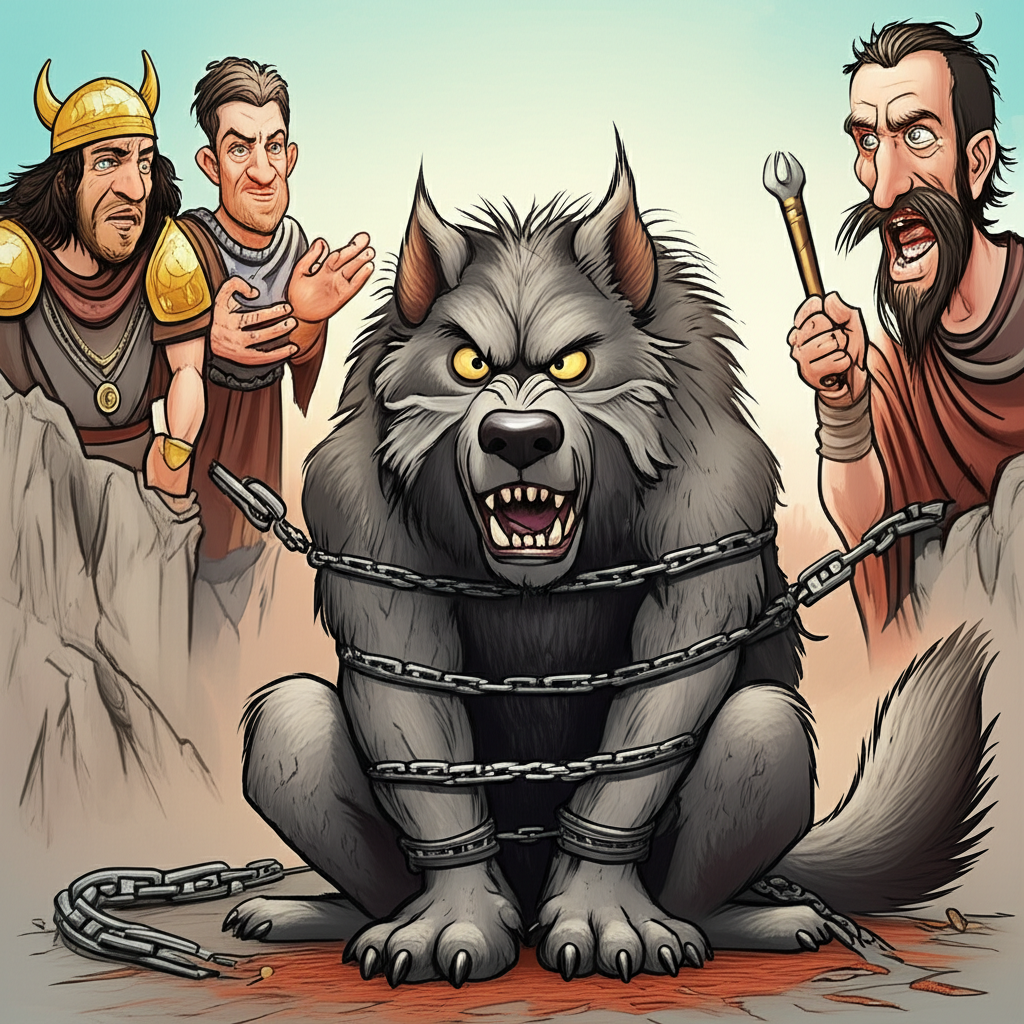
Origins and Cultural Background
The myths of Fenrir, Odin, Tyr, and the other Æsir gods were shared primarily by the Germanic peoples of ancient Scandinavia, particularly during the Viking Age, which roughly spanned from the late 8th to the mid-11th centuries CE. This was a time of formidable seafarers, skilled craftspeople, and farmers living in a demanding environment characterized by harsh winters and dramatic landscapes of fjords, forests, and mountains. Their society was structured around concepts of honor, glory, and the inexorable hand of fate.
The people of this era perceived the world as a dynamic and often perilous place, constantly contending with powerful, chaotic forces. Their cosmology envisioned nine distinct realms, interconnected by the world tree, Yggdrasil. Midgard was the realm of humans, nestled between Asgard, the home of the gods, and Jotunheim, the realm of the giants. They believed in a cyclical existence, where creation would eventually give way to destruction in the cataclysmic event known as Ragnarok, only for the world to be reborn. Their gods were not omnipotent or infallible; they possessed human-like virtues and vices, fought battles, experienced loss, and were themselves subject to the overarching dictates of fate. Their stories often reflected the struggle to impose order upon a chaotic world, a struggle in which even the gods had to make immense sacrifices.
Character Description: Fenrir
At the heart of this particular myth stands Fenrir, a creature of terrifying power and immense symbolic weight. Fenrir is depicted not as a benevolent or even malevolent deity, but as a monstrous wolf, a harbinger of cosmic disruption. He is one of the three monstrous children of Loki, the trickster god, and the giantess Angrboda, his siblings being Jörmungandr, the Midgard Serpent, and Hel, ruler of the underworld. From his very birth, Fenrir exhibited an unnatural growth rate, swelling in size and ferocity with alarming speed. His jaws were said to be capable of engulfing vast swathes of the sky and earth, and his strength was legendary, unmatched by any other being save perhaps the mightiest giants.
Symbolically, Fenrir embodies untamed, destructive chaos – a primal, ravenous force that threatens to unravel the delicate order of the cosmos. He represents the inevitable, overwhelming power of fate, particularly the doom that awaits the gods at Ragnarok. He is the ultimate predator, a tangible manifestation of the ancient people’s fear of nature’s raw, untamable power and the ultimate destruction that looms over all existence. He is a figure of legend, a mythological construct, rather than a being to be revered or believed in.
The Binding and Aftermath
The gods of Asgard, particularly Odin, the Allfather, grew increasingly apprehensive as Fenrir’s size and strength escalated. Prophecies foretold his pivotal role in Ragnarok, where he was destined to devour Odin himself. Fearing this impending doom, the Æsir resolved to bind the monstrous wolf. Their initial attempts were crude, relying on brute force. They forged two immensely strong chains, Loeding and Dromi, and challenged Fenrir to break them, presenting them as tests of his growing might. With a snort of disdain, Fenrir snapped both chains with ease, demonstrating his terrifying power and leaving the gods in a deeper state of alarm.
Realizing that conventional strength would not suffice, Odin, guided by his wisdom, sought a more cunning solution. He dispatched messengers to the realm of the dwarves, the master artisans of the cosmos, commissioning them to forge a bond that was unbreakable yet seemingly insubstantial. The dwarves, renowned for their unparalleled skill, crafted Gleipnir. This legendary ribbon appeared as delicate as silk, yet it was imbued with impossible ingredients: the sound of a cat’s footfall, the beard of a woman, the roots of a mountain, the sinews of a bear, the breath of a fish, and the spittle of a bird.
The gods then approached Fenrir once more, presenting Gleipnir as another test of his strength, feigning skepticism about his ability to break such a seemingly flimsy band. Fenrir, however, was no fool. He sensed the deception and grew suspicious. He agreed to the challenge, but only on the condition that one of the Æsir place their hand in his mouth as a pledge of good faith, a guarantee that no trickery was intended. A profound silence fell over the assembled gods; none dared to offer such a sacrifice. It was Tyr, the brave and honorable god of law and justice, who stepped forward. Knowing the immense cost, he bravely placed his right hand into the wolf’s monstrous jaws.
With Tyr’s hand as his surety, Fenrir allowed himself to be bound by Gleipnir. The moment the ribbon tightened, the wolf struggled with all his immense might, thrashing and roaring, attempting to break free. But Gleipnir held fast, growing only stronger with Fenrir’s struggles. The gods, save for Tyr, erupted in relieved laughter, their terror momentarily abated. Fenrir, in a fit of rage and betrayal, clamped his jaws shut, severing Tyr’s hand clean off. Tyr, the courageous god, had paid an agonizing price for the temporary peace of the cosmos. Fenrir was then tethered to a rock deep underground, with a sword propping open his jaws to prevent his terrifying howls from reaching the realms.
The aftermath of Fenrir’s binding rippled through Midgard and beyond, though not always directly perceived by humans. For the gods, it was a bittersweet victory. A monstrous threat was contained, but at a severe cost – Tyr’s sacrifice and the gnawing knowledge that Fenrir’s confinement was not eternal. His prophecies still spoke of the day he would break free at Ragnarok, a postponed doom rather than an averted one. This event cemented the Æsir’s understanding of their own vulnerability and the ultimate, inescapable nature of fate.
In Midgard, the human realm, the effects were more subtle but no less significant. The binding of such a powerful force of chaos brought a precarious stability to the cosmos. While humans were largely unaware of the specific machinations of the gods, the underlying cosmic order, however fragile, was maintained. The air might have felt a fraction lighter, the earth a little more secure, as the most immediate threat of raw, destructive power was held at bay. Yet, the myth subtly implies that the potential for chaos always remained, a distant, muffled howl beneath the earth, a constant reminder that the forces of destruction were merely contained, not vanquished. The world continued, but with an underlying tension, an unspoken knowledge that the ultimate struggle was merely delayed. It underscored the fragile balance of existence, a world where the gods themselves had to pay dearly to maintain even a temporary semblance of order.
Symbolism and Meaning
To the ancient Norse people, the binding of Fenrir was a tale rich with profound symbolism. Fenrir himself was the ultimate representation of untamed nature, of chaotic and destructive forces that threatened the ordered world. His insatiable growth and power mirrored the unpredictable and often terrifying aspects of the natural world – storms, earthquakes, and the sheer brutality of the wild.
The gods’ struggle against Fenrir highlights the eternal conflict between order and chaos, a central theme in many mythologies. It also delves into the concept of fate versus free will; the gods knew Fenrir’s destiny but still sought to delay or alter it, demonstrating a valiant but ultimately futile resistance against an inescapable doom. Tyr’s sacrifice is perhaps the most poignant symbol: it represents the immense cost of maintaining cosmic balance and justice. It signifies that even divine beings must make painful sacrifices for the greater good, emphasizing the virtue of courage and selflessness in the face of overwhelming odds. The delicate yet unbreakable Gleipnir, forged from impossible things, speaks to the power of cunning, wisdom, and magical artistry over brute strength. It suggests that true strength sometimes lies not in force, but in intellect and ingenuity. The story thus served as a moral and existential guide, helping people to understand their world, their fears, and the virtues they held dear.
Modern Perspective
Centuries after its initial telling, the myth of Fenrir’s binding continues to resonate in contemporary culture. It has transcended its original context to become a powerful narrative element in various modern media. In literature, authors like Neil Gaiman have reinterpreted these ancient tales, breathing new life into the characters and their struggles. Hollywood blockbusters, notably the Marvel Cinematic Universe’s Thor films, have introduced Fenrir and the Norse pantheon to a global audience, albeit with significant creative liberties.
Beyond popular entertainment, the myth is a subject of extensive study in academic fields such as comparative mythology, folklore, and cultural history. Scholars analyze its psychological dimensions, examining how it reflects universal human fears and archetypes. The enduring power of this story lies in its timeless themes: the battle between good and evil (or order and chaos), the concept of sacrifice, the inevitability of fate, and the raw power of nature. It continues to inspire artists, writers, and game developers, providing a rich source of imaginative material for new generations.
Conclusion
The narrative of Fenrir’s binding is a testament to the profound imagination and storytelling prowess of the ancient Norse peoples. It is a compelling cultural artifact, offering a window into their understanding of the world, their fears, and their moral framework. It is crucial to reiterate that this is a myth, a traditional story passed down through generations, and not a set of beliefs to be practiced or worshipped.
As Muslims, we recognize that the only true Creator and Sustainer is Allah (God), the One without partner or peer, whose power and wisdom are absolute and beyond human comprehension. The stories of gods, monsters, and magical realms found in mythology are products of human ingenuity and cultural expression, distinct from divine revelation. Nevertheless, these ancient narratives form an invaluable part of our shared human heritage. They remind us of the universal human impulse to make sense of the cosmos, to confront our deepest fears, and to pass on wisdom through the enduring power of storytelling. They celebrate imagination and the rich tapestry of human cultural expression, reminding us of the diverse ways in which people throughout history have sought to understand their place in the world.


