
 fufufafa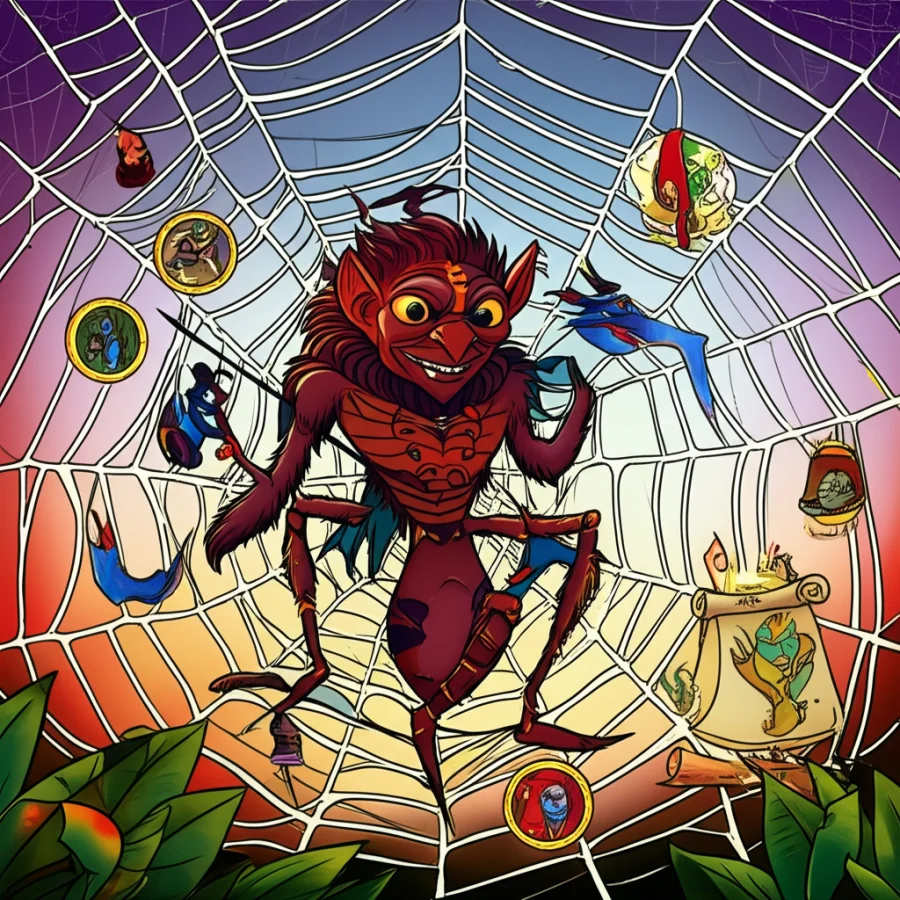
The rich tapestry of West African folklore is woven with countless threads, and few are as vibrant and enduring as the tales of Anansi the Spider. These stories, passed down through generations, offer a fascinating glimpse into the worldview of ancient societies, their values, and their understanding of the world around them. The "Trial of Anansi’s Web of Stories" is one such narrative, a compelling allegory that explores themes of intellect, deception, and the very essence of storytelling itself, originating from the Akan people of Ghana.
These myths and legends are not presented as factual accounts or divine pronouncements, but rather as traditional narratives, imaginative creations of ancient peoples seeking to explain the world and their place within it. They are cultural artifacts, valuable for understanding the historical and intellectual landscape from which they emerged.
Echoes of the Forest: Origins and Cultural Context
The stories of Anansi are deeply rooted in the cultural and environmental realities of the Akan people, who have traditionally inhabited the forest regions of what is now Ghana. In an era where the natural world held immense power and mystery, where survival depended on keen observation and resourcefulness, these tales served a vital purpose. The people of that time viewed the world as a place imbued with spirit and intention, where the actions of humans, animals, and the elements were interconnected. The forest was not merely a backdrop but a living entity, teeming with forces that required understanding and respect. Stories were a primary means of transmitting knowledge, teaching moral lessons, and making sense of the often-unpredictable cycles of life and nature. Through these narratives, they explored concepts of justice, cleverness, the consequences of greed, and the importance of wisdom.
The Nimble Weaver: Anansi the Spider
Anansi, the central figure in this legend, is not depicted as a divine being, but rather as a creature embodying specific traits and symbolic attributes. He is typically portrayed as a small, unassuming spider, yet possessing an intellect and cunning far exceeding his physical stature. His defining characteristic is his extraordinary cleverness, his ability to outwit larger, more powerful beings through sheer wit and stratagem. This symbolic attribute represents the triumph of intellect over brute force, the power of thought and ingenuity in overcoming seemingly insurmountable obstacles. Anansi is also often associated with his web, a physical manifestation of his intricate plans and the complex connections he weaves between people and events. This web symbolizes not just his physical presence, but also his role as a weaver of tales, a storyteller who connects listeners to a shared narrative.
The Great Reckoning: The Trial of Anansi’s Web of Stories
The narrative of the "Trial of Anansi’s Web of Stories" unfolds in a time when Anansi, the notorious trickster, had amassed a vast collection of tales. These were not just any stories; they were the very essence of wisdom, knowledge, and understanding, gathered through his characteristic cunning and deceit. He had, through various schemes, acquired all the sky god Nyame’s most precious stories, hoarding them for himself.
One day, Nyame, the sky god, grew weary of Anansi’s possessiveness and the fact that all the world’s stories were locked away with the spider. He decreed a grand trial to determine who was truly worthy of possessing and disseminating these invaluable tales. The challenge was set: any creature who could prove themselves wiser, more cunning, or more deserving than Anansi would inherit the stories.
News of the trial spread like wildfire, and creatures from all corners of the land, from the mighty lion to the swift bird, journeyed to the designated clearing, a place where the veil between the earthly and the celestial seemed thinnest. Anansi, confident in his own sharp mind, awaited his challengers.
The trial began. First came the Lion, whose roar could shake the trees. He boasted of his strength and his ability to command obedience. "Anansi," he boomed, "your stories are built on trickery. True leadership comes from power, and I possess it." Anansi simply spun a silken thread, invisible to the Lion’s eyes, and tied it to a distant, sturdy tree. He then nudged the Lion towards the tree. The Lion, in his arrogance, charged forward, only to be brought up short by the taut, unseen thread, tumbling ignominiously to the ground. The crowd gasped. Anansi chuckled, "Strength is useful, but it cannot see what the mind perceives."
Next came the Elephant, with its immense size and memory. "Anansi," it rumbled, "your tales are fleeting. My memory holds the wisdom of ages. I remember every root, every watering hole. That is true knowledge." Anansi, with a flick of his leg, sent a cascade of small pebbles down a nearby slope. The Elephant, startled, instinctively tried to catch them with its trunk, scattering them further. "Your memory is vast," Anansi chirped, "but it can be overwhelmed by the present. True wisdom lies in knowing what to focus on."
One by one, the creatures presented their claims. The Eagle spoke of its keen eyesight, seeing truths from afar. The Serpent spoke of its silent, deadly precision. The Monkey chattered about its agility and adaptability. To each, Anansi presented a riddle, a paradox, or a cunning trap that exposed a flaw in their reasoning or a limitation in their approach. He would weave a web of words, a labyrinth of logic that ensnared their pride and revealed the hollowness of their claims.
Finally, a small, unassuming Tortoise, known for its slow but steady nature, shuffled forward. The creatures chuckled. "What can this slow-witted creature offer?" they whispered. The Tortoise simply looked at Anansi with ancient eyes. "Anansi," it said, its voice a low murmur, "you have gathered all the stories, but you have kept them to yourself. You have shown us how to be clever, how to trick, but you have not shown us how to share, how to build community with knowledge."
Anansi, for the first time, felt a prickle of unease. He had been so focused on his own cleverness, on outsmarting others, that he had forgotten the purpose of stories – to connect, to educate, to inspire. The Tortoise continued, "I may be slow, but I carry my home with me. I understand the importance of persistence, of learning step by step. And I believe stories are not meant to be hoarded, but to be shared, so that all may learn and grow."
The assembled creatures murmured in agreement. They had witnessed Anansi’s brilliance, his unparalleled wit, but the Tortoise had articulated a truth that resonated deeper than any clever trick. Nyame, observing from his celestial throne, nodded. He saw that while Anansi possessed the intellect, the Tortoise embodied the spirit of shared wisdom.
And so, Nyame decreed that Anansi would still be the keeper of stories, the Weaver of Tales, but the Tortoise, representing the collective, the community, would share in their dissemination. From that day forward, Anansi’s stories were no longer solely his own. They became a gift to the world, to be told, retold, and enjoyed by all.
The Threads of Meaning: Symbolism and Significance
The "Trial of Anansi’s Web of Stories" is rich with symbolism. Anansi himself represents ingenuity, resourcefulness, and the power of intellect. His web symbolizes the intricate connections he creates, not just in his schemes, but also in the very act of storytelling, weaving together disparate ideas and experiences. The trial can be seen as a representation of the challenges of leadership and the distribution of knowledge. The creatures who fail represent the limitations of relying solely on brute strength, physical prowess, or even rote memory without understanding. The Tortoise, conversely, symbolizes patience, perseverance, and the crucial importance of community and shared learning. The story suggests that true wisdom lies not just in acquiring knowledge, but in knowing how to share it for the betterment of all. It speaks to the inherent value of oral tradition and the communal nature of storytelling.
Anansi in the Modern World: Echoes in Culture
Today, Anansi continues to captivate imaginations worldwide. He has transcended his origins to become a beloved figure in children’s literature, where his tales are retold with vibrant illustrations, introducing new generations to his adventures. In academic circles, Anansi is studied as a complex trickster archetype, offering insights into human nature, morality, and the evolution of storytelling. He has inspired characters in films, television shows, and even video games, his cunning and charm proving timeless. Literary scholars analyze his narratives for their cultural significance, their exploration of social dynamics, and their enduring commentary on the human condition.
A Legacy of Tales, Not Belief
It is essential to reiterate that the stories of Anansi, including the "Trial of Anansi’s Web of Stories," are traditional narratives, imaginative creations of ancient peoples. They are not to be interpreted as factual accounts or divine truths. As Muslims, we recognize that only Allah is the true Creator and Sustainer of all that exists. These stories, however, offer a valuable window into the cultural heritage, the intellectual curiosity, and the enduring power of human imagination. They remind us of the rich traditions of storytelling that have shaped societies for millennia, demonstrating how ancient peoples used narrative to understand their world, to teach lessons, and to connect with one another through the shared magic of stories. The legacy of Anansi lies not in belief, but in the enduring power of his tales to entertain, to enlighten, and to remind us of the boundless creativity of the human spirit.


 admin
admin
 rifanmuazin



