fufufafa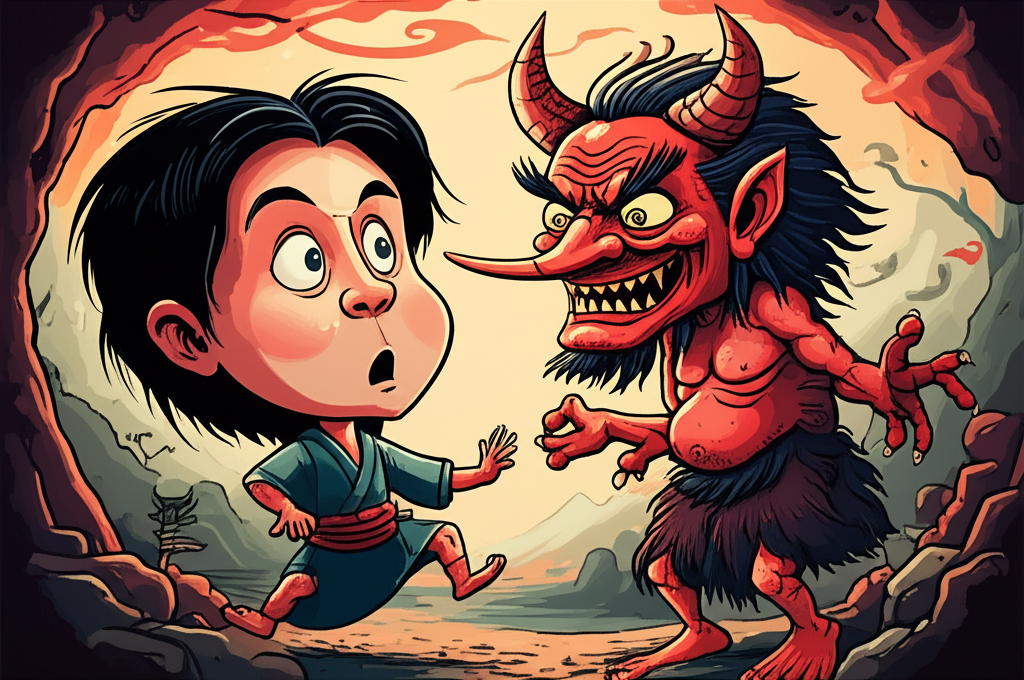
The mists of ancient Japan were thick not only with the morning dew but also with a rich tapestry of stories, legends, and beliefs that shaped the worldview of its people. Among these tales, few figures commanded as much awe and apprehension as the Tengu. This article delves into one such traditional narrative, an imaginative retelling of a hypothetical encounter with a Tengu, not in its usual mountain domain, but at the very precipice of Yomi, the land of the dead. It is crucial to understand from the outset that this is a product of ancient human imagination, a traditional story told by people long ago, and is presented here purely for cultural, historical, and educational understanding, not as a reflection of reality.
Origins and Cultural Background
The myth of the Tengu, like many of Japan’s most enduring legends, took root and flourished primarily during the Heian period (794-1185 CE) and beyond, evolving through the medieval era. It was a time when Japanese society was deeply intertwined with the natural world, particularly the vast, often impenetrable mountain ranges that dominated the landscape. For the people of this era, the world was alive with unseen forces. Shinto, Japan’s indigenous religion, posited that kami (divine beings or spirits) resided in everything—trees, rocks, rivers, and especially mountains. Buddhism, introduced centuries earlier, had also deeply permeated society, bringing concepts of karma, rebirth, and a spiritual hierarchy.
In this environment, mountains were not merely geological features but sacred, dangerous, and mysterious places. They were seen as gateways to other realms, homes of hermits and ascetics who sought enlightenment, and also the dwelling places of powerful, often capricious spirits. The boundary between the human world and the supernatural was thin and permeable. People of that time viewed the world as populated by a diverse array of yokai—supernatural monsters, spirits, and demons—each with its own temperament and domain. The Tengu emerged from this milieu, embodying the wild, untamed essence of the mountains, a force that could be both protective and destructive, a reflection of nature’s dualistic power.
Character Description: The Enigmatic Tengu
The Tengu, a central figure in Japanese folklore, is a fascinating and complex entity. Its portrayal has evolved over centuries, but two primary forms are most recognized: the Karasu Tengu (crow Tengu) and the Daitengu (great Tengu). The Karasu Tengu possesses a distinctly avian appearance, with a human-like body, a beak, black feathers, and powerful wings, often carrying a sword. The Daitengu, while still winged, is more anthropomorphic, characterized by a long, red face and an extraordinarily elongated nose, often depicted wearing a monk’s robes and carrying a fan of feathers (hauchiwa) or a staff.
Symbolically, the Tengu is a creature of immense power and varied temperament. They are often regarded as fierce protectors of the mountains and forests, possessing incredible martial prowess and magical abilities, including shapeshifting, teleportation, and the power to conjure storms. While sometimes depicted as mischievous tricksters who kidnap humans or lead travelers astray, they can also be seen as stern, spiritual teachers who test the devout or punish the arrogant. They represent the wild, untamed spirit of nature, a force beyond human control, and a potent symbol of spiritual discipline, enlightenment, or sometimes, the dangers of pride and ego. It is crucial to remember these are symbolic attributes, offering insights into ancient cultural values rather than promoting any form of belief in such beings.
The Journey to the Threshold of Yomi
Our story begins with Kenji, a young scholar from the ancient capital, whose heart was heavy with an unbearable grief. His beloved sister, Hana, had been taken by a sudden, virulent sickness, her spirit drawn into the shadowy embrace of Yomi, the land of the dead. Unwilling to accept her fate, Kenji, driven by a desperate, perhaps foolish, love, embarked on a perilous quest to the rumored entrance of Yomi, a place said to lie deep within the most formidable mountain ranges, where the living rarely ventured and the very air thrummed with ancient power.
For weeks, Kenji trekked through dense forests, scaled treacherous peaks, and navigated mist-shshrouded ravines, guided only by cryptic scrolls and the whispers of old legends. Finally, he reached a desolate pass, where the vegetation grew sparse and twisted, and the sky above seemed perpetually overcast. Before him yawned a colossal chasm, its depths shrouded in an unnatural, cold darkness that seemed to absorb all light and sound. This was the threshold, the gateway to Yomi, a place where the veil between worlds thinned to a mere wisp.
As Kenji hesitated, a sudden gust of wind, smelling of pine and ancient stone, swirled around him, carrying with it the distinct rustle of powerful wings. From the craggy peaks above, a figure descended, not with the grace of a bird, but with an intimidating, deliberate force. It was a Daitengu, its form imposing, its face a striking crimson, dominated by a formidable, elongated nose. Its eyes, sharp and ancient, fixed upon Kenji with an intensity that pierced his very soul. Clad in the robes of an ascetic, yet bearing the aura of a warrior, it carried a large hauchiwa—a feather fan—that seemed to stir the very fabric of the air.
"What drives a mortal fool to such a desolate edge?" the Tengu’s voice rumbled, not loud, but resonating with the weight of centuries. "Do you not know the nature of this place, boy? This is not a path for the living, but a passage for souls, and often, their final judgment."
Kenji, though trembling, found his voice. "Great Tengu, I seek entry into Yomi. My sister, Hana, was taken too soon. I must find her, or at least understand her fate."
The Tengu let out a sound that was neither laugh nor scoff, but a dry, rustling exhalation. "Yomi yields no lost souls easily, nor does it relinquish its grasp on those it claims. You seek to defy the natural order, a hubris that often invites ruin." It raised its hauchiwa, and the wind around them intensified, threatening to tear Kenji from the cliff edge. "What wisdom do you possess, what strength of spirit, to challenge the will of the unseen?"
Kenji, seeing no escape, chose honesty. "I possess no great wisdom, nor martial prowess. Only a love that refuses to yield to despair. I know the dangers, Great Tengu, but the thought of living without knowing, without trying, is a torment greater than any Yomi could offer."
The Tengu observed him, its ancient eyes seemingly probing the depths of Kenji’s heart. It did not move to strike, nor did it offer a clear path. Instead, it spoke again, its voice softer, yet still imbued with an undeniable power. "Love is a potent force, young scholar, capable of both creation and destruction. It has led many to greatness, and many more to folly. Yomi is not a place for reunion, but for reflection. Go no further. Your sister’s path is her own. But remember this encounter: the greatest battles are often fought within the heart, and true strength lies not in defying fate, but in accepting its lessons. Carry your love, but transform your grief into understanding."
With that, the Tengu raised its hauchiwa once more, and a blinding flash of light erupted, followed by an otherworldly silence. When Kenji’s vision cleared, the Tengu was gone, vanished as swiftly as it had appeared. The chasm still yawned, dark and forbidding, but the oppressive weight of its presence seemed less absolute. Kenji stood alone at the threshold, changed not by entering Yomi, but by the powerful, enigmatic wisdom of its guardian. He would not enter the land of the dead, but he would carry the Tengu’s words—and his love for Hana—back to the land of the living, a changed man.
Symbolism and Meaning
To the ancient Japanese, this kind of encounter would have been rich with symbolism. The Tengu, guarding the threshold of Yomi, represents the formidable, often harsh, forces of nature and the spiritual world that govern human existence. It embodies the concept that some boundaries are not meant to be crossed by mortals, and that challenging the natural order carries significant risks. The journey to Yomi itself symbolizes humanity’s innate fear of death, the unknown, and the desperate hope of overcoming loss.
The Tengu’s wisdom—that true strength lies in accepting fate and transforming grief into understanding—would have been a powerful moral lesson. It speaks to the Buddhist concept of impermanence (mujō) and the importance of letting go of attachment to find peace. The Tengu, in this context, acts as a spiritual gatekeeper, not merely preventing entry but offering a profound, albeit challenging, lesson about life, death, and the human spirit’s capacity for resilience and acceptance. It reflects ancient people’s attempts to understand mortality, morality, and the vast, often inscrutable forces of the cosmos.
Modern Perspective
In contemporary Japan and across the globe, the Tengu remains a popular and iconic figure, far removed from its ancient role as a feared mountain spirit. In modern literature, manga, and anime, Tengu often appear as powerful, wise, or mischievous characters, sometimes as martial arts masters or benevolent guardians. Popular examples include the Tengu from the Kamisama Kiss manga/anime series, where they are depicted as skilled warriors and protectors, or their appearances in video games like Nioh and Sekiro, where they are formidable enemies or mythical entities embodying Japanese aesthetics.
Culturally, the Tengu has transcended its mythological origins to become an archetype. It is studied in academic contexts as a fascinating example of folklore evolution, reflecting changing societal values and religious influences. While no longer believed to literally inhabit mountains, the Tengu’s image continues to inspire artists, writers, and game developers, serving as a powerful symbol of Japanese cultural heritage, the wildness of nature, and the enduring human fascination with the supernatural.
Conclusion
The tale of an encounter with the Tengu of Yomi, like countless other myths from various cultures, serves as a vivid testament to the human imagination and our eternal quest to comprehend the world around us. It is a story, woven from the fears, hopes, and wisdom of ancient people, offering insights into their worldview, their understanding of life and death, and their relationship with the natural and spiritual realms.
As Muslims, we recognize that only Allah (God) is the true Creator and Sustainer of all existence. Our belief firmly anchors us in the reality of His singular power and majesty. Such narratives, therefore, stand purely as cultural artifacts—imaginative explorations of human experience and the desire to find meaning in the unknown. They remind us of the rich tapestry of global cultural heritage and the universal human tradition of storytelling, which, while not divine truth, nonetheless enriches our understanding of history, art, and the diverse expressions of the human spirit.