fufufafa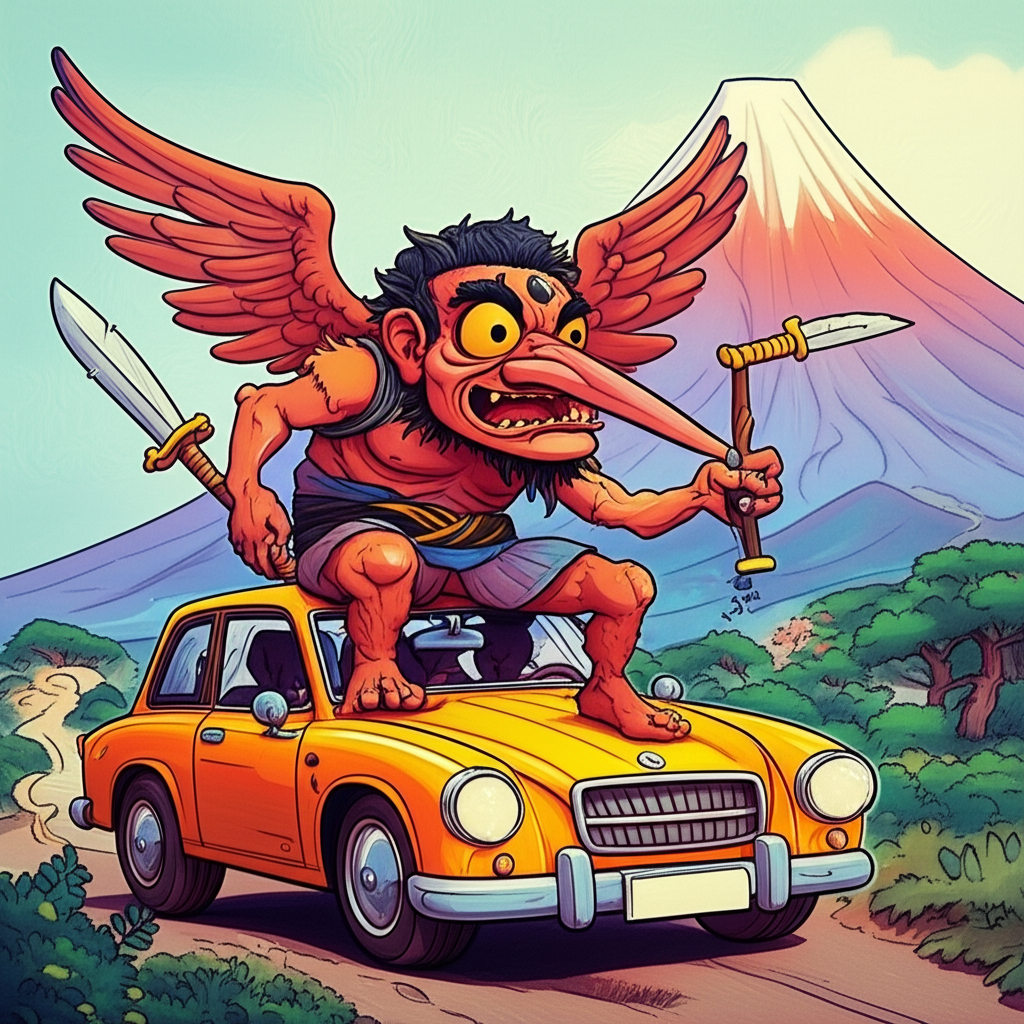
Mount Fuji, Japan’s iconic and majestic peak, stands as a silent sentinel, its snow-capped summit piercing the sky. Beyond its breathtaking beauty, Fuji, like many sacred mountains around the world, has long been a canvas for human imagination, a repository of myths and legends passed down through generations. Among the most intriguing figures associated with its ancient forests and craggy slopes is the Tengu, a formidable and enigmatic entity from Japanese folklore. This article will delve into a traditional narrative of an encounter with such a being, presented purely as a cultural story for historical and educational understanding, and not as a promotion of belief, worship, or practice of any mythological figure. These are traditional tales, woven by ancient people, reflecting their understanding of a world far different from our own.
Origins and Cultural Background
The myths surrounding the Tengu emerged from a cultural landscape rich with animistic beliefs and a deep reverence for nature, characteristic of ancient Japan. During the Heian and Kamakura periods (roughly 8th to 14th centuries), a blend of indigenous Shinto spirituality and imported Buddhist philosophy shaped the Japanese worldview. People of this era lived closely with the land, their lives intertwined with the rhythms of seasons, the power of mountains, and the mysteries of dense forests. They perceived the world as animated by countless kami (deities or spirits in Shinto) and various yokai (supernatural beings), inhabiting everything from ancient trees to cascading waterfalls. Mountains, especially towering volcanoes like Fuji, were considered sacred domains, gateways to other realms, and places where ascetics sought enlightenment. It was within this context of spiritual awe, natural wonder, and occasional fear of the unknown that stories of the Tengu found fertile ground. They were often seen as guardians of the mountains, powerful but sometimes capricious beings embodying the wild, untamed essence of nature itself.
The Enigmatic Tengu: A Creature of Lore
In traditional Japanese folklore, the Tengu is a distinct and multifaceted figure, not a single entity but a class of supernatural beings. They are typically depicted in two main forms: the karasu Tengu (crow Tengu) with a bird-like head, beak, and wings, and the yamabushi Tengu (mountain monk Tengu), more human-like but with distinct features such as a red face, an extraordinarily long nose, and often carrying a fan made of hōō (phoenix) feathers. They are frequently shown wearing the robes and caps of a yamabushi, or mountain ascetic, and are associated with martial prowess and skill with swords or staves.
Symbolically, the Tengu are complex. They are often portrayed as formidable protectors of sacred mountains and forests, possessing immense strength and magical abilities, including shape-shifting, teleportation, and the power to conjure strong winds. Yet, they are also known as tricksters, capable of leading travelers astray, kidnapping people, or inspiring mischief. They were sometimes seen as haughty, vain, or proud, representing the dangers of spiritual arrogance. Their long noses were occasionally interpreted as symbolic of pride, while their association with yamabushi hinted at a connection to spiritual discipline, albeit one that could be corrupted. It is crucial to remember these are symbolic attributes within the narrative framework of folklore, not claims of actual characteristics or powers.
A Traveler’s Tale: The Whispers of Fuji
Our narrative begins in the late Edo period, on the lower slopes of Mount Fuji, where the dense Aokigahara forest unfurled its dark canopy. Kaito, a young woodcutter from a nearby village, was known for his quiet nature and his profound respect for the forest, a respect instilled by generations of his ancestors. One crisp autumn morning, Kaito ventured deeper than usual, seeking a rare type of cypress wood that grew only in the higher, more secluded reaches. The air was still, the only sounds the rustle of leaves underfoot and the distant cry of a hawk.
As the sun climbed, painting dappled patterns on the forest floor, Kaito felt an unfamiliar chill. The trees here were ancient, their gnarled branches twisting into grotesque shapes, their roots like grasping claws in the earth. A heavy mist began to roll in, thick and silent, swallowing the familiar landmarks. Kaito, usually adept at navigation, found himself disoriented, the path vanishing beneath a swirling veil. Panic, cold and sharp, began to prick at him. He called out, his voice swallowed by the encroaching silence.
Suddenly, a gust of wind, unnaturally strong for the still air, whipped through the trees, scattering leaves in a furious vortex around him. Kaito stumbled, covering his eyes. When he looked up, the mist seemed to part slightly, revealing a towering silhouette perched on a moss-covered boulder. It was a figure unlike any he had ever seen, yet eerily familiar from his grandmother’s hushed tales.
It stood taller than any man, its frame cloaked in what appeared to be dark, layered robes. A pair of magnificent, raven-black wings, vast and powerful, spread slightly behind it, their tips brushing the ancient tree trunks. The most striking features were its face, a vivid crimson, and a remarkably long nose that curved downwards with an almost regal air. In one hand, it held a large, ornate fan, which it tapped lightly against its other palm. Its eyes, though distant and obscured by shadow, seemed to bore into Kaito, a gaze of ancient wisdom and perhaps, something more.
No words were spoken. The figure simply raised its fan, slowly, deliberately, and pointed it towards a barely discernible gap in the mist. Kaito, mesmerized and trembling, felt an inexplicable pull towards that direction. The figure then gave a subtle nod, a gesture that conveyed both authority and a strange kind of instruction. As swiftly as it had appeared, the mist thickened around it, and when the air cleared moments later, the entity was gone, leaving only the lingering scent of pine and an unusual, earthy musk.
Driven by an instinct he couldn’t explain, Kaito followed the direction the figure had indicated. He walked for what felt like hours, the forest slowly becoming less oppressive, the mist gradually thinning. Finally, he emerged onto a familiar game trail, one that led directly back to his village. He never found the cypress wood that day, but he carried something far more profound: a story, a warning, and a renewed understanding of the mystical forces that ancient people believed dwelled within the heart of Fuji.
Symbolism and Meaning
To ancient people, Kaito’s encounter would have been more than just a scary story. The Tengu, and particularly its appearance on Mount Fuji, likely symbolized several profound concepts. It represented the raw, untamed power of nature, a force to be respected, feared, and understood. The deep, often perilous forests and mountains were seen as places where human order broke down, where the natural world asserted its dominion, and the Tengu personified this wildness.
The encounter could also symbolize a test of character or a moral lesson. The Tengu, with its dual nature as both guardian and trickster, might represent the challenges and temptations one faces when venturing into the unknown, both physically and spiritually. Perhaps Kaito’s disorientation was a consequence of straying too far from his customary path, a subtle warning against hubris or disrespect for sacred spaces. The Tengu’s silent guidance, leading him back to safety, could be interpreted as a reminder that even in the face of nature’s daunting power, there is an underlying order or a guiding hand, albeit a mysterious one, that ensures balance. Ultimately, these stories served to impart reverence for the environment, encourage humility, and reinforce community values.
The Tengu in the Modern World
While no longer a figure of active belief for most, the Tengu remains a vibrant and enduring presence in contemporary Japanese culture and beyond. Far from being relegated to dusty ancient scrolls, the Tengu has found new life in a myriad of modern forms. They are popular characters in anime and manga, often depicted as powerful warriors, wise mentors, or sometimes still as mischievous spirits. In video games, from historical epics like "Nioh" and "Sekiro" to fantasy role-playing games, Tengu appear as formidable foes, allies, or unique mythological creatures, their distinctive appearance instantly recognizable.
Their imagery is also used in various cultural festivals, art, and even commercial branding, often stripped of their more fearsome aspects and presented in a stylized, almost benevolent manner. Academic studies of folklore continue to analyze the Tengu, examining their evolution within Japanese religious and cultural thought, and their role in shaping collective identity. They stand as a testament to the enduring power of myth to adapt, evolve, and continue to capture the human imagination, bridging the gap between ancient beliefs and modern narratives.
Conclusion
The tale of an encounter with the Tengu of Mount Fuji is a compelling thread in the rich tapestry of Japanese folklore. It offers us a window into the worldview of ancient people, their relationship with the natural world, and their way of understanding phenomena through storytelling. It is a story rooted in cultural heritage, passed down through generations, reflecting a time when the boundaries between the mundane and the mystical were far more permeable.
It is vital to reiterate that this narrative, and all similar mythological accounts, are products of human imagination and cultural tradition, serving specific societal and historical functions. As Muslims, we recognize and affirm that only Allah is the true Creator and Sustainer of all existence. He is the One without partners or equals, and no created being, whether real or imagined, holds divine power or deserves worship. These cultural stories, while fascinating and rich in human creativity, stand distinct from the truth of monotheistic belief.
Nonetheless, such legends enrich our understanding of diverse human cultures and the universal human need to make sense of the world, express fears, and impart wisdom through narrative. The Tengu of Mount Fuji, therefore, endures not as a being to be believed in, but as a fascinating testament to the boundless creativity of the human spirit and the enduring legacy of storytelling.