fufufafa
This article delves into a fascinating narrative drawn from the rich tapestry of Japanese mythology and folklore. The story presented here, an "Encounter with the Tengu of Takama-ga-hara," is a traditional tale, reimagined for modern understanding, passed down by ancient people through generations. It is crucial to understand from the outset that this narrative is purely a product of human imagination and cultural storytelling, not a reflection of reality. It is presented solely for its cultural, historical, and educational value, offering a window into the worldview and creative spirit of a bygone era.
Origins and Cultural Background
The myth of the Tengu and the concept of Takama-ga-hara are deeply rooted in ancient Japanese culture, flourishing particularly during the Heian (794-1185 AD) and Kamakura (1185-1333 AD) periods, when Buddhism and indigenous Shinto beliefs intertwined. For the people of that time, the world was a vibrant, animated place, teeming with unseen forces and spirits known as kami. Mountains, in particular, were revered as sacred spaces, often considered the dwelling places of powerful deities and enigmatic beings. These towering peaks, cloaked in mist and mystery, served as natural boundaries between the human realm and the spiritual world.
The worldview of ancient Japan was profoundly animistic, perceiving the divine in natural phenomena—from towering trees and roaring waterfalls to the very rocks beneath their feet. Every aspect of the environment held spiritual significance, and the boundaries between the mundane and the miraculous were fluid. People lived in close communion with nature, respecting its immense power and fearing its unpredictable whims. Within this cosmology, Takama-ga-hara, or the "High Plain of Heaven," was envisioned as the dwelling place of the kami, a celestial realm of purity and immense power, from which the imperial line of Japan was believed to descend. While mortals rarely, if ever, ventured there, the idea of an accidental, forbidden glimpse fueled many a captivating tale.
The Enigmatic Tengu: Guardians of the Peaks
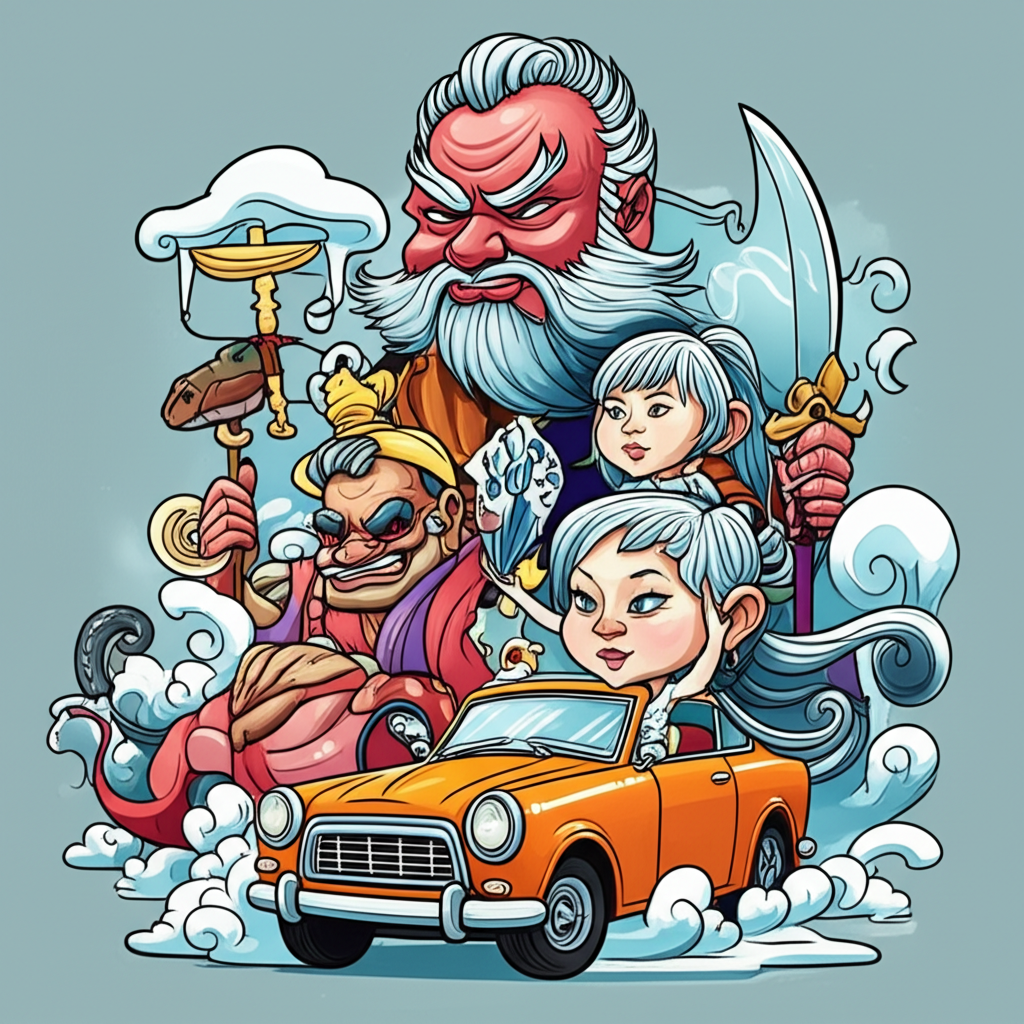
Central to our narrative are the Tengu, a class of supernatural beings unique to Japanese folklore. These figures are typically depicted with a blend of human and avian characteristics, embodying both the wisdom of a sage and the wildness of nature. There are primarily two types: the Karasu Tengu, possessing the head and beak of a crow, often with black wings and a fierce, warrior-like demeanor; and the Daitengu (Great Tengu), who are more human-like but distinguished by their long, often red faces and prominent noses, frequently wielding a fan of feathers that can conjure storms or strong winds. All Tengu are typically adorned in the robes of Yamabushi, the mountain ascetics, hinting at their connection to spiritual discipline and martial arts.
Symbolically, the Tengu represent a complex duality. They are often portrayed as mischievous tricksters, leading travelers astray, kidnapping children, or inciting fires. Yet, they are also respected as powerful guardians of the mountains and forests, possessing immense knowledge, martial prowess, and even spiritual wisdom. They are master swordsmen, skilled in magic, and are sometimes believed to punish the arrogant and the impious, while occasionally rewarding the humble and the pure of heart. They are not merely creatures of fear but also symbols of untamed nature, spiritual austerity, and the subtle, often contradictory forces that govern the world beyond human understanding. Their presence in a story like ours serves to highlight the boundaries between worlds and the respect due to forces greater than humanity.
A Journey to the High Plain: Kenji’s Encounter
Our story begins with Kenji, a young woodcutter from a small village nestled in the foothills of Mount Kurama. Kenji was a diligent and honest man, but he harbored a restless spirit and a deep reverence for the untamed wilderness. One autumn, driven by an inexplicable longing to explore the highest, most secluded reaches of the mountain, he ventured deeper than any villager dared. He sought not treasure or glory, but a profound connection to the sacred silence of the peaks, hoping to find a clarity of mind that eluded him in the bustling village.
Days turned into a week as Kenji navigated treacherous paths, his small pack growing lighter with each passing sunset. He ate berries and nuts, drank from crystal streams, and slept under the vast, star-dusted sky. One afternoon, after a particularly arduous climb through a dense, mist-shrouded cedar forest, he found himself in a clearing unlike any he had ever seen. The air here was strangely still, thick with the scent of ancient moss and an ethereal sweetness. Towering, impossibly old trees, their branches laden with glowing, unseen fruits, formed a natural archway. Beyond them, a path of pearlescent stones wound its way upwards, shimmering faintly as if lit by an inner light.
Awestruck, Kenji felt an irresistible pull. He knew, deep in his heart, that he had strayed far beyond the mortal realm. This was Takama-ga-hara, the High Plain of Heaven, a place mortals were never meant to tread. Yet, fear mingled with a profound sense of wonder, and he found his feet moving forward, drawn by an invisible current. The path led him to a vast, open plateau, bathed in a perpetual twilight where the sun never fully set nor rose. Magnificent, ornate temples and pagodas, built of materials unknown to man, floated on ethereal clouds, connected by bridges of shimmering light.
It was there, in a secluded training ground bordered by ancient pines, that Kenji first saw them. Figures moved with incredible grace and speed, their forms a blur of crimson and black. They were Tengu. Several Karasu Tengu, with their sharp, intelligent crow heads and powerful feathered wings, engaged in a silent, deadly dance with long, curved swords. Their movements were fluid, precise, and breathtakingly swift. Nearby, a group of Daitengu, their faces a striking crimson beneath their tall, black caps, sat in deep meditation, their long noses adding to their imposing presence. One, a venerable elder with an exceptionally long nose and eyes that seemed to hold the wisdom of ages, sat cross-legged, his feathered fan resting gently in his lap.
Kenji, hidden behind a cluster of luminescent ferns, watched in silent awe. He saw them practice martial arts with effortless mastery, their strength and agility defying earthly limits. He observed them discussing ancient texts, their voices a low, resonant murmur that seemed to carry the weight of centuries. He felt no malice from them, only an intense, focused energy, a sense of belonging to a world far grander and more potent than his own.
Suddenly, a shift in the air, a prickle on his skin. The elder Daitengu, who had seemed lost in meditation, slowly turned his head. His eyes, sharp as a hawk’s, fixed directly upon Kenji’s hiding place. There was no anger, no immediate threat, but an undeniable presence that pierced through Kenji’s very soul. The Tengu raised a hand, beckoning with a single, elegant finger.
Trembling, Kenji emerged, bowing deeply, his heart pounding a frantic rhythm against his ribs. He expected wrath, punishment for his intrusion. Instead, the elder Tengu spoke, his voice like the rustling of autumn leaves, ancient and resonant. "Mortal, you have strayed far. The paths to the High Plain are not for those of flesh and bone." He paused, his gaze assessing. "Yet, you carry no ill intent, only curiosity and a pure spirit."
The Tengu then rose, gliding towards Kenji with a grace that belied his size. He placed a gnarled hand on Kenji’s forehead. A surge of energy, cold and electric, coursed through Kenji’s body. Images flashed in his mind: the vastness of the cosmos, the intricate balance of nature, the fleeting nature of human life. It was not a lesson taught in words, but a direct infusion of understanding.
"Go," the Tengu commanded, his voice now gentle but firm. "Remember what you have seen, but speak not of its location. Let this encounter guide your path, not define it." With a gentle push, Kenji felt himself enveloped in a soft, swirling mist. When it cleared, he was back on a familiar mountain trail, the sun setting in the distance, the otherworldly clearing gone as if it had never been. The memory was vivid, yet hazy, like a dream that had left an indelible mark on his soul.
Symbolism and Meaning
To the ancient Japanese, Kenji’s encounter would have carried profound symbolism. The Tengu, as guardians of the mountains and often associated with Yamabushi, represented the wild, untamed power of nature and the arduous path of spiritual asceticism. Kenji’s accidental journey to Takama-ga-hara would have symbolized humanity’s innate curiosity about the divine and the sacred, as well as the inherent dangers and awe associated with crossing such boundaries.
The Tengu’s non-aggressive but authoritative response would have conveyed several messages: respect for sacred spaces, the importance of humility in the face of immense power, and the idea that wisdom can be imparted through experience rather than explicit instruction. The mental infusion of knowledge suggested a profound spiritual awakening, perhaps a lesson about the interconnectedness of all things or the disciplined pursuit of a higher understanding. Ultimately, the story would have served as a reminder that the world was full of unseen forces, demanding respect and caution, and that true wisdom often lay in understanding one’s place within the grand cosmic order.
Modern Perspective
Today, the Tengu and the mythology surrounding Takama-ga-hara continue to captivate audiences worldwide. Far from being figures of belief, they have transcended their folkloric origins to become enduring cultural icons. The Tengu are ubiquitous in modern Japanese media, appearing frequently in anime, manga, and video games, often as powerful warriors, wise mentors, or mischievous antagonists. Franchises like Nioh, Sekiro, Kamisama Kiss, and numerous others have brought these feathered and long-nosed beings to a global audience, reinterpreting their traditional attributes within new narrative contexts.
In literature and cultural studies, the Tengu are examined as complex representations of environmental awareness, social commentary (their association with punishing pride), and the enduring human fascination with hybrid creatures that bridge the gap between animal and human, physical and spiritual. They serve as a vibrant link to Japan’s ancient past, reminding us of the power of storytelling to preserve cultural identity and spark the imagination across centuries.
Conclusion
The "Encounter with the Tengu of Takama-ga-hara" is a testament to the enduring power of human imagination and the rich tapestry of global mythology. It is a traditional story, a cultural artifact, and a narrative that offers valuable insights into the worldview of ancient Japan. It is important to reiterate that these myths, while culturally significant, are not to be taken as literal truths or objects of worship. As Muslims, we recognize that only Allah (God) is the true Creator and Sustainer of the universe, and all power and divinity belong solely to Him.
This narrative, like countless others from various cultures, stands as a monument to our shared human heritage—a reflection of our ancestors’ attempts to understand the mysteries of existence, to impart moral lessons, and to express the profound beauty and terror of the world around them. Through such stories, we connect with the past, appreciate the diversity of human thought, and celebrate the timeless art of storytelling that continues to enrich our lives.