fufufafa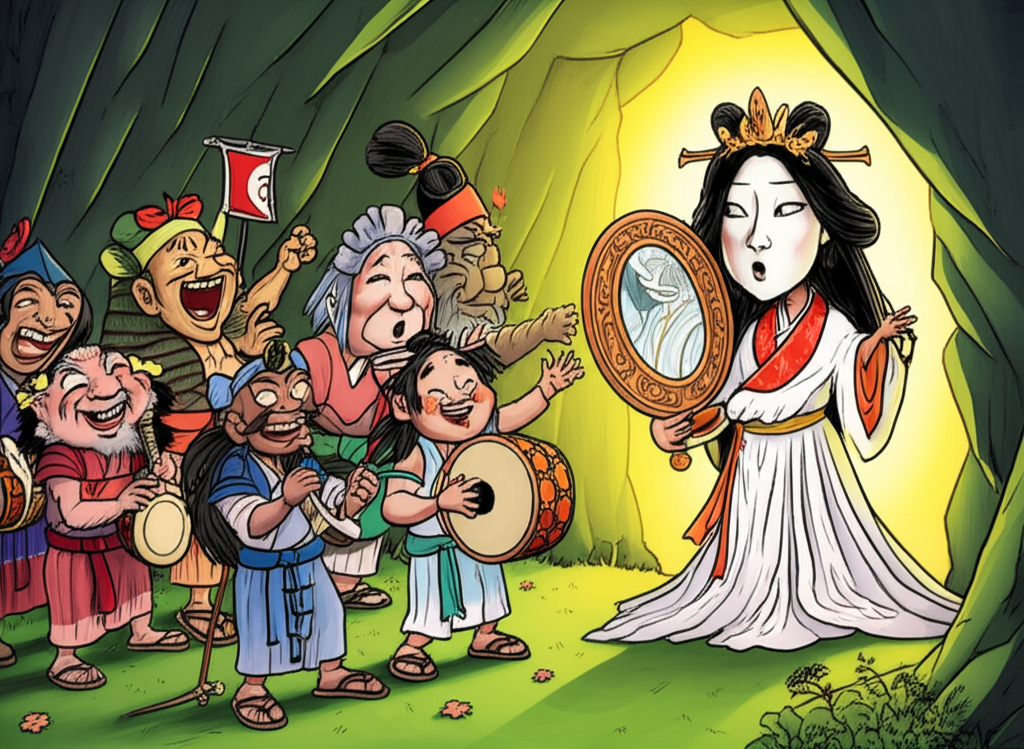
An Important Note for the Reader: The following article explores a foundational myth from Japanese folklore. This story is a product of ancient human imagination, created to explain the natural world and establish cultural values. It is presented here for educational and cultural understanding only and is not intended to be regarded as a factual or religious account.
Introduction
From the mist-shrouded mountains and verdant plains of ancient Japan comes a collection of stories known as the Kojiki ("Record of Ancient Matters") and the Nihon Shoki ("Chronicles of Japan"). These texts, compiled in the 8th century, preserve the oral traditions of a people deeply connected to the land. Among these tales, none is more central to the Shinto worldview than the story of the Amano-Iwato, or the Heavenly Rock Cave. It is a profound narrative about light lost and regained, a story that resonates with the symbolic grandeur of Japan’s most sacred peak, Mount Fuji. This is not a history of real events, but a traditional story told by ancient people to make sense of the cosmos, the changing seasons, and the very essence of their community.
Origins and Cultural Background
To understand this myth, we must travel back in time to a pre-modern Japan, an era when life was governed by the rhythms of nature. The society was agrarian, with rice cultivation forming the bedrock of its existence. For these early agricultural communities, the sun was not merely a celestial body; it was the source of all life, warmth, and prosperity. Its daily rising was a promise, and its seasonal cycles dictated the patterns of planting and harvest.
The worldview of this time was animistic, a belief system that would evolve into what is now known as Shinto, "the way of the kami." Kami were not gods in the monolithic sense, but spirits, essences, or divine forces that inhabited all things—from the wind and the rain to mountains, rivers, trees, and even certain people. The world was alive with these presences, and humanity’s role was to live in harmony with them. Myths like the one of Amaterasu’s cave were not just entertainment; they were a living framework for understanding natural phenomena like a solar eclipse or the deep cold of winter, as well as complex social dynamics like order, chaos, and reconciliation.
The Figures of the Celestial Plain
The story revolves around a cast of powerful beings, or kami, who represent fundamental forces of the natural world. Their actions are not those of perfect deities, but are instead filled with very human-like emotions: jealousy, joy, anger, and grief.
Amaterasu Omikami: The central figure of the story, her name translates to "the great august kami who shines from heaven." She is the celestial being of the sun and the universe. In this cultural narrative, she represents order, purity, life, and the meticulous art of weaving, which itself symbolized the creation of an orderly cosmos. As the provider of light, she was intrinsically linked to the success of the rice harvest and the well-being of the people.
Susanoo-no-Mikoto: Amaterasu’s younger brother, Susanoo is a complex and volatile figure. He is the kami of the sea and storms. Where Amaterasu represents celestial order, Susanoo embodies the untamable, chaotic, and destructive forces of nature. He is prone to fits of rage and jealousy, yet he is not purely evil; his actions, while disruptive, often lead to necessary change and renewal.
Ame-no-Uzume-no-Mikoto: The kami of the dawn, mirth, and revelry. She represents the irrepressible power of joy, laughter, and artistic performance. Her role in the story is crucial, showcasing the ancient belief that celebration and community could overcome even the deepest darkness.
The Main Story: The Sun’s Retreat into Shadow
The narrative unfolds in the High Celestial Plain, Takamagahara, a luminous realm where the kami resided. The story begins with Susanoo, who, after a dispute, was banished from the heavens. Before departing, he went to bid his sister, Amaterasu, farewell. His intentions, however, were not pure. In a series of disruptive acts, Susanoo rampaged through the celestial realm. He destroyed the carefully laid divisions of his sister’s sacred rice fields, filled in her irrigation ditches, and defiled her palace. Amaterasu, ever patient, initially excused his behavior as misguided grief.
But Susanoo’s transgressions escalated. While Amaterasu and her attendants were in their sacred hall, weaving the garments of the kami—an act of maintaining cosmic order—Susanoo committed an unforgivable act. He tore a hole in the roof and dropped a defiled heavenly horse into the loom, causing chaos and the tragic death of one of Amaterasu’s attendants.
Overwhelmed by grief, fear, and shame at the violation of her sacred space, Amaterasu made a fateful decision. She fled and hid herself inside the Amano-Iwato, the Heavenly Rock Cave, pulling a massive boulder across the entrance.
Instantly, the universe was plunged into an eternal night. The High Celestial Plain and the earthly world below were blanketed in a cold, suffocating darkness. Without the sun’s light and warmth, crops withered, and the distinction between day and night vanished. Malevolent spirits, once held at bay by the light, emerged from the shadows to wreak havoc. The world descended into chaos, and the laments of the "eight million" kami filled the silent, dark air.
Desperate, the celestial beings gathered on the banks of the heavenly river to devise a plan. They understood that force would not move the sun. Instead, they decided to appeal to her curiosity and her sense of community. They gathered sacred objects: roosters whose crowing heralded the dawn, a great sakaki tree decorated with a string of magatama beads (the Yasakani no Magatama), and a beautifully polished bronze mirror (the Yata no Kagami).
Their plan culminated in a performance. Ame-no-Uzume, the kami of mirth, stepped onto an overturned tub and began to dance. Her feet stomped a rhythmic, thunderous beat. Her dance became wilder and more comical, and soon the assembled kami erupted into thunderous, unrestrained laughter. Their collective joy echoed through the darkness, a sound of life and celebration in a world that had forgotten both.
Inside the cave, Amaterasu heard the commotion. She was bewildered. “How can they be celebrating when the world is cloaked in darkness because of my absence?” she wondered. Pushing the boulder aside just enough to peek out, she asked, “Why do you laugh?”
Ame-no-Uzume replied, “We rejoice because we have found a being more radiant and beautiful than you!”
As she spoke, another kami held up the gleaming Yata no Kagami mirror. Amaterasu leaned out further to see this new, brilliant being and saw her own reflection, a dazzling image of light she had not seen in an age. Captivated by her own radiance, she emerged from the cave. In that moment, the powerful kami Ame-no-Tajikarao grabbed her hand and pulled her out completely, while another quickly sealed the cave entrance with a sacred rope, ensuring she could never hide away again.
Light, warmth, and order flooded back into the universe. The crops revived, the evil spirits retreated, and life was restored.
Symbolism and Meaning
For the ancient people who told this story, it was rich with symbolic meaning. On one level, it is a powerful mythological explanation for a solar eclipse or, more commonly, the winter solstice. The sun’s “death” in the shortest days of winter and its triumphant “rebirth” as the days grow longer is mirrored in Amaterasu’s retreat and return. The celebration outside the cave is reminiscent of the festivals and rituals held to encourage the sun’s return.
The story also explores the fundamental tension between order (Amaterasu) and chaos (Susanoo). It suggests that while chaos can be destructive, it is an inescapable part of the world. More importantly, the myth champions the power of community and ingenuity over brute force. The kami do not try to break down the rock door; instead, they use ritual, art, and collective joy—the stomping dance of Ame-no-Uzume and the laughter of the gods—to lure the light back. It is a profound statement on the ability of community spirit to overcome despair.
Modern Perspective
Today, the story of Amaterasu’s cave remains a cornerstone of Japanese culture. It is no longer interpreted as a literal explanation for natural events but is studied as a foundational piece of literature and cultural identity. The three sacred items used to lure her from the cave—the mirror, the jewel, and a sword later found by Susanoo—became the Imperial Regalia of Japan, symbolizing the legitimacy of the Emperor, who is traditionally said to be a direct descendant of Amaterasu.
The myth’s influence is pervasive in modern media. In the popular anime and manga series Naruto, some of the most powerful techniques are named Amaterasu, Susanoo, and Tsukuyomi. The critically acclaimed video game Ōkami features the player as a white wolf incarnation of Amaterasu, tasked with restoring color and life to a cursed world. These adaptations introduce the ancient story to new generations, reinterpreting its themes of light versus darkness, order versus chaos, and the restoration of balance.
Conclusion
The tale of Amaterasu’s cave is a timeless piece of cultural heritage, a testament to the human imagination’s power to weave meaning from the world around it. It is a story that belongs to the rich tapestry of global folklore, offering insight into the values and worldview of ancient Japan. While we appreciate these narratives for their cultural and historical significance, as Muslims, we recognize that only Allah is the true Creator and Sustainer, the sole source of all light and life in the universe. Stories like this remain valuable, not as articles of faith, but as reflections of a shared human tradition: the art of storytelling, which allows us to explore our deepest fears, our greatest hopes, and the enduring belief that even after the longest night, the dawn will always return.