fufufafa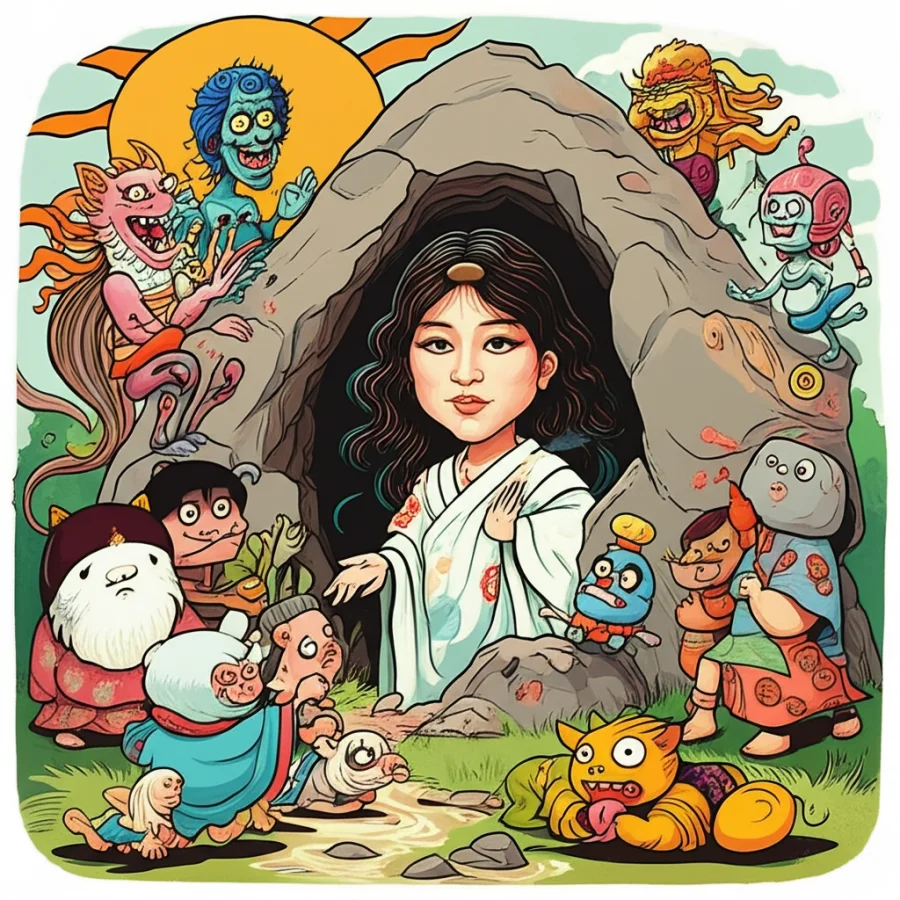
From the mists of ancient Japan comes a story, whispered through generations, of a sun goddess, sibling rivalry, and a nation plunged into darkness. This is the tale of Amaterasu Omikami and her retreat into a celestial cave, a cornerstone of Japanese mythology and a foundational narrative in the Shinto religion. It is a story, not a history, passed down to explain the world through the lens of ancient beliefs and human experiences. We explore it now not as an article of faith, but as a window into the cultural landscape of ancient Japan.
Origins and Cultural Background:
The story of Amaterasu’s cave is deeply rooted in the Yayoi and early Kofun periods of Japanese history (roughly 300 BCE to 600 CE). This was a time of significant social and political change, marked by the introduction of rice cultivation, the development of stratified societies, and the emergence of powerful clans vying for control. The natural world, with its unpredictable forces and vital resources, held immense significance. People lived intimately with the land, dependent on its bounty and vulnerable to its wrath. Animism, the belief that spirits inhabit all things, was prevalent, and rituals were performed to appease these spirits and ensure prosperity. This worldview shaped the development of Shinto, the indigenous religion of Japan, which emphasizes the veneration of kami, or spirits, that reside in natural features, ancestors, and abstract concepts. In this era, myths were not merely entertainment; they were explanations of the universe, justifications for social order, and guides for navigating the complexities of life.
Character Description: Amaterasu Omikami
Amaterasu Omikami, the Great Shining Heaven Goddess, occupies a central position in Shinto mythology. She is the sun goddess, ruler of the High Celestial Plain (Takamagahara), and considered the ancestor of the Japanese Imperial family. She is often depicted as a radiant and benevolent figure, representing light, warmth, order, and prosperity. While artistic depictions vary, she is commonly shown wearing elaborate robes and jewelry, holding a mirror that reflects her own divine light.
Symbolically, Amaterasu embodies the life-giving power of the sun. Her presence ensures the growth of crops, the well-being of the people, and the continuation of the world. Her absence, therefore, signifies darkness, chaos, and despair. The mirror she often holds is not merely an accessory; it represents truth, self-reflection, and the ability to see through illusion. It reflects not only her own divinity but also the potential for divinity within all beings.
Main Story / Narrative Retelling:
In the High Celestial Plain, home to the kami, lived Amaterasu and her impetuous younger brother, Susanoo-no-Mikoto, the storm god. While Amaterasu brought light and order, Susanoo was known for his wild and destructive nature. He raged through the heavens, destroying rice paddies, defiling sacred spaces, and generally causing mayhem.
Amaterasu, patient for a time, eventually reached her breaking point. Susanoo’s final act of defiance was particularly egregious: he flung a flayed horse into her weaving hall, terrifying her attendants and causing one to die of shock. Grief-stricken and deeply offended by her brother’s repeated transgressions, Amaterasu retreated into Ama-no-Iwato, the Rock Cave of Heaven.
As the great goddess vanished, darkness enveloped the world. The sun disappeared, plunging the land into perpetual night. Crops withered, people starved, and evil spirits roamed freely, taking advantage of the absence of light and order. The other kami, terrified by the consequences of Amaterasu’s withdrawal, gathered outside the cave, desperately trying to coax her out.
They tried everything. Prayers were offered, pleas were made, but Amaterasu remained unmoved. Finally, the kami devised a cunning plan. They built a bonfire outside the cave and, led by the goddess Ame-no-Uzume, began to perform a raucous and suggestive dance. Her performance was so hilarious and outrageous that the other kami erupted in laughter.
Curiosity piqued, Amaterasu cautiously peeked out of the cave. "Why such merriment," she wondered, "when the world is shrouded in darkness?"
Ame-no-Uzume replied, "We rejoice because we have found a goddess even more radiant than you, Amaterasu-sama!"
As Amaterasu stepped further out of the cave to investigate, she saw a magnificent mirror strategically placed before her. In it, she saw her own radiant reflection, believing it to be this "new" goddess. Captivated by the beauty before her, she stepped completely out of the cave.
At that moment, the strong god Ame-no-Tajikarao seized the opportunity and blocked the entrance to the cave, preventing Amaterasu from retreating back into the darkness. Light flooded the world once more, restoring order and banishing the evil spirits. Susanoo was punished for his misdeeds and banished from the High Celestial Plain.
Symbolism and Meaning:
The myth of Amaterasu’s cave is rich in symbolism. The story can be interpreted on multiple levels. It represents the cyclical nature of day and night, the ebb and flow of light and darkness. The conflict between Amaterasu and Susanoo can be seen as a metaphor for the struggle between order and chaos, good and evil. Amaterasu’s withdrawal symbolizes the importance of the sun for life and prosperity, while her return signifies the triumph of light over darkness.
Furthermore, the story highlights the importance of community and cooperation. The kami were unable to solve the problem individually but succeeded when they worked together, using their collective intelligence and creativity. Ame-no-Uzume’s dance symbolizes the power of laughter and entertainment to uplift spirits and break down barriers.
For the people of ancient Japan, the myth likely served as a reminder of the importance of maintaining harmony and social order. It reinforced the idea that even the most powerful beings are vulnerable to negative influences and that cooperation and cleverness are essential for overcoming adversity. The story also legitimized the role of the emperor as a descendant of Amaterasu, thus reinforcing the imperial family’s authority.
Modern Perspective:
The myth of Amaterasu’s cave continues to resonate in modern Japanese culture and beyond. It appears in various forms of media, including literature, manga, anime, and video games. In some instances, Amaterasu is depicted as a powerful and benevolent goddess, while in others, she is portrayed as a more complex and flawed character. The story’s themes of light and darkness, order and chaos, and the importance of community continue to be explored and reinterpreted in contemporary works.
For example, the character of Amaterasu often appears in video games like Okami, where the player controls her in the form of a white wolf to restore balance and beauty to a world corrupted by darkness. In anime and manga, the story is often adapted and modernized, exploring themes of sibling rivalry, forgiveness, and the power of self-reflection. The myth also inspires artistic interpretations in painting, sculpture, and performance art.
In cultural studies, the myth is analyzed as a reflection of Japanese cultural values and beliefs. It provides insights into the ancient Japanese worldview, their relationship with nature, and their understanding of the divine.
Conclusion:
The story of Amaterasu’s cave is a testament to the power of mythology to explain the world, convey cultural values, and inspire creativity. It is a story that has been passed down through generations, evolving and adapting to reflect the changing times. We understand that this is a narrative created by people of the past, not a reflection of divine truth.
As Muslims, we believe that only Allah is the true Creator and Sustainer of the universe. This story, like other myths and legends, serves as a reminder of the rich tapestry of human imagination and the enduring power of storytelling traditions. It allows us to appreciate the cultural heritage of ancient Japan and to understand how people of the past sought to make sense of their world. The story of Amaterasu is a window into a different worldview, a reminder that while our beliefs may differ, the human capacity for imagination and storytelling is a shared and universal trait.