fufufafa
In the misty, windswept landscapes of ancient Ireland, where the veil between the mundane and the mystical was said to be thinnest, tales were woven like intricate Celtic knots. Among these, the legend of Morrigan and the Eternal Sea stands as a potent echo of a time when the natural world was imbued with spirit and the forces of fate were personified in compelling narratives. This is not a chronicle of divine power, but rather a traditional story, a product of the rich oral tradition of the ancient Irish people, passed down through generations to explain the unexplainable and to reflect their deep connection to their land and its potent, often untamed, elements.
The cultural era in which these stories likely took root was one characterized by a profound reverence for nature and a worldview deeply intertwined with the cycles of life, death, and rebirth. The ancient Irish, living amidst rugged coastlines, dense forests, and rolling hills, often viewed the world as alive with unseen forces. The sea, a constant, powerful presence, was both a source of sustenance and a terrifying abyss, capable of both generous bounty and utter destruction. The changing seasons, the raw power of storms, and the mystery of the deep ocean likely fueled their imaginations, leading them to personify these vast forces and to create beings that embodied their perceived qualities. Their understanding of the world was not governed by scientific inquiry as we know it, but by observation, intuition, and a deeply spiritual interpretation of the phenomena around them.
At the heart of this legend resides Morrigan, a figure often depicted not as a single goddess, but as a complex triad of war goddesses, or a singular entity embodying sovereignty, fate, and battle. In the context of the Eternal Sea, she is often portrayed as a formidable, enigmatic presence, her form fluid and shifting like the tides. She might appear as a raven, her wings beating a somber rhythm against the grey sky, or as a woman of ethereal beauty, her eyes holding the fathomless depth of the ocean. Her symbolic attributes are manifold: the raven, a bird of prophecy and omen, representing her connection to destiny and the unseen; the color black, signifying mystery, death, and the unknown depths; and the sea itself, a symbol of immense power, changeability, and the primal source of life and oblivion. She is not a benevolent mother figure, but a force of nature, representing the raw, untamed aspects of existence that humans could neither control nor fully comprehend.
The narrative of Morrigan and the Eternal Sea often unfolds with a sense of inevitable fate. It is said that the Eternal Sea was not merely water, but a vast, sentient entity, a primordial force that predates mortal understanding. Morrigan, in her capacity as a weaver of destinies, was intrinsically linked to this sea. The legend tells of a time when mortals, perhaps driven by ambition or desperation, sought to conquer or exploit the secrets of the Eternal Sea. They built great ships, armed themselves with courage and hubris, and sailed towards the horizon, seeking riches or dominion over its boundless waters.
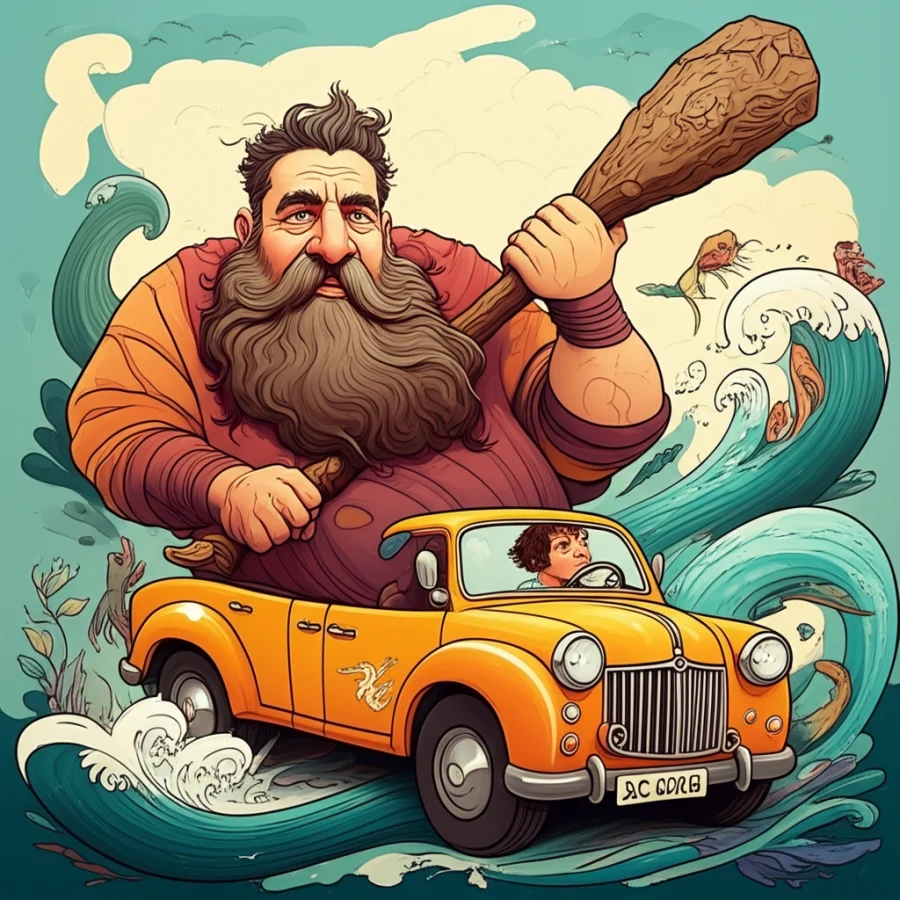
But the Eternal Sea, in its ancient wisdom, would not yield its mysteries easily. As these ambitious mortals ventured further, the sea would respond. Storms would rise with an unnatural fury, waves would swell like mountains, and the very currents would conspire against them. It is said that Morrigan would often be seen or heard in these tempests. Perhaps her laughter, like the crashing of waves, would echo across the water, or her form, a silhouette against the lightning-streaked sky, would inspire dread. She was the guardian of the sea’s boundaries, ensuring that its power remained in balance, and that mortal folly would not disrupt the ancient order.
Some tales suggest that those who dared to disrespect the sea or its power would be claimed by it, their ships splintered and their souls absorbed into the vast, eternal expanse. Others speak of Morrigan appearing to lost sailors, offering cryptic guidance or leading them back to shore, a testament to her dual nature – both a harbinger of doom and a guide through peril. The narrative is less about a direct confrontation and more about the inexorable power of nature and fate, with Morrigan as its embodiment and enforcer. The sea, in this story, is not a passive body of water but an active participant, a cosmic entity governed by ancient laws that even Morrigan, in her formidable role, respected.
The symbolism embedded within the legend of Morrigan and the Eternal Sea is rich and multifaceted. The Eternal Sea itself can be interpreted as representing the vast, unknowable depths of the subconscious, the primal forces of creation and destruction, or the ultimate mystery of death and the afterlife. Morrigan, as its custodian, embodies the concept of fate and destiny, the idea that certain outcomes are preordained and that human actions, while seemingly significant, are ultimately woven into a larger tapestry of existence. Her presence in the storms signifies the destructive potential of nature, a reminder of humanity’s vulnerability in the face of elemental forces. Conversely, her guidance to lost souls suggests the possibility of finding one’s way through adversity, albeit through a perilous journey. The legend might also reflect the ancient Irish people’s understanding of leadership and sovereignty, where rulers were expected to understand and respect the natural world, lest they incur its wrath.
In the modern world, the legend of Morrigan, and indeed many figures from Celtic mythology, has found new life in various forms of popular culture. She is a recurring character in fantasy literature, often depicted as a powerful, morally ambiguous figure associated with war, magic, and prophecy. Her image has been adapted for video games, where she might be a playable character with unique abilities or a formidable antagonist. In film and television, she can be reimagined as a witch, a sorceress, or a powerful entity influencing human affairs. These modern interpretations, while drawing inspiration from ancient lore, often diverge significantly from the original narratives, reflecting contemporary sensibilities and narrative needs. Cultural studies scholars also explore these myths as valuable windows into the beliefs, anxieties, and social structures of ancient societies.
In conclusion, the legend of Morrigan and the Eternal Sea is a testament to the enduring power of storytelling and the human desire to make sense of the world. It is a cultural narrative, a product of the imagination of ancient peoples who lived in close communion with the powerful forces of nature. As Muslims, we recognize that only Allah is the true Creator and Sustainer of all that exists, the ultimate source of power and wisdom. These ancient stories, while captivating in their own right, are not to be mistaken for divine truth. Instead, they offer us a glimpse into the rich tapestry of human cultural heritage, a reminder of the diverse ways in which people have sought to understand their place in the cosmos, and a celebration of the enduring tradition of storytelling that continues to shape our understanding of ourselves and the world around us.