fufufafa
In the mist-shrouded lands of ancient Ireland, where rolling hills met the wild expanse of the Atlantic, a rich tapestry of myths and legends was woven into the fabric of daily life. These were not mere tales for entertainment, but profound expressions of how people understood the world around them, its mysteries, and their place within it. Among these enduring narratives, the legend of Morrigan and the Eternal Mountain stands as a potent example of ancient Irish folklore, a story passed down through generations, echoing with the echoes of a time when the natural world was imbued with potent, often unseen, forces.
The cultural era in which such stories flourished was one deeply intertwined with the land. The ancient Irish, a people who lived in close proximity to the rhythms of nature, often viewed the world as a place alive with spirits and potent energies. Their understanding was shaped by the harsh beauty of their environment: the ever-present sea, the rugged mountains, the deep, ancient forests, and the dramatic shifts in weather. They saw cycles of birth, death, and rebirth in the turning of the seasons, the ebb and flow of tides, and the very growth and decay of the earth. In this context, natural phenomena were not simply occurrences but manifestations of powerful entities, reflecting their hopes, fears, and their awe for the untamed. Myths like the legend of Morrigan served as a framework for understanding these forces, offering explanations for the inexplicable and providing moral compasses for their society.
At the heart of this particular legend lies Morrigan, a figure who, in the broader Irish mythological landscape, is often associated with fate, war, and sovereignty. She is not a single, static entity, but rather a complex and multifaceted being, sometimes depicted as a triple goddess embodying maiden, mother, and crone aspects, or as a raven, a bird often seen as an omen. In this legend, Morrigan is presented not as a benevolent deity, but as a formidable presence, a guardian or embodiment of the primal forces that shaped the land. Her symbolic attributes are potent: the raven, her avian form, signifies transition, foresight, and the connection between the living and the spirit world. Her association with war suggests the inherent struggles and cycles of conflict that are a part of life, while her connection to sovereignty speaks to the deep respect for the land and its inherent power. She represents the wild, untamed aspects of existence, a force that demands respect and understanding, rather than simple adoration.
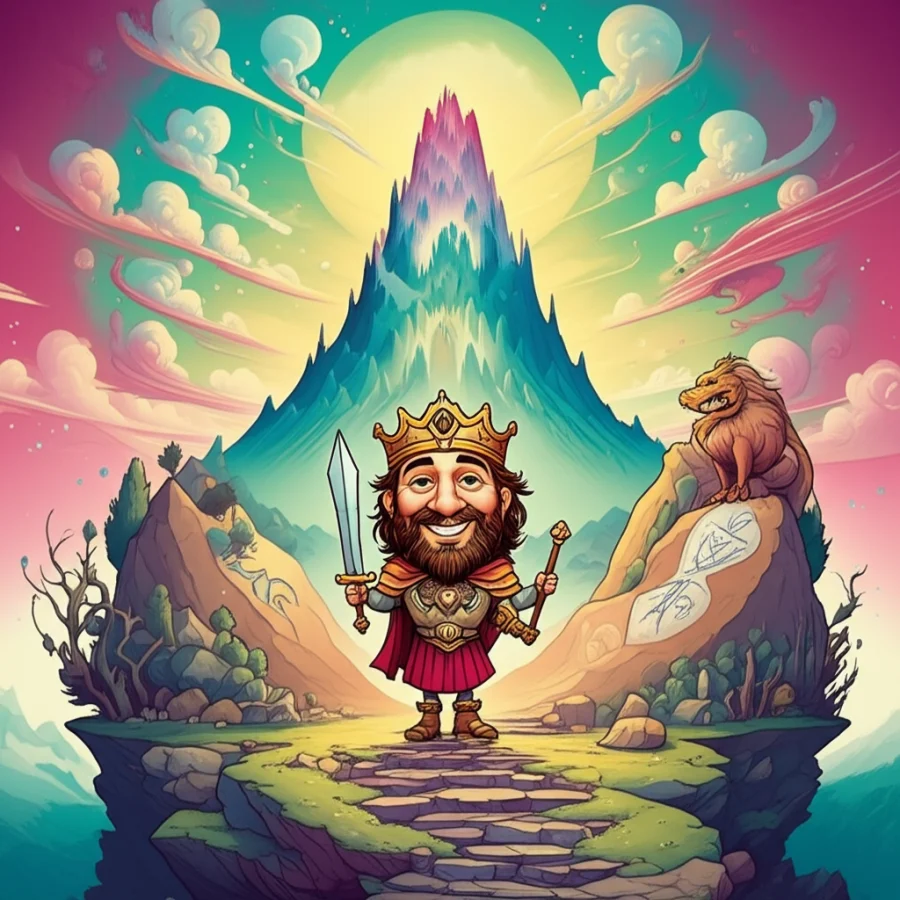
The narrative of Morrigan and the Eternal Mountain unfolds not in a place of comfort or ease, but in the stark, breathtaking grandeur of a colossal peak that pierced the heavens. This mountain, known by many names lost to time, was not merely a geological formation; it was considered the heart of the land, a place where the earth’s energies converged. It was said that at its summit, perpetually wreathed in clouds and buffeted by winds, resided the Eternal Mountain itself, a sentient entity embodying the enduring spirit of the land.
Morrigan, in her myriad forms, was its protector. Tales spoke of her appearing to mortals who dared to seek the mountain’s secrets or its power. She might appear as a cloaked woman with eyes like the deepest pools, her voice a rustling of leaves, or as a fierce raven, its shadow a harbinger of change. The legend recounts the story of a young chieftain, driven by ambition and a desire to bring prosperity to his people, who set out to climb the Eternal Mountain. He believed that if he could reach its summit, he could petition the mountain’s spirit for boundless riches and unending peace.
His ascent was fraught with peril. The mountain’s slopes were treacherous, its paths shifting like dreams. He faced biting winds that seemed to whisper taunts and blinding snow that obscured his vision. At every turn, Morrigan would appear, not to guide him, but to test him. She would appear as a beguiling spirit, offering shortcuts that led to dead ends, or as a spectral warrior, challenging his resolve. Her presence was a constant reminder of the mountain’s power and the futility of human arrogance.
One chilling encounter saw her appear as a gaunt, ancient woman, her face etched with the harshness of ages. She spoke of the mountain’s true purpose: not to bestow gifts, but to endure, to witness, and to remain. She explained that the mountain’s strength lay not in what it could give, but in its unwavering existence. The chieftain, humbled by her words and the sheer immensity of the forces he had encountered, began to understand. He realized that true prosperity was not to be found in a magical boon, but in the resilience and enduring spirit that the mountain, and Morrigan, embodied. He turned back, not with the riches he sought, but with a profound understanding of the land’s power and the respect it demanded. He learned that his role was not to conquer nature, but to live in harmony with it, to be a steward of its gifts, and to draw strength from its enduring presence.
The symbolism within this legend is rich and multifaceted. The Eternal Mountain itself can be interpreted as representing the enduring power and resilience of nature, a constant in a changing world. It could also symbolize the spiritual or primal core of existence, a source of power that is not to be exploited but respected. Morrigan, as its guardian, embodies the wild, untamed aspects of the world, the forces of change, fate, and the cyclical nature of life and death. Her tests of the chieftain represent the trials and tribulations that life throws at individuals, and the importance of wisdom, humility, and respect for forces greater than oneself. The legend might have served as a cautionary tale against unchecked ambition and the human tendency to seek dominion over nature, instead advocating for a more harmonious and respectful relationship with the environment.
In the modern world, these ancient tales continue to resonate, finding new life in various forms of media. Morrigan, with her dark allure and potent symbolism, has become a popular figure in fantasy literature, video games, and even films. She is often depicted as a powerful sorceress, a harbinger of doom, or a complex character grappling with her own destiny. Scholars of folklore and mythology delve into these stories to understand the worldview of ancient cultures, the anxieties they faced, and the values they held dear. These interpretations often focus on the psychological and societal implications of the myths, exploring themes of power, identity, and the human relationship with the unknown.
It is crucial to reiterate that the legend of Morrigan and the Eternal Mountain is a product of ancient human imagination, a cultural narrative passed down through generations. As Muslims, we understand that only Allah is the true Creator and Sustainer of all that exists. Our faith teaches us that all power and existence originate from Him alone. This story, therefore, is appreciated for its cultural heritage, its artistic merit, and the insights it offers into the minds of those who first told it. It serves as a testament to the enduring power of storytelling, the human need to make sense of the world through narrative, and the rich tapestry of human cultural expression that continues to captivate and inform us today. The whispers of the peaks, carried on the winds of time, remind us of the stories that have shaped us, even as we acknowledge the singular truth of our faith.