fufufafa
The mist-shrouded shores and tempestuous seas of ancient Ireland and the Isle of Man whisper tales of a time when the world was alive with unseen forces and powerful beings. Among these traditional narratives, one figure stands prominently at the threshold between the mortal realm and the mystical Otherworld: Manannán mac Lir, son of the sea. This article delves into the legend of Manannán and a sacred mountain often associated with his dominion, presenting it purely as a cultural story shared by ancient peoples, intended for historical and educational understanding, not as a claim of truth or a subject of belief.
Origins and Cultural Background
The legend of Manannán mac Lir originates from the rich tapestry of Celtic mythology, particularly vibrant in the oral traditions of Ireland, Scotland, Wales, and the Isle of Man. These myths were first shaped and shared during the pre-Christian Iron Age by Celtic societies, a people deeply connected to their natural environment. Their worldview was animistic, perceiving spirits and divine presences in every aspect of nature – the towering trees, the flowing rivers, the mighty oceans, and the very land beneath their feet. The sea, in particular, was a formidable and revered entity, both a source of sustenance and a pathway to unknown dangers and distant lands.
For these ancient Celts, the world was not merely a physical space but a layered reality where the mundane intertwined with the magical. Gods and goddesses were not distant, abstract figures but potent forces that influenced daily life, harvest, weather, war, and destiny. The boundaries between this world and the Otherworld, often depicted as a land of eternal youth, beauty, and magic, were thin and permeable, often guarded or accessed by powerful deities like Manannán. Myths served not only as entertainment but also as explanations for natural phenomena, moral lessons, and chronicles of their cultural heroes and divine ancestors.
Character Description: Manannán mac Lir
Manannán mac Lir, whose name translates to "Manannán, son of the Sea," is one of the most enigmatic and revered figures in Celtic lore. He is a member of the Tuatha Dé Danann, the ancient race of gods and goddesses who, in myth, ruled Ireland before the coming of mortals. Manannán is primarily known as a powerful sea deity, embodying the ocean’s vastness, its unpredictable nature, and its profound mysteries.
Symbolically, Manannán is attributed with mastery over the sea and all its creatures, but his powers extend far beyond the waves. He is a master of illusion and enchantment, capable of conjuring impenetrable mists to hide his realm, his treasures, or even entire islands from mortal sight. His magical cloak can change colors and patterns, his boat "Scuabtuinne" (Wave-Sweeper) needs no sails or oars, and his horse, "Aonbharr," can travel over land and sea. He is also often depicted as a wise and generous patron, a protector of the Tuatha Dé Danann, and a guide to the Otherworld – a realm he governs, known by various names such as Tír na nÓg (Land of Youth) or Emain Ablach (Isle of Apple Trees). His attributes speak to the Celtic respect for the sea’s power, its transformative nature, and the allure of the unknown realms beyond the horizon. He is a guardian of boundaries, a weaver of magic, and a source of profound, ancient wisdom.
Main Story: The Mists of the Sacred Mountain
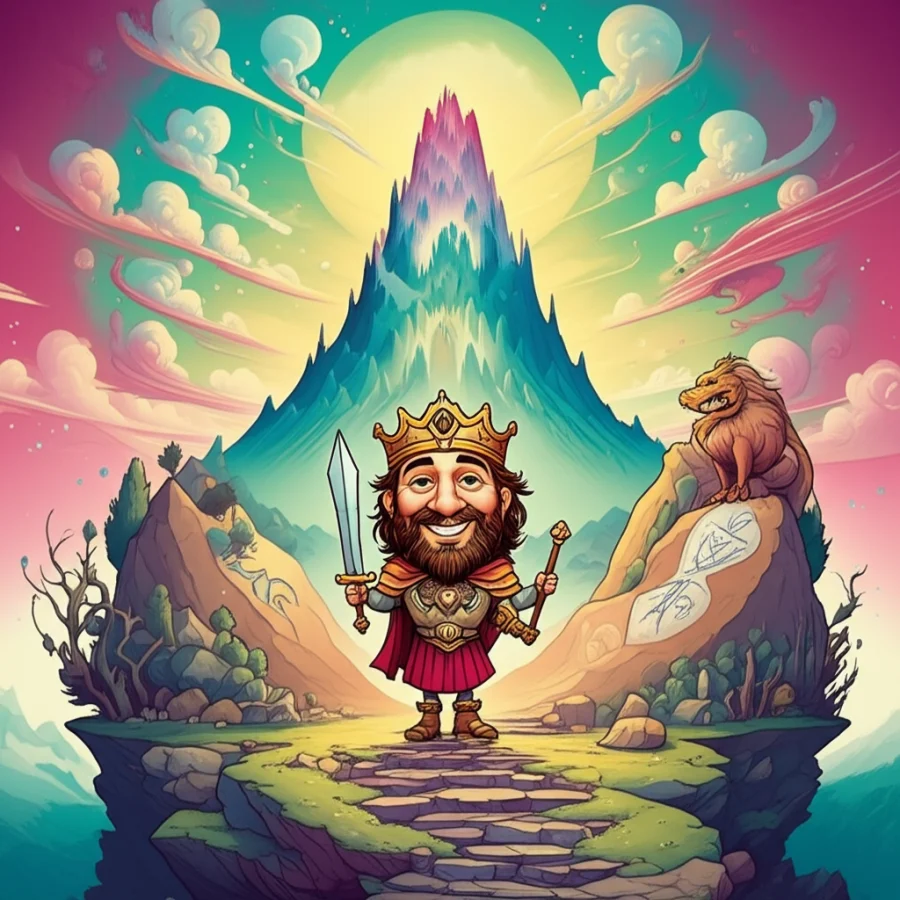
In the heart of the Celtic Sea, where the tumultuous currents met the ancient shores, there lay a solitary, towering peak, often lost to mortal sight. It was known simply as the Sacred Mountain, for its summit was perpetually wreathed in a veil of shifting mists, a signature of the great Manannán mac Lir. Mortals whispered that this mountain was not merely stone and earth, but a nexus point, a place where the veil between the mortal world and the shimmering Otherworld grew exceptionally thin.
Our tale unfolds during a time of great sorrow and longing among the people of the coast. A terrible blight had struck their lands, wilting crops and sickening livestock. Their seers and druids, after long rituals, spoke of a need for wisdom from beyond the mortal realm, a gift from the one who held dominion over the hidden paths and the deep mysteries: Manannán himself.
A young, courageous chieftain named Bran, known for his pure heart and unyielding spirit, volunteered for the perilous quest. He would seek the Sacred Mountain, brave its mists, and beseech Manannán for aid. Gathering his courage, Bran set sail in a small curragh, guided by the ancient charts of his ancestors and the faint, shimmering glow said to emanate from the mountain’s peak on moonless nights.
For days, Bran battled the sea, the waves rising like giants to challenge his resolve. Finally, through a parting of the storm clouds, he glimpsed it – the Sacred Mountain, its lower slopes rugged and forbidding, its summit swallowed by an ethereal, swirling shroud. As he drew closer, the very air grew heavy with an otherworldly energy, and the mists, rather than clinging passively, seemed to coil and writhe with a life of their own, parting and closing like living gates.
Bran landed his curragh on a small, hidden cove at the mountain’s base and began his ascent. The mists descended upon him, thick and disorienting. Every step felt like a journey into an unfamiliar dimension. Familiar sounds of the sea faded, replaced by the faint, melodious strains of unseen music and the rustling of leaves that seemed to whisper ancient secrets. Illusions flickered at the edge of his vision – phantom ships sailing on air, shimmering forests of silver trees, and fleeting glimpses of figures dancing in emerald fields. This was Manannán’s magic, testing his perception, his courage, and his faith.
Though fear gnawed at him, Bran pressed on, guided by an inner compass and the deep conviction that his people depended on him. After what felt like an eternity, the mists began to thin, and he found himself not on a barren peak, but in a clearing bathed in an unearthly light. Before him stood a figure of immense presence, cloaked in robes the color of the deep ocean and the sky at twilight. His eyes held the wisdom of ages, and his voice, when he spoke, was like the gentle murmur of waves yet resonant with profound power. It was Manannán mac Lir.
Manannán did not ask Bran why he had come, for he knew all that transpired in the mortal world. Instead, he smiled, a knowing, ancient smile, and extended a hand. In his palm rested a single, shimmering dewdrop, clearer than any water Bran had ever seen. "This," Manannán intoned, "is the essence of clarity and renewal. Carry it back to your people. Let it touch the blighted lands, and the mists of ignorance shall lift, allowing life to flourish anew. Remember, true healing begins with understanding the unseen currents that flow beneath the surface of existence."
With the dewdrop clutched safely in his hand, Bran felt the mists swirl around him once more, gently guiding him back down the Sacred Mountain. He returned to his people, and as the dewdrop touched the parched earth, a verdant green spread forth, revitalizing the land and lifting the blight. The story of Bran and the Sacred Mountain became a testament to Manannán’s profound wisdom and the enduring connection between the mortal world and the mystical realms he guarded.
Symbolism and Meaning
To the ancient Celts, the legend of Manannán mac Lir and the Sacred Mountain held deep symbolic resonance. Manannán himself embodied the untamable power and mystery of the sea, a vital yet dangerous force that governed their lives. His mists symbolized the boundaries between the known and unknown, the visible and invisible worlds, and the often-elusive nature of truth and spiritual insight. The Sacred Mountain, rising from the sea and touching the heavens, represented a bridge between realms, a place of spiritual ascent, divine encounter, and profound transformation.
The quest of a mortal like Bran to seek wisdom from Manannán reflected the human desire to understand and overcome life’s challenges, to seek guidance from higher powers, and to embark on a journey of self-discovery. The illusions and tests encountered in the mists symbolized the trials and deceptions one must navigate on the path to wisdom. Ultimately, the story underscored the Celtic belief in the interconnectedness of all things – that the health of the land, the wisdom of the people, and the blessings of the divine were inextricably linked. It was a narrative of respect for nature’s might, the pursuit of knowledge, and the enduring hope for renewal.
Modern Perspective
Today, the legend of Manannán mac Lir continues to captivate imaginations, albeit through a different lens. In modern literature, particularly in fantasy novels and Celtic-inspired fiction, Manannán is often reimagined as a powerful wizard, a mysterious king, or a guardian of forgotten knowledge. His mastery of mists and illusions provides rich thematic material for authors exploring themes of reality versus perception, hidden worlds, and magical journeys.
In popular culture, elements of Celtic mythology, including figures like Manannán, inspire characters and settings in video games, animated films, and television series, contributing to a broader appreciation for diverse cultural narratives. Academically, folklorists and cultural studies scholars analyze these myths to understand ancient worldviews, societal values, and the evolution of storytelling. Manannán’s tales offer insights into ancient Celtic reverence for the sea, their spiritual landscapes, and their complex pantheon, contributing to a deeper understanding of human heritage and the enduring power of myth.
Conclusion
The legend of Manannán mac Lir and the Sacred Mountain is a remarkable testament to the imaginative prowess and spiritual depth of the ancient Celtic people. It is a traditional story, rich in symbolism and narrative power, providing a window into a time when the world was perceived as inherently magical and deeply interconnected. As we explore these fascinating cultural narratives, it is crucial to remember their context: these are stories, not statements of fact or objects of religious veneration. As Muslims, we recognize that only Allah is the true Creator and Sustainer of all existence, the One who is unique and absolute in His power and being. These myths, while captivating, are human constructs of imagination and cultural expression. They stand as a testament to the universal human impulse to understand the world, to tell tales, and to preserve cultural heritage through the enduring art of storytelling.