fufufafa
In the tapestry of ancient Celtic lore, woven from the mists of Ireland and the roaring of the Atlantic, resides the enigmatic figure of Manannán mac Lir. He is a deity, a spirit of the sea, and a guardian of otherworldly realms, whose tales speak of magic, mystery, and the profound connection between the mortal world and the unseen. Among his many legends, the story of the Hidden Mountain stands as a particularly potent example of how ancient peoples interpreted the forces of nature, the mysteries of the unknown, and the power of human endeavor. This is a traditional story, a narrative passed down through generations, reflecting the worldview and imagination of those who lived in a time when the world was steeped in wonder and the boundaries between the physical and the spiritual were fluid.
The genesis of this legend lies in the rugged landscapes and tempestuous seas of ancient Ireland, a land shaped by the raw power of nature. During the Iron Age and into the early medieval period, when these stories likely took root and flourished, the world was a place of profound awe and often, deep uncertainty. Communities lived in close proximity to the elements, their lives dictated by the rhythm of the seasons, the bounty of the land, and the capricious nature of the ocean. The natural world was not merely a backdrop to human existence; it was imbued with spirit and agency. Mountains, with their towering, often inaccessible peaks, were seen as liminal spaces, bridging the earth and the sky, places where the veil between worlds might be thinnest. The sea, with its unfathomable depths and ever-changing moods, was a source of both sustenance and terror, a powerful force that could bestow life or deliver destruction. In this environment, where the forces of nature held such sway, it was natural for people to attribute supernatural powers to these phenomena and to the beings they imagined resided within them.
Manannán mac Lir himself is a figure of immense symbolic weight. Often depicted as a sea-king, cloaked in mist and riding the waves in a chariot drawn by horses of foam, his attributes speak to the dual nature of the ocean. He is both a provider, bringing forth the fish that sustained coastal communities, and a formidable power, capable of unleashing storms that could shatter ships and drown men. His presence is often associated with the Otherworld, a mystical realm that coexisted with the mortal world, accessible through hidden portals and shrouded in illusion. Manannán’s symbolic attributes include his magical cloak, which could render him invisible or transform him into any shape, representing the elusive and ever-changing nature of the sea and the hidden truths it conceals. He is also often associated with a boat that sails without oars or wind, a testament to his mastery over the elements. His magic is not that of brute force, but of subtlety and illusion, reflecting the way the sea can mesmerize and deceive even as it reveals its secrets.
The legend of the Hidden Mountain, as it might have been told around crackling hearths, speaks of a time when the people of Ireland faced a grave challenge. Perhaps a harsh winter threatened to starve them, or a blight upon the land left their crops withered and their spirits low. In their desperation, they turned their thoughts to the great Manannán mac Lir, the lord of the sea and the master of illusions, hoping for his intervention. It is said that a wise elder, or perhaps a brave young warrior, embarked on a perilous journey, seeking to find the dwelling of the sea-god. This journey was not merely across land and sea, but a quest into the realm of myth itself. The seeker might have sailed for days into an uncharted mist, the familiar coastlines vanishing behind them, replaced by an unsettling calm and an eerie silence.
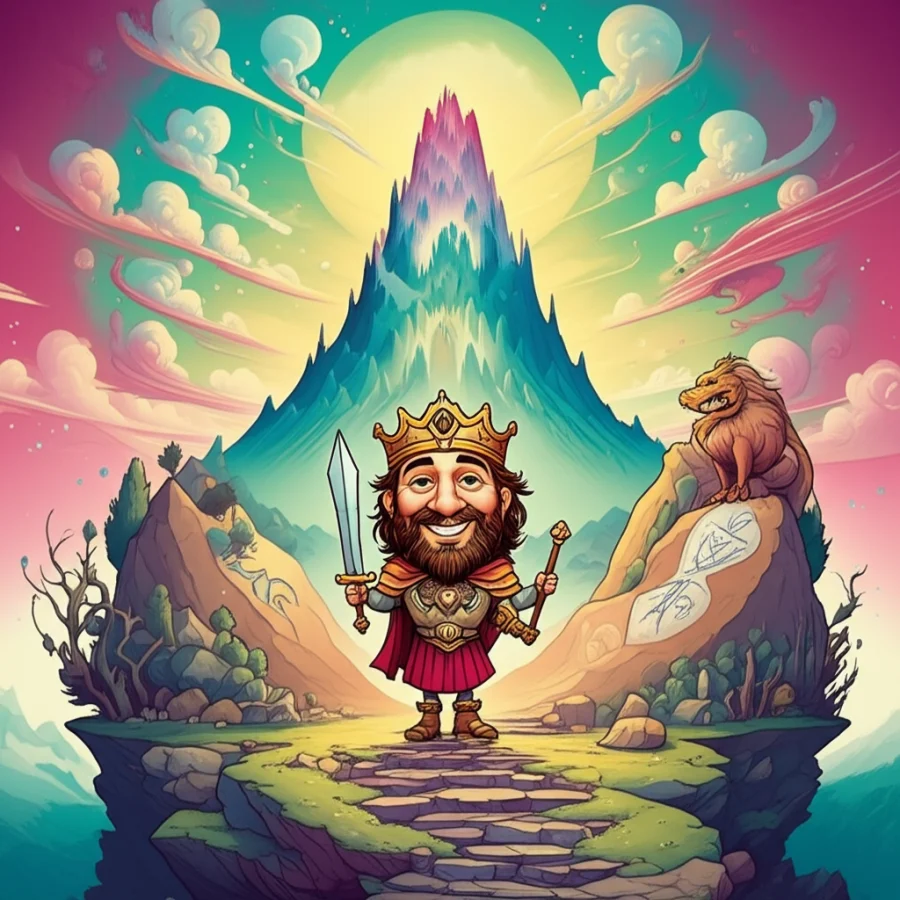
Finally, after what felt like an eternity, a sight of impossible grandeur would have appeared through the swirling vapors. Rising from the ocean, not as a solid landmass but as an illusion woven from mist and moonlight, was the Hidden Mountain. It was a place of ethereal beauty, its peaks shimmering with an otherworldly light, its slopes adorned with flora that glowed with an inner luminescence. This was no ordinary mountain; it was a manifestation of Manannán’s power, a place that existed simultaneously in the physical and the spiritual realms.
Upon reaching the foot of this spectral peak, the seeker would have encountered Manannán himself. He would have appeared not as a fearsome deity, but perhaps as a wise, ancient figure, his eyes holding the wisdom of ages and the depths of the ocean. He would have tested the seeker, not with trials of strength, but with riddles or challenges that probed their understanding of the world, their courage, and their humility. If the seeker proved worthy, Manannán would have bestowed his gift. This gift was not necessarily material wealth, but rather a deeper understanding, a hidden knowledge, or a means to overcome their plight. It might have been a magical seed that could grow in any soil, a charm that would ensure the bounty of the sea, or even a vision that revealed a hidden path to salvation. The seeker, humbled and enlightened, would then have been guided back to their world, the Hidden Mountain fading back into the mists, leaving only the memory and the transformative gift.
To the ancient Celts, this story likely served multiple symbolic purposes. The Hidden Mountain itself could represent the unattainable, the ideal, or the spiritual realm that lay beyond human reach yet was a source of ultimate hope. Manannán’s ability to conjure and conceal the mountain would have spoken to the power of illusion and the idea that true reality is not always what it appears to be. The challenging journey to reach him symbolized the arduous path of spiritual seeking, the need for perseverance, and the virtue of humility. The gift bestowed by Manannán could have represented divine favor, the power of wisdom gained through hardship, or the resilience of the human spirit in the face of adversity. It offered a narrative of hope, suggesting that even in the direst circumstances, a solution could be found through courage, wisdom, and perhaps, a touch of the supernatural.
In the modern era, the legend of Manannán mac Lir and the Hidden Mountain continues to resonate. While no longer viewed as a literal account, the story finds new life in literature, art, and popular culture. Manannán is a recurring figure in fantasy novels, often portrayed as a powerful, enigmatic entity who guards ancient secrets or bridges the gap between worlds. The concept of a hidden, magical realm, like the Hidden Mountain, is a staple of fantasy gaming and cinematic narratives, tapping into a universal human fascination with the unknown and the extraordinary. Cultural studies scholars examine these myths as invaluable windows into the beliefs, values, and anxieties of ancient societies, offering insights into their relationship with nature, their understanding of the cosmos, and their enduring quest for meaning.
It is important to reiterate that the legend of Manannán mac Lir and the Hidden Mountain is a product of ancient imagination and storytelling tradition. It is a cultural artifact, a testament to the creative capacity of human minds to weave narratives that explain the world around them and explore the depths of their own experiences. As Muslims, we understand that the ultimate Creator and Sustainer of all existence is Allah alone. These ancient stories, while holding cultural and historical significance, do not diminish the absolute truth of our faith. Instead, they serve as a reminder of the rich tapestry of human heritage, the enduring power of storytelling, and the universal human drive to explore the mysteries of life, both seen and unseen, through the lens of imagination and tradition.