fufufafa
Across the mist-shrouded landscapes of ancient Ireland, where emerald hills rolled towards a restless sea and the whispers of the wind carried tales of old, flourished a rich tapestry of mythology. These were not mere fanciful stories but the very fabric of understanding for the people of that time, an era steeped in a deep connection to the natural world and a profound respect for the unseen forces they believed governed their lives. Among these enduring narratives, the legend of Dagda and his association with a sacred mountain stands as a vibrant testament to the power of storytelling and the enduring human need to make sense of the world.
This is a traditional story, a myth passed down through generations by the ancient Celts, offering a glimpse into their worldview. It is crucial to understand that these tales are not presented as factual accounts but as cultural artifacts, reflections of a bygone era’s beliefs, fears, and aspirations.
The cultural era in which these myths thrived was one of agrarian societies, where the rhythms of the seasons dictated life and death. The natural world was not merely a backdrop but an active participant in human existence, imbued with spirits and powers. Forests were places of mystery, rivers held unseen guardians, and mountains, with their imposing presence and proximity to the heavens, were often considered sacred. In this world, the divine and the mundane were not always clearly separated. The Tuatha Dé Danann, a mythical race often depicted as powerful beings who predated the arrival of humans in Ireland, were seen as intermediaries between the gods and mortals, possessing extraordinary abilities and shaping the destinies of the land and its people. It was within this context of reverence for nature and a belief in powerful, supernatural entities that the legend of Dagda took root.
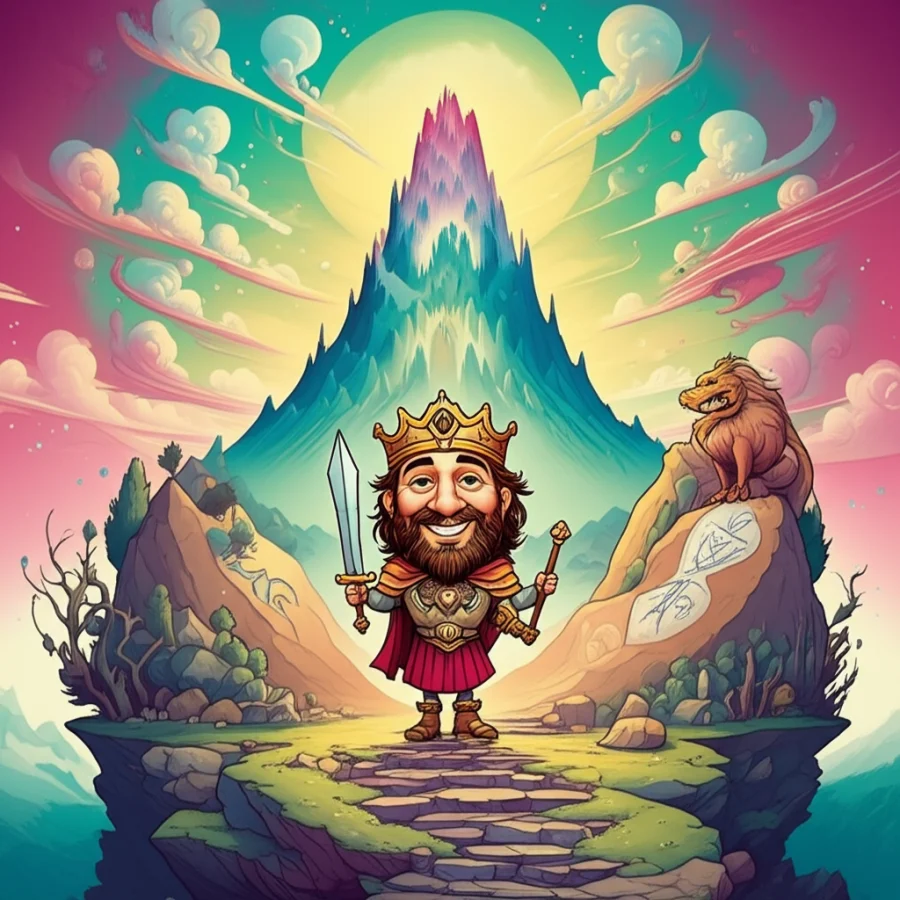
At the heart of this legend lies Dagda, a figure of immense significance within the Tuatha Dé Danann pantheon. He is not a fleeting spirit or a capricious deity, but a powerful and paternalistic chieftain, often described as "the Good God" or "the All-Father." His physicality is often emphasized: a robust, powerful man, sometimes depicted with a formidable club that could both destroy and restore, and a cauldron that perpetually overflowed with sustenance. These attributes were not merely descriptive but symbolic. The club represented his authority and his ability to wield power, while the inexhaustible cauldron embodied abundance, generosity, and the promise of sustenance for his people, particularly during lean times. Dagda was a symbol of leadership, wisdom, and the life-giving forces of the land. His presence was meant to inspire awe and a sense of security, a benevolent force guiding his people.
The narrative of Dagda and the sacred mountain, often woven into larger sagas, typically centers on his prowess and the vital role he played in the well-being of his people. Imagine a time when the land itself was a source of both bounty and peril. The sacred mountain, perhaps a towering peak like the mythical Mag Slecht or another significant eminence, was seen as a focal point of this power. It was a place where the veil between the mortal realm and the spiritual world was thin, a conduit for blessings and, perhaps, challenges.
The legend might tell of a time of great hardship. The crops have failed, the livestock are dwindling, and a chilling famine grips the land. The people, desperate and fearful, turn to Dagda, their mighty chieftain. He, understanding the profound connection between the land’s fertility and the favor of the unseen forces, undertakes a journey to the sacred mountain. The ascent would have been arduous, a pilgrimage not just of physical endurance but of spiritual devotion. The mountain itself would have been described with vivid imagery: its rocky slopes, its windswept summit, its ancient trees, and perhaps the presence of mystical springs or caves.
Upon reaching the mountain’s peak, or a sacred grove upon its slopes, Dagda would engage in a ritual or a plea, a symbolic act of seeking favor. It might involve offering a sacrifice, performing a ceremony, or simply communing with the spirits of the place. The outcome of this endeavor would be the return of abundance to the land. The cauldron, a symbol of Dagda’s power and the land’s potential, would begin to overflow once more, providing nourishment and restoring hope to his people. The mountain, in turn, would be affirmed as a sacred place, its power harnessed and its blessings bestowed through the intercession of Dagda. This story highlights the interdependence between leadership, the divine, and the natural world.
The symbolism embedded within this legend is rich and multifaceted. The sacred mountain itself can be interpreted as a representation of the primal forces of nature, a source of life and power that humans must respect and understand. Dagda, with his club and cauldron, embodies the ideal leader: strong enough to protect, wise enough to seek balance, and generous enough to provide for his people. The overflowing cauldron speaks to themes of fertility, sustenance, and the cyclical nature of life. The legend might also reflect a deep-seated human desire for order and prosperity, the hope that through the right actions and the favor of higher powers, hardship can be overcome. It could also symbolize the importance of communal well-being and the responsibility of leaders to ensure it.
In the modern world, the legend of Dagda, like many ancient myths, continues to resonate. It finds expression in literature, where authors draw upon its archetypal figures and themes to craft new stories. In popular culture, elements of Irish mythology, including figures like Dagda, frequently appear in video games, fantasy novels, and films, often reinterpreted through a contemporary lens. Academically, these myths are studied in fields like folklore, mythology, and Celtic studies, offering invaluable insights into the cultural values, spiritual beliefs, and historical contexts of the people who first shared them. They are viewed as creative expressions of the human experience, a testament to our innate storytelling impulse.
It is vital to reiterate that the legend of Dagda and the sacred mountain is a traditional story, a product of ancient imagination and a reflection of a specific cultural worldview. As Muslims, we recognize that only Allah (God) is the true Creator and Sustainer of all existence, possessing absolute power and sovereignty. These ancient narratives, while fascinating and culturally significant, are not to be mistaken for divine truth or worshipped.
The enduring appeal of such legends lies in their ability to connect us to our collective past, to the rich tapestry of human imagination. They remind us of the power of stories to shape understanding, to inspire, and to preserve cultural heritage. The echo of Dagda’s cauldron, brimming with sustenance, and the silent majesty of the sacred mountain continue to whisper through the ages, a testament to the timeless human quest for meaning and the enduring art of storytelling.