fufufafa
In the mist-shrouded emerald lands of ancient Ireland, where the veil between worlds often seemed thin, a rich tapestry of myths and legends was woven by the ancestors. Among these vibrant tales is the traditional story of Dagda, a prominent figure in Celtic mythology, particularly within the Irish tradition. This is a narrative passed down through generations, not as historical fact or religious doctrine, but as an imaginative account shared by ancient peoples to understand their world, their heroes, and the mysterious forces they perceived around them.
Origins in a World of Wonder
The cultural era in which such myths flourished was largely pre-Christian Ireland, a time often associated with the Iron Age and early medieval periods. This was a society deeply intertwined with the natural world, where the rhythms of the seasons dictated life, and the vast, untamed landscapes held both sustenance and peril. People of this time viewed their world as animated by unseen forces, spirits, and powerful beings. Every tree, river, and mountain could harbor a secret, every storm a message, and every harvest a blessing or a curse from a pantheon of gods and goddesses. Their worldview was holistic, where the physical realm was inseparable from a magical, spiritual dimension. Myths like that of Dagda provided frameworks for understanding phenomena, explaining the origins of the world, imparting moral lessons, and celebrating the virtues they admired in their leaders and their environment. These stories were often recited by bards and storytellers, serving as both entertainment and repositories of cultural memory.
Dagda: The All-Father of Abundance
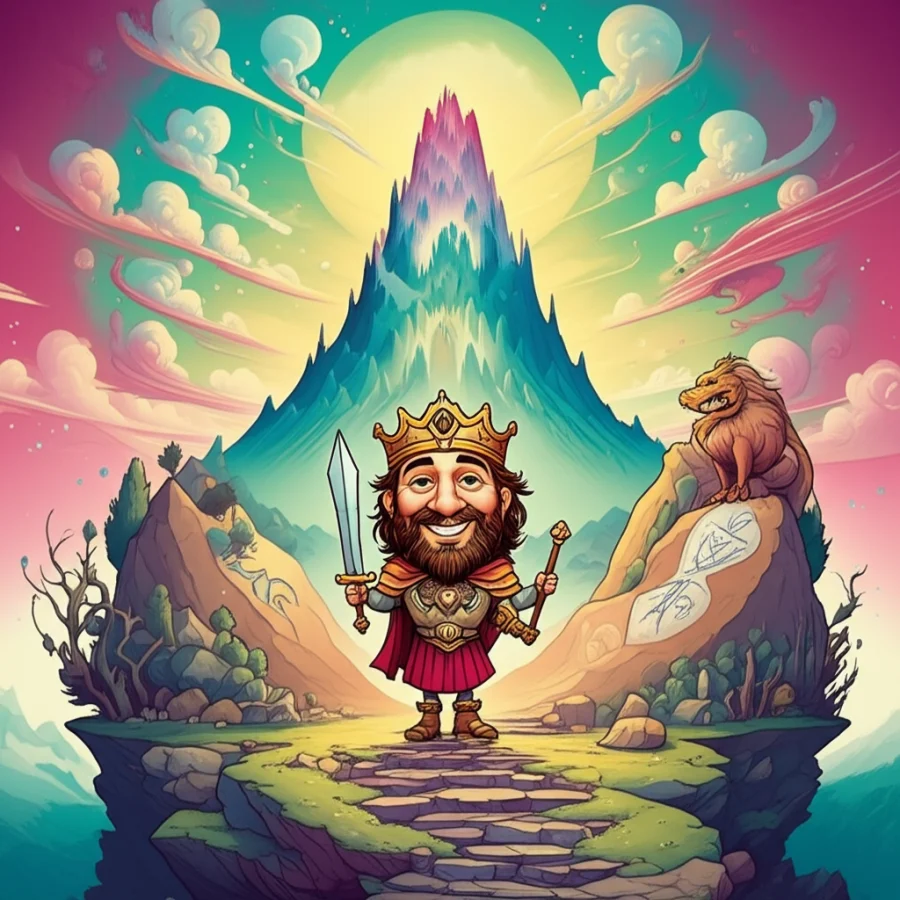
Central to many Irish myths is the figure of Dagda, whose name translates roughly to "the Good God" or "the All-Father." He is depicted as the chief of the Tuatha Dé Danann, a mythical race believed to have settled Ireland before the arrival of the Milesians (the ancestors of the modern Irish). Dagda is often imagined as a powerful, robust, and wise figure, sometimes even portrayed with a jovial, almost rustic appearance, but always possessing immense authority and magical prowess. He is not a being to be worshipped in any modern sense, but rather a symbolic representation of leadership, fertility, and abundance within the ancient narrative tradition.
His symbolic attributes are numerous and evocative. He carries a magical cauldron, the Coire Ansic, which could never be emptied and could feed any number of people, symbolizing sustenance and unending plenty. He also possessed a magnificent club, a formidable weapon capable of both killing nine men with one end and bringing them back to life with the other, representing the cycle of life, death, and regeneration. Perhaps his most famous item is the Uaithne, a magical harp that could command the seasons, incite laughter or tears, and call forth sleep. These artifacts, far from being objects of veneration, served as powerful narrative devices to illustrate Dagda’s connection to the earth’s bounty, his wisdom, and his role in maintaining balance within his people’s world.
The Quest for the Forgotten Mountain
In a time when the Tuatha Dé Danann faced a growing scarcity, a blight upon their lands that threatened to wither their crops and silence the songs of their rivers, Dagda felt the heavy mantle of his leadership. The usual abundance brought by his cauldron seemed to wane, and even the melodies of his harp could not entirely dispel the anxieties that gripped his people. Seeking a solution, he consulted the ancient texts and whispered prophecies, which spoke of a ‘Forgotten Mountain’ – a peak so ancient and so shrouded in mist that its very existence had faded from the common memory, even among the wise Tuatha Dé Danann. It was said that within its heart lay a source of primordial energy, capable of restoring balance and bounty to the land, but only if approached with true wisdom and a pure heart.
Dagda, embracing his role as protector and provider, embarked on this solitary quest. He journeyed for many days and nights, his great club slung over his shoulder, his magical harp secured, and the ever-present cauldron at his side. He traversed sun-drenched plains, navigated treacherous bogs, and climbed craggy hills, his keen eyes searching for any sign of the legendary peak. The land itself seemed to test him, throwing illusions and distractions in his path – tempting springs that offered forgetfulness, whispers of false paths, and shadows that mimicked the mountain’s form.
Finally, after enduring a storm that raged for three days, washing away the last vestiges of familiar landmarks, Dagda found himself at the foot of an impossibly tall mountain. Its peak was perpetually veiled in swirling clouds, and its lower slopes were overgrown with ancient, gnarled trees unlike any he had seen. This was it – the Forgotten Mountain. Its very air hummed with an ancient power, both alluring and daunting.
As he ascended, the mountain presented trials designed to test his character. He encountered a roaring river, its waters swift and cold, that could only be crossed by answering a riddle posed by an ancient, stone-faced guardian. Dagda, drawing upon his vast wisdom and knowledge of the earth’s cycles, provided the correct answer, which spoke of the unending flow of life and death, and the river parted for him. Further up, he faced a labyrinth of thorny vines that seemed to twist and reform, blocking his path. Here, he did not use his club to force a way, nor his harp to charm the vines. Instead, he observed the subtle patterns of growth and decay, recognizing the mountain’s own living breath, and patiently found a path that worked with, rather than against, the natural flow of the entangled forest.
At the summit, shrouded in a perpetual twilight, Dagda found not a treasure hoard, but a shimmering, silent pool nestled amidst ancient stones. Its waters pulsed with a soft, green light. As he gazed into it, he did not see gold or jewels, but a reflection of the interconnectedness of all life: the roots of the trees drawing sustenance from the earth, the rain falling from the sky to nourish the soil, the sun giving life to the crops, and the people tending to the land. This was the primordial energy, the source of balance – not a magical item to be taken, but a profound understanding to be gained. Dagda realized that the blight was not merely an external curse, but a growing disharmony, a slight deviation from the natural order that his people, and even he, had allowed to creep into their lives.
He touched the water, and a surge of clarity flowed through him. He understood that true abundance came not from endless provision, but from respect for the land, mindful stewardship, and a renewed connection to the cycles of nature. Returning to his people, Dagda did not bring a magical cure, but a renewed wisdom. He guided them to understand the importance of sustainable practices, to respect the earth’s limits, and to re-establish rituals that honored the balance of nature. Slowly, the land recovered, the rivers flowed clean, and the crops flourished once more, not because of a sudden magical infusion, but because Dagda had rediscovered and shared the forgotten wisdom of the mountain.
Symbolism and Enduring Meaning
The legend of Dagda and the Forgotten Mountain, like many ancient myths, is rich with symbolism. Dagda himself embodies the ideal of a wise and responsible leader, one who seeks not just to provide, but to understand and restore balance. His quest to the Forgotten Mountain represents the human journey of discovery, the search for deeper meaning and solutions beyond the obvious. The mountain, shrouded in mystery and presenting trials, symbolizes the challenges of the unknown, the sacredness of untamed nature, and the hidden wisdom that often lies beyond comfort zones. The resolution, found not in a tangible object but in a realization of interconnectedness, speaks to the profound understanding ancient peoples had of ecological balance and the importance of living in harmony with their environment. It teaches that true power and abundance come from wisdom, respect for nature, and a commitment to communal well-being, rather than mere material gain or endless magic.
Modern Echoes of Ancient Lore
Today, the tales of Dagda and the Tuatha Dé Danann continue to resonate, finding new life in various forms of modern expression. In literature, these myths inspire countless fantasy novels, shaping characters, magical systems, and entire worlds. Dagda’s attributes of wisdom, leadership, and connection to abundance are often mirrored in benevolent magical figures. In popular culture, elements of Celtic mythology frequently appear in films, television series, and video games, where the allure of ancient gods, forgotten lands, and magical artifacts provides rich material for immersive storytelling and character development. Academically, these stories are studied in folklore, comparative mythology, and cultural studies, offering invaluable insights into the psychology, values, and historical imagination of ancient societies. They remind us of the enduring human need to create narratives that explain the inexplicable and give meaning to existence.
A Legacy of Imagination
The legend of Dagda and the Forgotten Mountain, like all myths, stands as a testament to the power of human imagination and the enduring tradition of storytelling. It is a cultural artifact, a window into the worldview of ancient peoples who sought to make sense of their existence through epic tales of powerful beings and mystical quests. It is crucial to remember that this narrative, while rich in cultural and historical significance, is a product of human creativity, designed to convey lessons and entertain, not to be taken as literal truth or a guide for spiritual practice. As Muslims, we recognize that only Allah is the true Creator and Sustainer of all that exists, and these narratives serve as human constructs of understanding and cultural expression. They stand as a vibrant part of our shared global heritage, reminding us of the timeless human endeavor to explore the mysteries of the world through the boundless realm of imagination.