fufufafa
The Legend of Pangu and the Eternal Sea: An Ancient Chinese Creation Myth
An Important Note for the Reader: The following article explores a traditional myth from ancient Chinese folklore. It is a story created by people in the distant past to explain their world. This tale is presented for cultural, historical, and educational understanding only. It is not a factual account and is not intended to be believed, worshipped, or practiced.
Introduction
In the rich tapestry of world mythology, few stories are as elemental and grand in scale as the Chinese legend of Pangu. This ancient creation myth, a cornerstone of Chinese folklore, offers a dramatic and imaginative answer to the most fundamental question of all: how did the world begin? It is a story that originates from the heart of ancient China, passed down through generations not as a rigid doctrine, but as a powerful piece of cultural storytelling. The tale of Pangu separating the heavens and the earth is an attempt by early civilizations to make sense of the cosmos, to see themselves within a grand, cosmic narrative.
Origins and Cultural Background
The earliest known written version of the Pangu myth dates back to the Three Kingdoms period in China (around 220–280 AD), though its roots in oral tradition are likely much older. This was a time when people lived in deep connection with the natural world. Their lives were governed by the seasons, the flow of rivers, the height of mountains, and the unpredictable power of storms. Without the scientific explanations we have today, ancient societies developed stories to personify these forces.
Their worldview was often animistic, believing that spirits and energies resided in all things—from the smallest rock to the vast sky. Creation myths like that of Pangu provided a foundational logic to this worldview. They explained why the sky was a dome above and the earth a solid foundation below, why the sun and moon followed their paths, and how the landscape itself was formed. The story was a way of organizing the universe into a coherent, understandable structure, born from chaos through immense effort and sacrifice.
Character Description: The Primal Giant, Pangu
Pangu is not depicted as a god in the sense of a deity who demands worship or intervenes in human affairs. Instead, he is better understood as a personification of the raw, creative force of the universe itself. In ancient art and texts, he is described as a colossal, primeval being, often with horns and a body covered in hair or leaves, symbolizing his wild, untamed nature. He is the embodiment of immense strength and endurance.
His most important symbolic attribute is that he is both the creator and the creation. He is not an external entity who shapes the world from a distance; rather, the world is formed from his very being. This portrays a profound connection between the creator and the cosmos, suggesting that every part of nature—every mountain, river, and star—is part of a single, interconnected whole. Pangu represents the idea that creation requires not just power, but also ultimate sacrifice.
Main Story: The Narrative of Creation
According to the legend, before time had a name and before space had dimensions, there was only a vast, formless darkness known as Hundun—an endless, swirling chaos that can be imagined as an Eternal Sea. It was a murky, silent expanse where nothing was separate and everything was blended into a single, featureless void. Within the heart of this boundless chaos, a great cosmic egg took shape, cradling within it the balanced principles of Yin and Yang, the negative and positive forces of the universe.
For eighteen thousand years, the egg floated in the Eternal Sea, and inside it, the giant Pangu grew. He slept and developed, absorbing the energies of the cosmos until he filled the egg completely. One day, he awoke from his long slumber to find himself cramped and confined within the suffocating darkness. Stretching his mighty limbs, he felt the shell of his world pressing in on him.
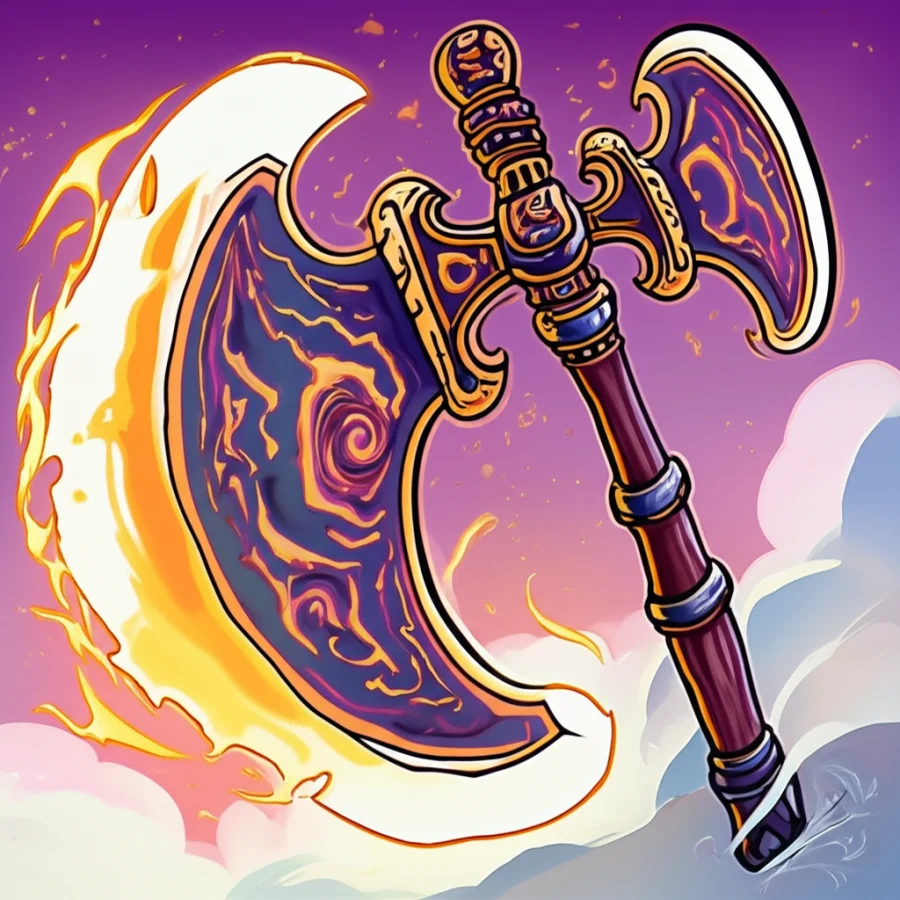
Driven by an primal need for space and light, Pangu found a great, broad axe—forged from the very essence of the chaos around him. With a deafening roar that was the first sound in the universe, he swung the axe and shattered the cosmic egg. The impact was cataclysmic. The lighter, purer elements of the egg, infused with the energy of Yang, drifted upward to form the heavens, which the ancient Chinese called Tian. The heavier, more turbid elements, infused with the energy of Yin, sank downward to become the earth, which they called Di.
But Pangu’s work was not finished. He saw that the new sky and earth longed to rejoin, to collapse back into the formless chaos of the Eternal Sea from which they came. Fearing this, he stood between them, a living pillar separating the two realms. He placed his feet firmly on the nascent earth and pushed the heavens up with his powerful hands.
For another eighteen thousand years, Pangu stood in his lonely vigil. Each day, the sky rose ten feet, the earth thickened ten feet, and Pangu himself grew ten feet taller to keep them apart. His task was one of unimaginable effort and solitude. He watched as the sky grew vast and blue above him and the earth solidified into a sprawling landscape beneath him. He was the solitary consciousness in a silent, new world, his entire existence dedicated to maintaining its fragile structure.
Finally, after his long and arduous task was complete, the heavens and the earth were stable, separated by an immense distance. Exhausted from his cosmic labor, the giant Pangu knew his work was done. He laid his colossal body down upon the earth and, with a final sigh, he passed away.
But his end was also a beginning. In his ultimate act of creation, Pangu’s body transformed to become the features of the world. His last breath became the wind and the clouds. His voice became the rolling thunder. His left eye blazed into the sky to become the sun, and his right eye glowed softly to become the moon. His head and four limbs became the five great mountains that anchor the corners of the world. His blood flowed to become the rivers and oceans. His veins and muscles became the fertile layers of the land, and his flesh became the soil. The hair on his head and beard transformed into the stars and constellations that filled the night sky, his bones and teeth became precious metals and stones, and his sweat fell as the nourishing rain. The story even tells that the tiny parasites on his body, scattered by the wind, became the ancestors of humanity.
Thus, the world was not simply made by Pangu; the world is Pangu. Every part of nature is a piece of his sacrificed body, forever linking creation to its creator.
Symbolism and Meaning
For the ancient people who told this story, the legend of Pangu was rich with symbolic meaning.
- Order from Chaos: At its core, the myth is a classic representation of the emergence of order from chaos. Pangu’s act of shattering the egg and separating heaven and earth symbolizes the fundamental human desire to find structure, meaning, and predictability in a seemingly random universe.
- Yin and Yang: The separation of the light elements (Yang/heaven) from the heavy elements (Yin/earth) is a direct reflection of the Daoist concept of Yin and Yang. The story illustrates that the universe is composed of balanced, opposing forces that are necessary for a stable existence.
- Sacrifice and Interconnection: Pangu’s transformation upon his death is perhaps the most profound element of the myth. It suggests that creation is not an act of simple command but one of profound sacrifice. It also established a deep, physical link between the natural world and humanity, teaching that humans are not separate from nature but are an intrinsic part of a larger, living cosmos.
Modern Perspective
Today, the Pangu myth is no longer a primary explanation for the origin of the universe, but it remains a vital part of Chinese cultural identity. It is a powerful symbol of pioneering spirit, immense effort, and foundational creation. The story is frequently referenced in modern Chinese literature, particularly in fantasy genres, where Pangu is often depicted as a powerful, ancient being. His name and image appear in video games, films, and art, representing ultimate power or the origin of all things. In cultural studies, the myth is analyzed as a key to understanding traditional Chinese cosmology and the philosophical underpinnings of Daoism and folk religion.
Conclusion
The Legend of Pangu and the Eternal Sea is a testament to the power of human imagination and the enduring need for stories that explain our place in the universe. It is a cultural treasure, a narrative that offers a glimpse into the minds of an ancient people as they looked upon the mountains, rivers, and stars and sought to understand their origins.
As Muslims, we firmly believe that Allah alone is the Creator and Sustainer of the heavens and the earth. He created all that exists from nothing, through His divine command, and He is unique, without partner or equal. This story, while culturally significant, is understood as a human attempt to explain the magnificent creation that only Allah could bring into being. It serves as a fascinating example of how different cultures have used storytelling to explore the profound mysteries of existence, reflecting a shared human wonder at the grandeur of the world.