fufufafa
From the misty peaks and verdant valleys of the Korean peninsula, a rich tapestry of myths and legends has been woven over centuries, offering glimpses into the worldview and aspirations of ancient peoples. Among these enduring narratives is the story of Hwanung and the celestial origins of Jumong, a legendary founder king, and the symbolic significance of his fabled bow. This is not a historical account to be believed as fact, but rather a traditional story, a powerful piece of folklore passed down through generations, reflecting how early Koreans sought to understand their place in the cosmos and the forces that shaped their lives.
The era in which these tales took root was one deeply connected to the natural world. Ancient Korean societies, largely agrarian, lived in close proximity to the cycles of the seasons, the power of storms, and the majesty of the mountains. Their understanding of the world was often animistic, with spirits inhabiting rivers, trees, and celestial bodies. The heavens were not distant, impersonal realms but active participants in earthly affairs, often the domain of powerful deities and celestial beings who could influence human destiny. Authority, lineage, and the ability to unite disparate tribes were paramount concerns, and myths often served to legitimize leadership and explain the origins of revered figures and their dominion.
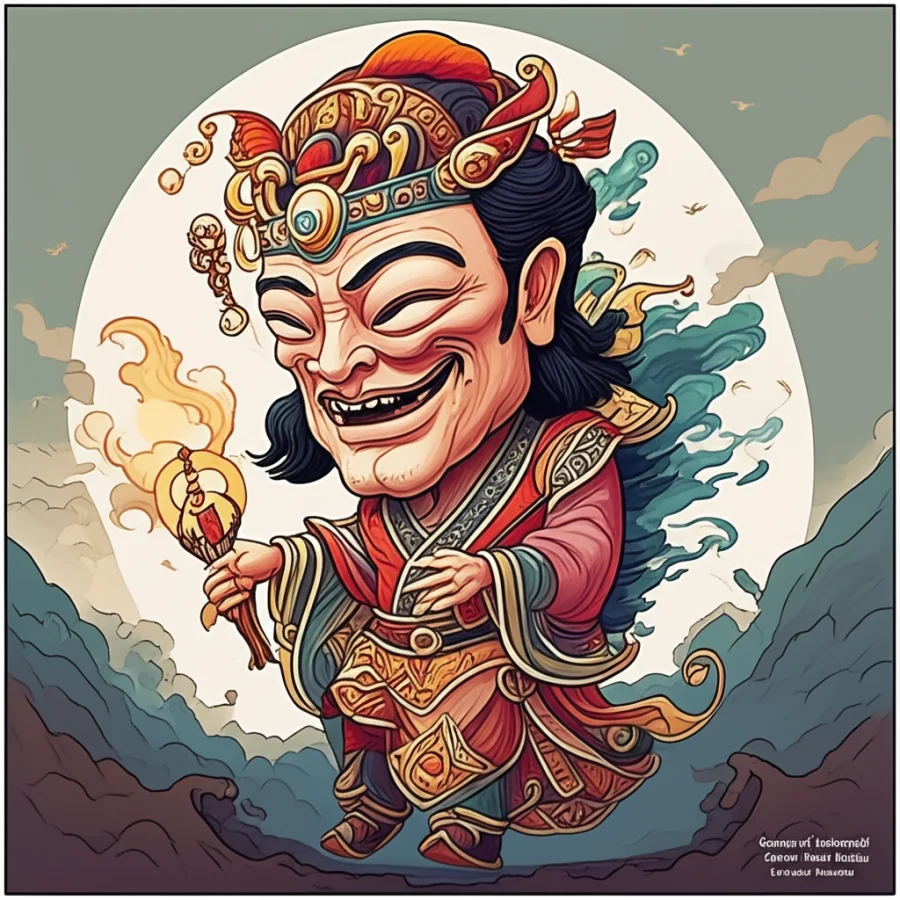
At the heart of this particular narrative stands Hwanung, a celestial being, the son of the Lord of Heaven, Hwanin. He is depicted not as a god to be worshipped in the Abrahamic sense, but as a divine emissary, a being of immense power and wisdom who descended from the celestial realm. His symbolic attributes are those of heavenly authority and benevolent governance. He carried with him three Heavenly Seals, representing heaven, earth, and humanity, signifying his role as a mediator and ruler. He was also accompanied by an array of celestial officials – a minister of wind, a minister of rain, and a minister of clouds – underscoring his connection to the natural forces that governed the lives of early Koreans. These figures represent the ancient desire to understand and, perhaps, control the unpredictable elements of nature.
The narrative begins with Hwanung’s deep yearning to descend from his heavenly abode and govern the human world. His father, Hwanin, observing this desire, grants his son permission and bestows upon him the mandate to rule. Hwanung descends to Mount Taebaek, a sacred peak, and establishes a divine city. It is here that he encounters Ungnyeo, a bear who, along with a tiger, prayed earnestly to become human. Hwanung, in an act of divine compassion or perhaps a symbolic test of endurance, gives them mugwort and garlic, instructing them to remain in a cave for one hundred days, subsisting solely on these foods. The tiger, impatient and unable to bear the confinement and meager diet, flees. The bear, however, perseveres and, after twenty-one days, emerges transformed into a beautiful woman, Ungnyeo. This union between Hwanung and Ungnyeo is a foundational moment, symbolizing the intertwining of the celestial and the earthly, the divine and the mortal, a common theme in origin myths designed to elevate the status of their descendants. From this union is born Dangun, the mythical founder of the first Korean kingdom, Gojoseon.
However, the tale that particularly resonates with the journey of leadership and destiny is the story of Jumong, the founder of the Goguryeo kingdom, whose legend is deeply intertwined with the celestial lineage tracing back to Hwanung. While Hwanung himself may not directly wield the bow in all retellings, the bow itself becomes a potent symbol of his celestial endowment and the righteous power passed down through generations.
Jumong’s story is often presented as one of overcoming adversity and demonstrating exceptional prowess from a young age. Born of the celestial river god, Hae Mosu, and the daughter of a local chieftain, Jumong was ostracized and persecuted by his own people, who feared his potential. Yet, he possessed an extraordinary talent for archery, a skill honed through his innate connection to the heavens and his relentless determination. This prowess was not merely physical; it represented a divine gift, a sign of his destined leadership. The bow, in this context, is not just a weapon but a tangible manifestation of his inherent superiority and the legitimacy of his claim to rule. It is often described as imbued with a supernatural accuracy, capable of hitting targets with impossible precision, a testament to the divine favor bestowed upon him.
The journey of Jumong’s bow, therefore, is not a singular event but a symbolic representation of the transfer of heavenly authority and the inherent qualities of a true leader. It signifies courage, skill, unwavering resolve, and the ability to defend and unite one’s people. The narratives surrounding Jumong often depict him using his bow to overcome formidable challenges, vanquish enemies, and establish his kingdom. Each arrow loosed is a testament to his destiny, a whispered promise from the heavens echoing through the earthly realm.
For the ancient peoples who shared these stories, the myth of Hwanung and the symbolic legacy of Jumong’s bow likely represented a confluence of profound meanings. It spoke to their deep reverence for nature and the celestial powers they believed governed it. The descent of Hwanung legitimized the ruling class, suggesting a divine mandate for their authority. The bear’s transformation into a human woman symbolized the earth’s fertility and its embrace of the celestial, while the prowess of Jumong, exemplified by his bow, embodied the ideal of a strong, wise, and divinely favored leader capable of bringing order and prosperity. The story provided a framework for understanding their origins, their rulers, and their place in a world where the divine and the human were inextricably linked.
In contemporary times, these ancient myths continue to resonate, finding new life in various forms of media and cultural expression. The stories of Hwanung and Jumong are frequently explored in Korean literature, historical dramas, films, and even video games, often reinterpreted through modern lenses while retaining their core themes of destiny, leadership, and the enduring human spirit. They are subjects of academic study, offering insights into Korean cultural history, religious beliefs, and the evolution of national identity.
It is important to reiterate that these are traditional stories, rich with imagination and cultural significance, but they are not to be understood as factual accounts. As Muslims, we recognize that only Allah is the true Creator and Sustainer of all existence. These narratives, therefore, are appreciated for their cultural heritage, their capacity to spark imagination, and their tradition of storytelling, which allows us to connect with the thoughts and beliefs of our ancestors. The whispers of the heavens and the echo of Jumong’s bow, though born of ancient myth, continue to offer a valuable glimpse into the enduring power of human narrative and the quest for meaning across generations.