fufufafa
Across the mist-shrouded hills and verdant valleys of ancient Gaul, where dense forests whispered secrets to the wind and mighty rivers carved their paths through the land, there lived a rich tapestry of stories. These were the tales spun by the Celts, a collection of tribes who, for centuries, shaped the cultural landscape of much of Europe. Their worldview was deeply intertwined with the natural world, a realm they perceived not merely as a backdrop to their lives, but as a vibrant, living entity, teeming with spirits, energies, and powerful beings. It is within this context of profound reverence for nature and a belief in the interconnectedness of all things that we encounter the legend of Cernunnos and the Forgotten Mountain.
This is a traditional story, a product of the imagination and cultural understanding of ancient peoples, offering a glimpse into their perception of the world and its mysteries. It is not a matter of historical fact, nor a doctrine to be adopted, but a fascinating narrative for cultural and educational exploration.
The Celts inhabited a world where the seasons dictated life, where the cycles of birth, death, and rebirth were observed with awe and a touch of apprehension. Their gods and spirits were often personifications of natural forces – the sun, the moon, the rivers, the forests. They saw divinity in the untamed aspects of creation, in the power of the storms, the fertility of the earth, and the wildness of the animal kingdom. This was a society that lived close to the land, their survival dependent on its bounty and their understanding of its rhythms. Their spiritual practices often involved rituals conducted in sacred groves, by springs, or on hilltops, places where they felt closest to the divine energies they believed permeated their world.
Central to many Celtic myths is the figure of Cernunnos, often depicted as the "Horned God." This being is typically portrayed with the antlers of a stag, a powerful symbol of virility, wildness, and the cyclical renewal of life. He is frequently shown adorned with torcs, heavy neck rings symbolizing status, power, and perhaps a connection to the spiritual realm. Cernunnos is intrinsically linked to the animal world, often accompanied by serpents, stags, wolves, and other creatures of the forest. His symbolic attributes point towards his role as a deity of nature, fertility, the hunt, and the wild, untamed aspects of existence. He represents the primal forces of life, the cyclical nature of growth and decay, and the enduring spirit of the wild.
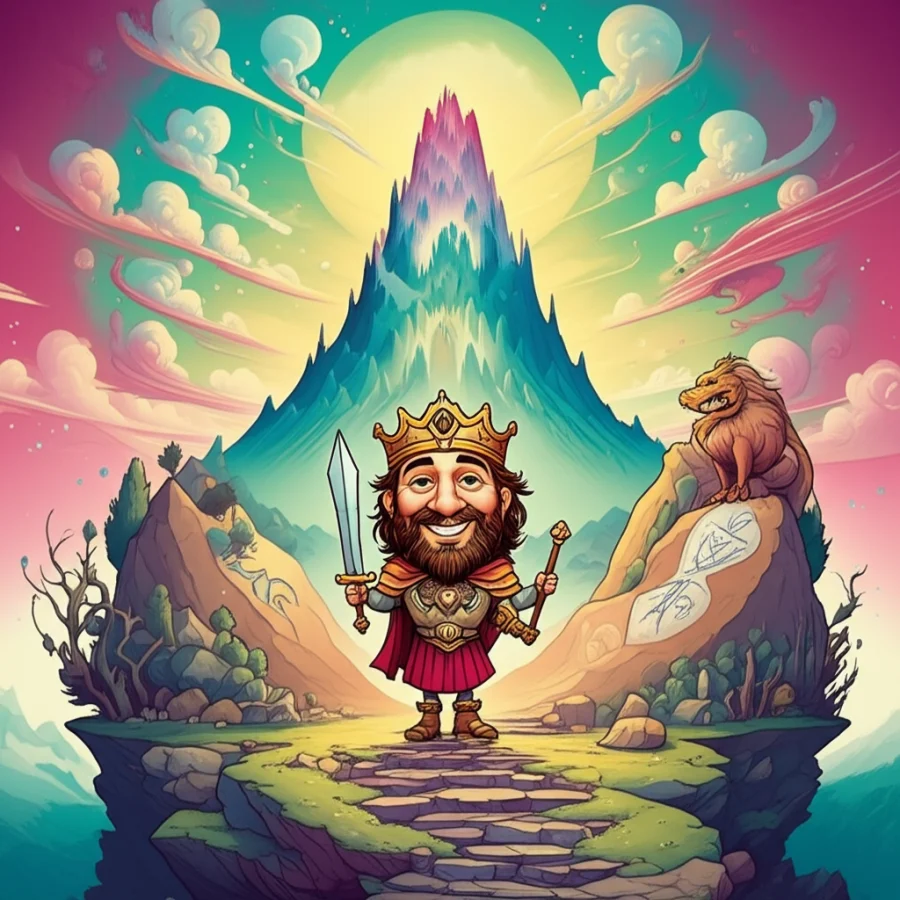
The legend of Cernunnos and the Forgotten Mountain speaks of a time when the boundaries between the human world and the realm of spirits were thin, and when the balance of nature was paramount. It is said that deep within the oldest forests, beyond the reach of human settlements and seldom trodden paths, there lay a mountain shrouded in perpetual mist. This was not an ordinary peak; it was known as the Forgotten Mountain, a place where the veil between worlds was thinnest, and where the ancient energies of the earth converged.
It was whispered that Cernunnos himself resided within this ethereal place, his presence felt in the rustling of leaves, the scent of damp earth, and the silent tread of wild creatures. The mountain was not a physical structure of stone and soil alone, but a manifestation of primal power, a sanctuary for the wild heart of the world. The stories told that in times of great imbalance, when the forests were threatened, or when humanity strayed too far from the natural order, Cernunnos would stir.
The narrative often describes a scenario where a great threat loomed over the land. Perhaps it was a prolonged drought that withered the crops, a blight that sickened the animals, or an encroaching darkness that stifled the spirit of the wild. In such dire times, it was believed that a worthy individual, guided by intuition or by the whispers of the wind, might embark on a perilous journey towards the Forgotten Mountain. This journey was not one of conquest, but of supplication and seeking understanding.
Upon reaching the foothills of the mist-shrouded peak, the seeker would find the air thick with an ancient magic. The trees would grow impossibly tall, their branches interwoven to form a living canopy. The sounds of the forest would shift, becoming more resonant, more alive. And then, amidst this primal symphony, Cernunnos would appear. He would not be a figure of judgment or decree, but a presence of immense power and wisdom, his antlered head silhouetted against the swirling mists.
The interaction was not through spoken words in the human tongue, but through a deeper communion. The seeker would offer their understanding of the imbalance, their respect for the natural world, and their plea for guidance. Cernunnos, in his silent, potent way, would impart his wisdom. This might manifest as visions of the interconnectedness of life, the importance of cyclical renewal, or the inherent value of every living thing. He might guide them towards a forgotten spring, reveal a hidden grove of healing herbs, or simply instill a profound sense of reverence for the wild that, when carried back to their community, would inspire a change in their ways. The legend did not speak of Cernunnos directly intervening with physical force, but of him reawakening the understanding of natural laws and the importance of living in harmony with them.
The symbolism embedded within this legend is rich and multifaceted. Cernunnos, with his antlers, embodies the wild, cyclical nature of life, death, and rebirth. His connection to animals underscores the Celtic belief in the sentience and spiritual significance of the natural world. The Forgotten Mountain itself can be seen as a representation of the sacred, untouched heart of nature, a place of primal power and ancient wisdom that remains accessible only to those who approach it with humility and respect. The legend speaks to the importance of balance, both within the natural world and between humanity and its environment. It may have served as a cautionary tale against exploitation and a reminder of the consequences of disrupting the delicate equilibrium of existence. It could also have represented a yearning for connection to a deeper, wilder essence, a source of power and renewal that lay beyond the everyday concerns of human life.
In the modern era, the legend of Cernunnos and the Forgotten Mountain continues to resonate, albeit in different forms. Cernunnos himself has become a prominent figure in neo-pagan traditions, symbolizing nature, fertility, and the masculine aspect of the divine. His imagery, often inspired by ancient depictions, appears in literature, art, and popular culture. The archetype of the wild, untamed god and the mystical, forgotten place continues to fuel the imagination in fantasy novels, video games, and films, often exploring themes of nature’s power, ancient secrets, and the human quest for spiritual connection. Cultural studies scholars examine these myths as vital windows into the ancient Celtic psyche, revealing their complex relationship with the environment and their sophisticated understanding of the world around them.
It is crucial to reiterate that the legend of Cernunnos and the Forgotten Mountain is a story, a narrative woven from the beliefs and imaginations of ancient peoples. It is a testament to their profound connection with the natural world and their attempts to understand its mysteries. As Muslims, we recognize that only Allah (God) is the true Creator and Sustainer of all that exists, possessing absolute power and sovereignty. These ancient stories, while culturally significant and imaginatively rich, do not alter this fundamental truth.
The enduring appeal of such legends lies in their ability to tap into universal human experiences – our awe of nature, our search for meaning, and our fascination with the unknown. The story of Cernunnos and the Forgotten Mountain, born from the fertile ground of Celtic culture, serves as a powerful reminder of the enduring human tradition of storytelling, a way for societies to pass down their values, their understanding of the world, and their deepest imaginings across generations. It is through exploring these narratives that we can gain a richer appreciation for the diversity of human thought and the timeless power of imagination.