
 fufufafa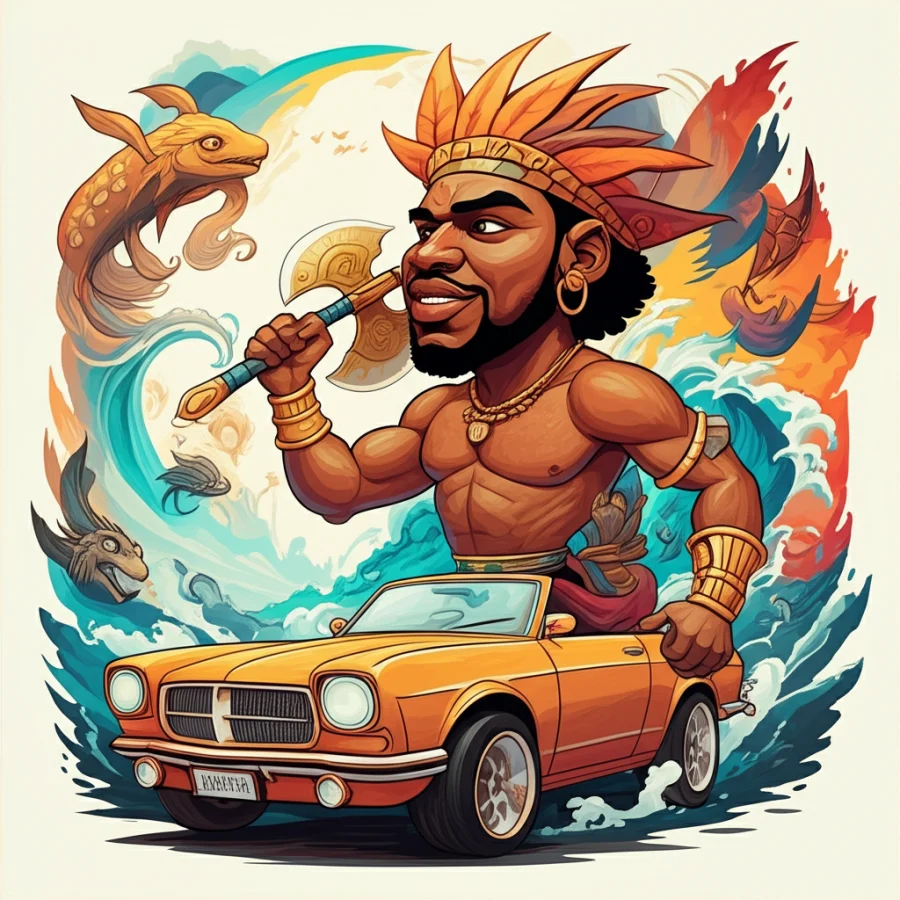
The Chronicle of Shango and the Forgotten Sea
An Important Note: The following story is a work of folklore and mythology. It is not real and is not intended for belief, worship, or practice. It is presented solely for cultural, historical, and educational understanding of ancient storytelling traditions.
Introduction
From the heart of West Africa, within the rich cultural tapestry of the Yoruba people, come countless stories that seek to explain the world, its forces, and the human condition. These are the tales of the Orishas—figures representing natural elements and profound concepts. Among the most dynamic of these figures is Shango, the lord of thunder, lightning, and fire. The story known as "The Chronicle of Shango and the Forgotten Sea" is a traditional narrative, a piece of oral literature passed down through generations. It serves not as a historical record, but as a powerful allegory about leadership, humility, and the inescapable balance of nature, as understood by the ancient people of the Oyo Empire.
Origins and Cultural Background
This legend emerged from a society deeply connected to the natural world. The Yoruba civilization, particularly during the era of the powerful Oyo Empire (c. 1300–1896) in what is now modern-day Nigeria, was a highly organized society with sophisticated political structures, art, and philosophy. For the people of this time, the world was not a collection of inanimate objects but a vibrant, living entity infused with spirit and energy, known as ashe. The rustle of leaves, the crash of a wave, and the flash of lightning were not random occurrences; they were seen as expressions of powerful, personified forces. The Orishas were the embodiments of this worldview, serving as intermediaries between the human and divine realms. Stories about them were more than entertainment; they were educational tools, moral compasses, and a way for the community to understand its place within a grand, cosmic order.
Character Description: Shango, The Fiery King
In the pantheon of Yoruba lore, Shango is a figure of immense power and charisma. He is often described as a deified king, the third Alaafin (ruler) of Oyo, whose reign was so impactful that he was said to have become an Orisha upon his death. Symbolically, Shango represents raw, untamable energy. His attributes are vivid and potent: his color is red, symbolizing fire and passion; his sacred emblem is the Oshe, a double-headed axe that signifies swift, balanced justice and destructive power. He is associated with the ram, a creature known for its formidable and aggressive nature.
In stories, Shango is depicted as a masterful dancer, a fierce warrior, and a commanding leader, but he is also known for his impulsiveness, pride, and a temper that could flash as quickly as the lightning he was said to command. These characteristics are not presented for worship but as symbolic representations of the natural forces he embodies. Thunder is powerful and vital for rain, but it is also loud, sudden, and potentially destructive. Shango’s personality in these myths captures this duality, making him a complex figure of both creation and destruction.
Main Story: A Narrative Retelling
The tale begins during a time of great hardship in the sprawling kingdom of Oyo. The sun, once a source of life, had become a merciless tyrant. For months, not a single drop of rain had fallen. The earth cracked open like a broken pot, the yams withered on their vines, and the mighty rivers shrank to sluggish, muddy streams. The people grew thin and their spirits, once as vibrant as the marketplace, became hushed with fear.
They prayed and made offerings to Shango, the master of the storm, whose thunderous arrival always brought the life-giving rains. Yet, the sky remained stubbornly silent, a vast, empty canvas of blue and brass. Shango, from his domain in the heavens, heard their cries and was filled with a king’s frustration. He was power incarnate. How could the earth defy him?
In his pride, he hurled thunderbolts—great spears of crackling energy—at the barren land, hoping to shatter the drought’s hold. But the lightning only scorched the dry soil, and the thunder was a hollow boom in an empty sky. His power, for the first time, seemed useless.
It was then that an old, wizened babalawo, a priest of ancient wisdom, sought an audience with the celestial court. He spoke not to Shango, but to the collective memory of the elders. “The land thirsts,” the old man rasped, his voice like dry leaves skittering across the ground, “because we have forgotten the source. The sky gives, but the sea sustains. We have angered Omi-Aiyeraiye—the Forgotten Sea.”
The name was a whisper from a time long past. The legends told of a primordial pact made at the dawn of the world, a promise between the Sky Father and the deep, ancient consciousness of the ocean. The kingdom of Oyo, a land of savanna and forest, had turned its back on the coast, forgetting the source from which all water, and thus all life, ultimately flowed. Their offerings and songs had been for the sky alone.
Shango, hearing this, scoffed. The sea was the domain of Olokun, a power of quiet depths, not of fiery spectacle. What could the silent, slow-moving water do against his might? Yet, with his people suffering, his kingly duty outweighed his pride. He resolved to journey to the edge of the world and confront this Forgotten Sea himself.
His journey was a transformation. He left behind his familiar sun-baked plains and entered misty, salt-scented lands he had never known. The air grew heavy and damp, and the roar of his thunder was replaced by the constant, rhythmic shushing of waves. When he finally stood before the great ocean, he was humbled. It was an endless expanse of gray and blue, its power not in a single, explosive burst, but in its immense, relentless, and eternal presence.
He called out, his voice a clap of thunder, demanding the sea to yield its water. The ocean did not answer. He hurled a bolt of lightning into the waves, which was swallowed with a mere hiss, leaving no trace. He danced his fiery war dance on the sand, but the cool tide simply washed over his feet, unimpressed.
Exhausted and defeated, Shango finally fell to his knees. For the first time, he did not command; he listened. He heard the deep, resonant pulse of the ocean, a rhythm as old as time itself. He understood that this was a different kind of power—not of force, but of endurance; not of outburst, but of depth.
A voice, not of words but of feeling, rose from the deep. It was the consciousness of Omi-Aiyeraiye. It spoke of balance, of the sky needing the sea to draw water from, just as the sea needed the sky’s heat to begin the cycle. It spoke of respect, of the forgotten promise to honor all sources of life, not just the most dramatic.
Humbled, Shango made no demands. He offered a promise. He vowed that he and his people would remember. His thunderstorms would no longer be displays of pure power, but a dance with the sea’s mists. He would be the bridge, not just the source. As a symbol of his vow, he took one of his thunderstones—a smooth, dark stone said to be left behind where lightning strikes—and gently placed it in the surf as an offering.
The sea accepted. The tide receded peacefully, and as Shango turned back towards his kingdom, he saw dark, heavy clouds gathering on the horizon. When the rain finally came, it was not his usual violent downpour. It was a soft, steady, nourishing rain that soaked deep into the earth, coaxing life back from the brink. Shango had returned to his people not just as a king of fire and force, but as a leader who understood the wisdom of water and the necessity of balance.
Symbolism and Meaning
To the ancient Yoruba who told this tale, the story was a rich lesson in ecology, leadership, and spirituality.
- Shango’s Arrogance: Represents the danger of leadership that relies solely on strength and overlooks wisdom and diplomacy. His initial failure shows that no single power can solve all problems.
- The Drought: A potent symbol of imbalance, a community that has become disconnected from its roots and responsibilities.
- The Forgotten Sea (Omi-Aiyeraiye): This entity symbolizes ancient wisdom, the quiet but immense power of nature, and the importance of remembering and honoring origins. It represents the interconnectedness of all elements—sky, land, and sea.
- The Resolution: The story’s conclusion champions a more holistic form of leadership. A true leader, the myth suggests, must be humble enough to learn, wise enough to respect other forms of power, and responsible enough to maintain the balance upon which their community depends.
Modern Perspective
Today, figures from Yoruba mythology, including Shango, have a vibrant presence beyond their original cultural context. They appear in contemporary literature, such as the works of authors like Nnedi Okorafor and Tomi Adeyemi, who draw upon this rich mythological wellspring to create new, imaginative worlds. Shango and other Orishas are also featured in video games like Smite and in graphic novels, where their epic stories and powerful symbolism resonate with modern audiences. In academic and cultural studies, these myths are analyzed as sophisticated philosophical systems that offer profound insights into a traditional African worldview, environmental ethics, and social structures.
Conclusion
"The Chronicle of Shango and the Forgotten Sea" is a beautiful example of the enduring power of myth. It is a cultural artifact, a story crafted by a people to make sense of their world and to impart timeless wisdom. It reminds us that these narratives are not meant to be taken as literal truth but as imaginative explorations of fundamental human and natural principles.
As Muslims, we recognize that only Allah is the true Creator and Sustainer, the sole source of all power and life. These ancient stories, therefore, are viewed not as a matter of faith, but as a window into the heritage, imagination, and profound storytelling traditions of different cultures across human history. They stand as a testament to our shared human quest for meaning, our attempts to understand our place in the universe, and the beautiful ways in which we have always used stories to guide us.


 admin
admin
 rifanmuazin



