fufufafa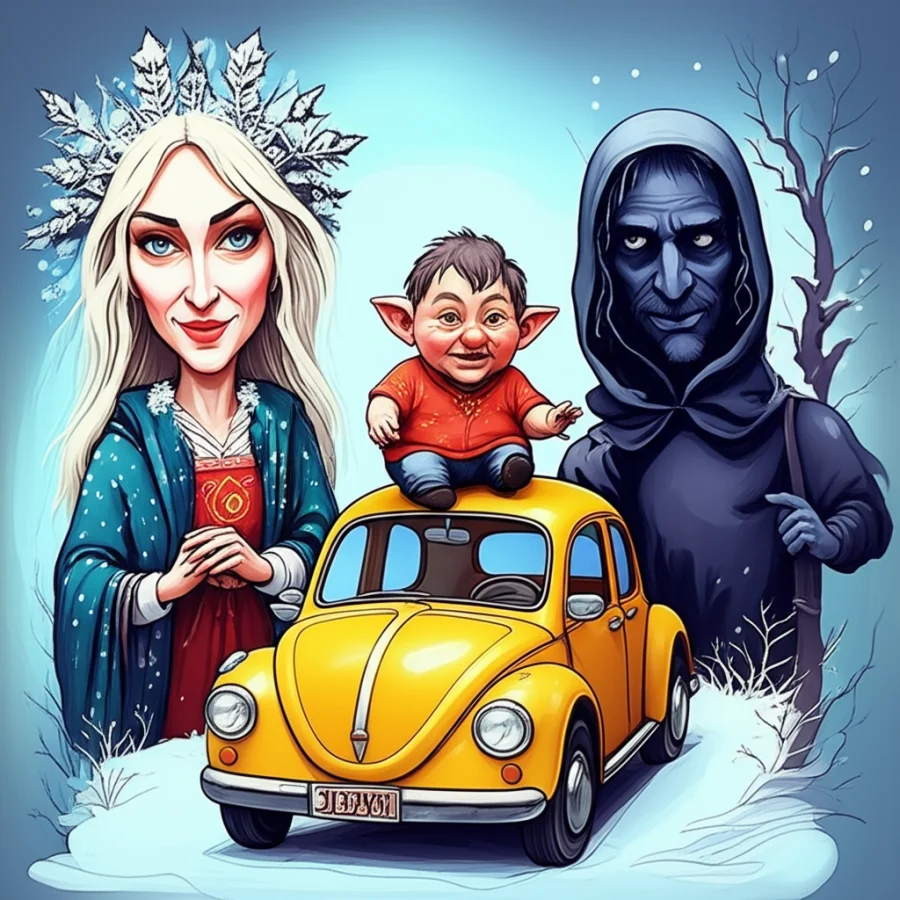
In the heart of Slavic lands, where ancient forests whispered secrets and rivers carved their stories into the earth, a rich tapestry of folklore was woven. These were the tales of a people who lived closely with the rhythms of nature, attributing spirit and agency to the very fabric of their world. Among these deeply rooted narratives, the figures of Morana, the Domovoi, and the concept of Nav offer a glimpse into the ancient Slavic worldview, a complex understanding of life, death, and the unseen forces that governed their existence. It is crucial to remember that these are traditional stories, born from the imagination and cultural understanding of past generations, not accounts of verifiable reality.
The cultural era in which these stories flourished was one steeped in animism and a profound respect for the natural world. Before the widespread adoption of monotheistic religions, ancient Slavs perceived the cosmos as alive, populated by spirits residing in trees, rocks, water, and the very air they breathed. Their lives were intrinsically linked to the agricultural cycle, the changing seasons, and the ever-present duality of creation and decay. Their worldview was not strictly scientific; it was one of interconnectedness, where the visible and the invisible realms were understood to influence one another. Fear and reverence often intertwined, shaping their rituals and their narratives.
Within this rich cultural milieu, the figure of Morana emerges as a potent embodiment of winter, death, and the harsh realities of nature’s cyclical demise. She is often depicted as a formidable, chilling entity, sometimes a crone, other times a pale, beautiful maiden, whose touch brings frost and whose presence signifies the end of warmth and life. Her dominion is the barren landscape, the frozen earth, and the silence that follows the last falling leaf. Morana, in this context, represents not an evil deity in the modern sense, but a necessary force of nature – the power that strips away the old to make way for the new, the inevitable transition that governs all living things.
Conversely, the Domovoi, meaning "of the house," stands in stark contrast. This is a benevolent, often unseen guardian spirit of the household. Unlike the grand, elemental power of Morana, the Domovoi is an intimate presence, deeply tied to the hearth and home. Ancient tales describe the Domovoi as a small, elderly man, often with a long white beard, sometimes resembling the master of the house in his youth. He might be seen as a furry creature, a cat, or even just a shadow. His presence is felt through subtle signs: the warmth of the hearth when no fire is lit, the sound of footsteps when no one is present, or the inexplicable tidiness of a messy room. The Domovoi’s role was to protect the family and their dwelling, ensuring prosperity and good fortune. However, he was also a creature of habit and sentiment. Neglecting the home, leaving chores undone, or showing disrespect could incur his displeasure, leading to misfortunes like broken objects, lost items, or even restless nights. Offering him a saucer of milk or a small portion of food was a customary way to appease and acknowledge him, a symbolic gesture of shared existence.
The concept of Nav, or Naw, adds another layer to this intricate cosmology. Nav is often understood as the underworld, the realm of the dead, or a parallel, unseen dimension. It is a place where souls might journey after death, or a liminal space that exists alongside the living world, occasionally intersecting with it. Nav was not necessarily a place of eternal damnation but a realm of transition and mystery. It represented the unknown, the ultimate destination that awaited all beings, and a reminder of the ephemeral nature of mortal life. The boundaries between the living world and Nav were considered permeable, especially during significant times like twilight, midnight, or certain festivals.
The narrative of Morana, the Domovoi, and Nav can be envisioned as a cyclical unfolding of existence, as understood by ancient Slavs. Imagine a harsh winter, personified by the chilling breath of Morana. The land lies dormant, life retreats, and the world seems to hold its breath. During this time, the Domovoi, the quiet guardian of the home, diligently tends to his domain, a beacon of warmth and stability within the frozen landscape. He ensures that the family within the dwelling remains safe and protected from the external harshness, a small pocket of enduring life.
As the cold grips the land, whispers of Nav might seem to grow louder. The fading light and the stillness of winter could evoke thoughts of the departed and the mysteries of the afterlife. Perhaps a story would be told around the crackling fire, a Domovoi’s unseen presence felt in the comforting glow, about a brave hunter who, lost in a blizzard, stumbled upon a hidden path that seemed to lead into Nav, a realm of ethereal beauty and melancholic silence, before finding his way back to the warmth of his home, forever changed by the encounter. Or perhaps a tale of a family mourning a loss, the Domovoi subtly comforting them by arranging a forgotten trinket of the deceased in a prominent place, a gentle reminder of memory and continued connection.
In these ancient tales, Morana embodies the inevitable cycle of decay and the stillness of death, a force that all must eventually face. The Domovoi represents the enduring spirit of life, continuity, and the sanctity of the home, a bulwark against the encroaching darkness. Nav is the great unknown, the ultimate destination that underscores the preciousness of the present moment and the interconnectedness of all existence. These figures and concepts were not worshipped as deities but were understood as integral parts of a complex, often precarious, natural order.
The symbolism woven into these narratives is profound. Morana could represent the necessary cleansing of winter, the fallow period that allows for eventual rebirth. Her presence was a reminder of mortality, urging people to appreciate life while it lasted and to prepare for its inevitable end. The Domovoi symbolized the importance of domestic harmony, community, and the unseen forces that contribute to well-being. He was a personification of good stewardship and the rewards of a well-ordered life. Nav represented the universal human experience of confronting the unknown, the mystery of death, and the spiritual dimension of existence. These stories served to explain the inexplicable, to provide comfort in times of uncertainty, and to imbue everyday life with a sense of wonder and purpose.
In modern times, these ancient echoes continue to resonate in literature, film, and gaming. The concept of guardian spirits like the Domovoi, albeit in more secularized forms, often appears in fantasy narratives, representing protective entities or the spirit of a place. Morana’s archetype, as a figure of winter and death, is a recurring motif in gothic literature and dark fantasy. The idea of parallel realms or the underworld, reminiscent of Nav, is a staple of speculative fiction and mythology-inspired storytelling. Cultural studies scholars explore these myths to understand the psychological, social, and environmental factors that shaped ancient Slavic societies.
In conclusion, the tales of Morana, the Domovoi, and Nav are captivating remnants of ancient Slavic folklore, offering a unique perspective on the world as perceived by past generations. They are powerful narratives born from human observation, imagination, and the deep-seated need to understand life, death, and the unseen forces that seemed to govern their existence. As Muslims, we recognize that only Allah is the true Creator and Sustainer, the ultimate power behind all things. Yet, the study of these cultural stories allows us to appreciate the richness of human heritage, the enduring power of storytelling, and the diverse ways in which humanity has sought meaning and order in the world throughout history. These echoes of Morana, the vigilance of the Domovoi, and the mystery of Nav serve as testament to the boundless creativity of the human spirit and its continuous quest to comprehend the universe around us.