
 fufufafa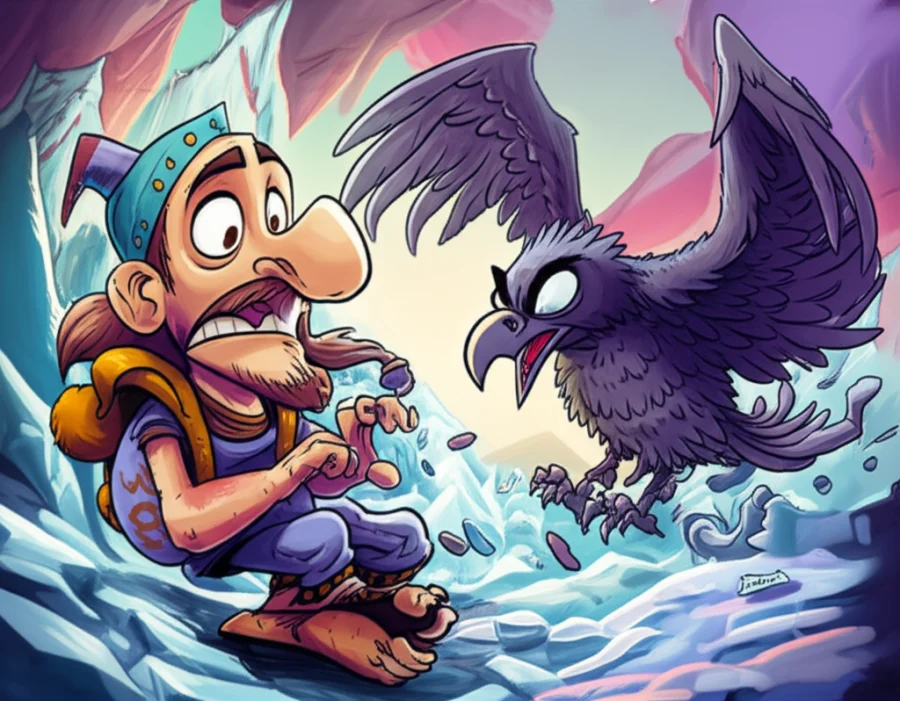
The chilling winds that howl across the stark, unforgiving landscapes of ancient Scandinavia carried with them tales of gods, giants, and beings that dwelled in realms beyond mortal ken. Among these narratives, woven into the very fabric of Norse culture, are stories of Niflheim, the primordial realm of ice and mist, and its enigmatic inhabitants. It is within this frigid, ethereal domain that we might imagine an encounter with the Muninn, a creature deeply embedded in the mythology of the Norse peoples. This is not a chronicle of verifiable events, but rather a journey into the heart of ancient storytelling, a testament to the human impulse to explain the unknown through myth and legend.
The era that birthed these tales was one of harsh realities and profound wonder. The Norse people, dwelling in the northern reaches of Europe, were intimately familiar with the power of nature. Their lives were dictated by the seasons, the fury of storms, and the vast, silent expanse of the wilderness. Their worldview was one where the physical world was but one layer of existence, interwoven with a vibrant, often perilous, spiritual realm. Gods walked among mortals, spirits inhabited the natural world, and the dead journeyed to distinct afterlife realms. This was a society that found meaning and order not only in the tangible but also in the symbolic, in the stories that helped them grapple with life’s mysteries and their own place within the grand cosmic design.
The Muninn, as envisioned in these ancient narratives, is not a creature of flesh and blood in the way we understand it. It is more of an essence, a manifestation of memory, thought, and the lingering echoes of what has been. Its symbolic attributes are those of intellect, the passage of time, and the ethereal nature of consciousness. It is often associated with Odin, the All-Father, and his ravens, Huginn (Thought) and Muninn (Memory), who fly across the worlds bringing him knowledge. However, within the context of Niflheim, the Muninn takes on a more primal, perhaps even melancholic, form. It is a guardian, a keeper of forgotten histories, a silent observer in the realm where all things eventually fade into the cold embrace of oblivion. Imagine it not as a beast with claws and fangs, but as a swirling mist, a fleeting shadow, a whisper carried on an icy gust. Its eyes, if it possesses them, might gleam with the distant light of dying stars, reflecting the accumulated weight of eons. Its form would be fluid, shifting, a tangible representation of the intangible – memory itself.
Let us then, with respectful curiosity, step into the frigid expanse of Niflheim and envision such an encounter. The air is thin and bites with an unnatural cold. Jagged peaks of ice pierce a sky perpetually shrouded in a pale, diffused light. Rivers of frozen mist flow sluggishly, carrying with them the faint, melancholic murmur of lost sounds. It is here, amidst this desolate beauty, that the path of a traveler, perhaps one seeking forgotten lore or venturing too close to the edges of existence, might intersect with the Muninn.
The encounter would not be heralded by roars or thunderous footsteps. Instead, a subtle shift in the atmosphere would occur. The biting wind might momentarily still, replaced by an almost imperceptible hum, like the distant resonance of an ancient bell. A patch of mist, denser than the rest, would begin to coalesce, taking on a vaguely humanoid shape, or perhaps something more abstract, like a column of swirling, luminous frost. There would be no direct confrontation, no threat of physical violence. The Muninn’s power, if such a term can be applied, lies in its presence, in the overwhelming sense of being in the presence of something ancient and all-encompassing.
The traveler might feel a profound sense of stillness, a quieting of their own internal thoughts. Images, fragmented and dreamlike, could begin to flicker at the edges of their vision – scenes from forgotten battles, the laughter of long-dead children, the whispers of prophecies unfulfilled. These are not visions imposed by malice, but rather the natural effluence of the Muninn’s being, the echoes of all that has ever been, now residing in the ultimate repository of all things that fade. The traveler might feel a profound understanding dawn within them, not through spoken words, but through an intuitive grasping of the cyclical nature of existence, the inevitability of decay, and the enduring power of memory, however faint. The Muninn would be a silent witness, a repository of the past, its presence a stark reminder of the ephemeral nature of all things, even the most vibrant of lives. The encounter would leave the traveler with a sense of awe, perhaps a touch of sorrow, and a deep contemplation of their own mortality and the stories that will outlast them.
To the ancient Norse people, the Muninn, and the concept it embodied, held significant symbolic weight. It represented the constant struggle against oblivion, the importance of remembering and preserving knowledge, and the inherent impermanence of all things. In a world where oral tradition was paramount, the concept of memory, personified by the Muninn, was crucial for the transmission of history, laws, and cultural identity. Its association with Niflheim, the realm of primordial cold and mist, further emphasized the idea that even the most vibrant of memories eventually succumb to the passage of time, fading into the vast, undifferentiated void. It could also be seen as a symbol of the wisdom that comes with age and experience, the accumulated knowledge that shapes understanding.
In the modern world, the echoes of such mythological beings continue to resonate. The concept of memory and its power is a recurring theme in literature, film, and video games. Characters who possess immense knowledge of the past, who can commune with spirits of forgotten eras, or who are intrinsically linked to the concept of memory itself, often draw inspiration from figures like the Muninn. Scholars of mythology and folklore study these narratives to understand the cultural anxieties, beliefs, and aspirations of ancient societies. The Muninn, as a symbol of remembrance and the ethereal nature of consciousness, continues to fuel our imaginations, prompting us to consider the enduring power of stories and the indelible mark that memory leaves upon the human experience.
It is vital to reiterate that the Muninn is a creation of ancient storytelling, a product of human imagination attempting to comprehend the world. It is not a being to be believed in or worshipped. As Muslims, we understand that all creation, all power, and all sustenance originate from Allah, the One True Creator. Our understanding of the world is guided by divine revelation and the teachings of Islam.
This exploration of the Muninn of Niflheim serves as a reminder of the rich tapestry of human cultural heritage. These traditional stories, born from the fertile ground of ancient imagination and shaped by the environments and beliefs of their creators, offer invaluable insights into the minds of our ancestors. They are a testament to our innate need to tell stories, to find meaning in the unknown, and to connect with something larger than ourselves, even if that connection is forged through the whispers of myth and the enduring power of imagination. The tales of Niflheim and its spectral inhabitants remind us that while the physical world may fade, the echoes of our stories and the essence of memory can, in their own way, endure.







