fufufafa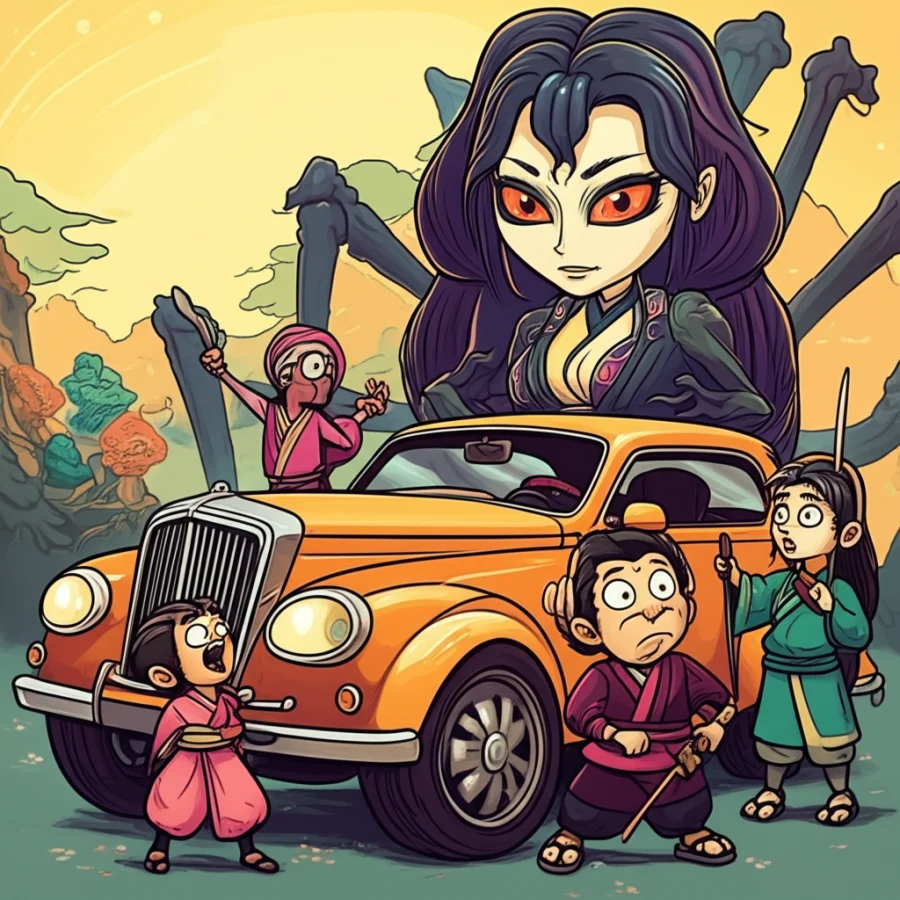
The mists that shroud the ancient landscapes of Japan, particularly the storied province of Izumo, have long been a canvas for the vibrant tapestry of its folklore. Within these tales, woven from threads of human experience, fear, and wonder, resides the legend of the Jorōgumo. This is not a chronicle of divine decree, but a traditional story, passed down through generations by the people of ancient Japan, offering a glimpse into their worldview and the imaginative ways they sought to understand the world around them.
The era in which stories like that of the Jorōgumo likely took root was one deeply intertwined with the natural world. For the ancient Japanese, the boundary between the mundane and the spiritual was permeable. Forests were not merely collections of trees but potent realms inhabited by spirits, both benevolent and capricious. The changing seasons, the abundance of harvest, the ferocity of storms – all were seen as manifestations of forces beyond human control, often attributed to supernatural beings. In such a society, where survival depended on a delicate balance with nature, and where the unseen held significant sway, creatures born from the shadows and the wild held a profound resonance. The natural world was a place of both beauty and danger, and the myths reflected this duality.
The Jorōgumo, at its heart, is a creature of duality, a being that embodies both alluring beauty and deadly peril. In its most commonly depicted form, it is a spider of immense size, capable of transforming into a beautiful woman. This human guise is often depicted as incredibly alluring, with captivating eyes and a seductive charm, designed to lure unsuspecting travelers. Her true nature, however, is revealed by subtle details: perhaps a lingering glimpse of a spider’s leg, or the glint of multiple eyes hidden within her human form. Her symbolic attributes are deeply rooted in the characteristics of her arachnid namesake. Spiders are weavers, creating intricate webs that are both traps and homes. This act of weaving can symbolize the complex, often deceptive, nature of fate, or the intricate machinations of those who wield power. The silk itself, strong yet delicate, can represent beauty that conceals danger, or the subtle threads that bind individuals to their destinies. The multiple eyes of a spider can symbolize heightened awareness, or perhaps a sinister, all-seeing gaze that observes and judges.
The narrative of the Jorōgumo often unfolds with a chilling predictability. A lone traveler, perhaps a weary merchant or a curious scholar, ventures into a secluded forest or a forgotten mountain path. As dusk settles, and the shadows lengthen, he encounters a woman of extraordinary beauty. She might offer him shelter, sustenance, or simply her captivating company. Drawn in by her charm and perhaps by a sense of enchantment, the traveler finds himself increasingly ensnared. The conversation flows, the atmosphere grows intimate, and the traveler, blinded by desire, fails to notice the subtle shifts in his surroundings or the growing unease within himself.
As the night deepens, or at a crucial moment of vulnerability, the Jorōgumo’s true form begins to manifest. The alluring woman might reveal glimpses of her arachnid nature – a leg elongating unnaturally, eyes multiplying in her reflection, or her voice taking on a hissing quality. The traveler, horrified and trapped, realizes his mistake. He has been ensnared not by love or kindness, but by a predator. The spider, in its full, monstrous form, then proceeds to incapacitate its victim, often wrapping them in thick, silken threads, draining their life force or consuming them whole. The tale serves as a cautionary narrative, warning against the dangers of misplaced trust, the allure of superficial beauty, and the unseen perils that can lurk in the natural world.
The symbolism embedded within the Jorōgumo myth is multifaceted. For ancient people, it could have represented the primal fear of the wild and its untamed dangers. The forest, while a source of sustenance, was also a place where one could easily become lost, both physically and metaphorically. The creature’s ability to transform speaks to the deceptive nature of appearances, a vital lesson in a society where survival often depended on discerning true intentions. The Jorōgumo can also be seen as a personification of nature’s indifferent power – a force that can nurture and sustain, but also consume and destroy. The intricate web she weaves can symbolize the interconnectedness of life and death, or the inescapable consequences of certain choices. Some interpretations suggest the Jorōgumo embodies the darker aspects of feminine allure, a cautionary tale about the potential dangers of unbridled desire and the seduction of the unknown.
In the modern era, the Jorōgumo continues to captivate the imagination, finding new life in various forms of media. In literature, she appears as a complex antagonist or a tragic figure, her dual nature explored through intricate character development. In video games, the Jorōgumo is often depicted as a formidable boss enemy, her spider-like abilities and alluring human form translating into challenging combat mechanics. Her presence in manga and anime often delves into themes of temptation, transformation, and the blurred lines between humanity and the monstrous. These modern interpretations, while drawing from the ancient legend, often add layers of psychological depth or explore the creature’s motivations beyond mere predatory instinct, reflecting contemporary storytelling sensibilities.
It is crucial to reiterate that the legend of the Jorōgumo is a product of ancient storytelling, a cultural artifact born from the imagination of people long past. As Muslims, we recognize that only Allah (God) is the true Creator and Sustainer of all existence. These stories, while fascinating from a cultural and historical perspective, do not represent divine truth or hold any power over our faith. They are testaments to the enduring human capacity for storytelling, for weaving narratives that explore our fears, our desires, and our understanding of the world. The Jorōgumo, in her silken embrace, reminds us of the richness of cultural heritage, the power of imagination, and the timeless tradition of sharing tales that continue to resonate, even centuries after they were first whispered into the twilight.