
 fufufafa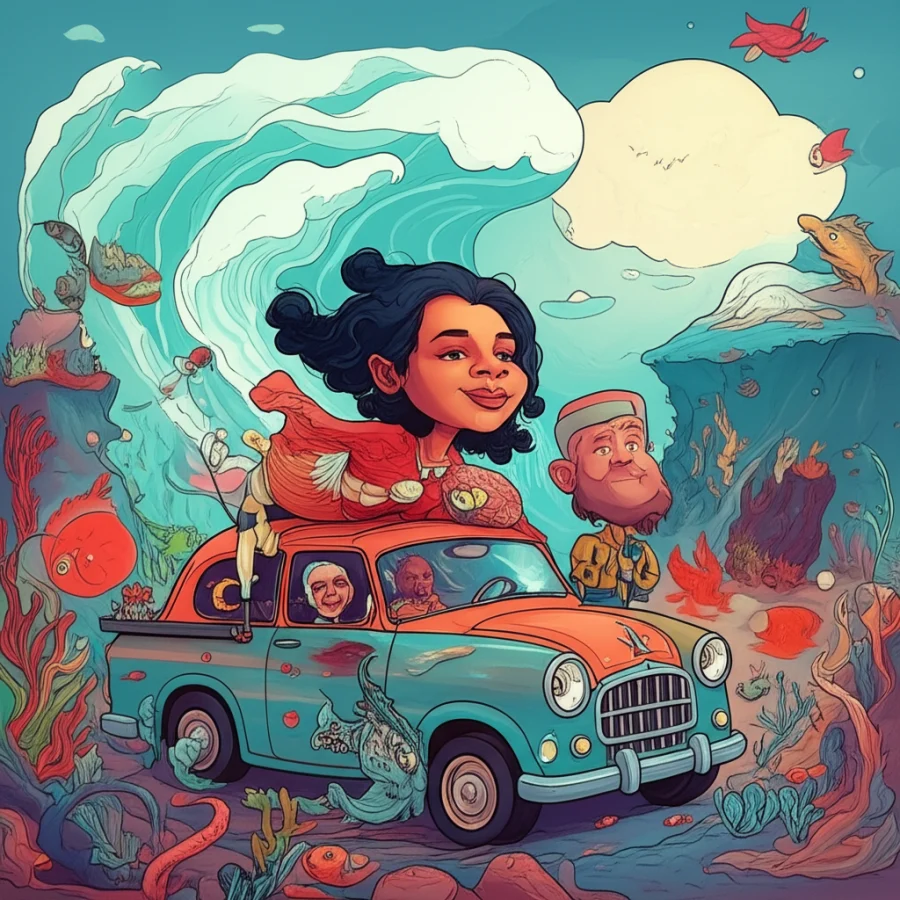
In the rich tapestry of West African folklore, particularly among the Yoruba people of what is now Nigeria, lie countless stories woven from the threads of nature, human experience, and the unseen forces that ancient peoples believed shaped their world. Among these narratives, one that whispers through the wind and the rustling leaves is the chronicle of Oya and the Forgotten Sea. This is not a tale of divine decree or historical fact, but a traditional story, a product of the human imagination striving to understand the vastness of existence, passed down through generations as a way to make sense of the world around them.
The origins of this myth are deeply rooted in the cultural landscape of the Yoruba civilization, a society that flourished for centuries, characterized by sophisticated city-states, intricate spiritual systems, and a profound connection to the natural world. Imagine a time when life was intimately tied to the rhythms of the earth – the planting and harvesting seasons, the fury of thunderstorms, the gentle ebb and flow of rivers, and the distant, awe-inspiring presence of the ocean. In this environment, where the forces of nature were not merely observed but felt with visceral intensity, people sought explanations for the phenomena that governed their lives. Their worldview was animistic, perceiving spirits and consciousness not only in humans but also in animals, plants, rivers, and the sky. The divine was not confined to a distant realm but was immanent, interwoven with the fabric of reality. It was within this context that stories like the Chronicle of Oya and the Forgotten Sea were born, serving as imaginative interpretations of the world’s power and mystery.
At the heart of this narrative stands Oya, a formidable figure often depicted as an Orisha, or deity, associated with winds, storms, lightning, and change. In her symbolic essence, Oya is a force of potent energy and transformative power. She is the whirlwind that can uproot the old and pave the way for the new, the thunderclap that shakes the very foundations of the earth, and the lightning that illuminates the darkest skies. Her attributes are not those of a benevolent matriarch or a stern judge in the Abrahamic sense, but rather the untamed, dynamic aspects of nature itself. She embodies the exhilarating, and at times terrifying, power of change, the restless spirit that drives creation and destruction in an unending cycle.
The narrative of Oya and the Forgotten Sea speaks of a time when the world was different, when the boundaries between the known and the unknown were more permeable. It is said that Oya, in her restless quest for knowledge and dominion, once journeyed to the edge of existence, to a place where the waters of the world converged, but which had somehow been lost to memory and understanding – the Forgotten Sea. This was not a mere body of water, but a mystical expanse, a repository of forgotten truths and lost destinies.
The tale unfolds with Oya, her spirit as tempestuous as the winds she commanded, feeling a pull towards this elusive realm. She traversed lands scorched by drought and forests heavy with rain, her presence marked by the rustling of leaves and the distant rumble of thunder. Her journey was not easy; she faced trials of endurance and tests of will, her path often obscured by illusions and the whispers of doubt. But Oya, with her fierce determination, pressed on, her eyes fixed on the horizon where the sky met an unseen, unfathomable ocean.
Upon reaching the shores of the Forgotten Sea, Oya found not a tranquil haven, but a turbulent expanse, its waters swirling with an ancient, potent energy. The air thrummed with the echoes of forgotten songs and the lamentations of lost civilizations. Here, the sea did not reflect the sky but held within its depths a myriad of spectral lights, hinting at a world beyond the ordinary. Oya, recognizing the profound power held within this forgotten realm, engaged with its enigmatic currents. Some accounts suggest she wrestled with the very essence of the sea, attempting to harness its power, while others speak of a more contemplative interaction, where she sought to understand its secrets. It is said that she learned of the cyclical nature of existence, of how even the most powerful forces eventually fade and are reborn, and that true mastery lies not in control, but in understanding and adapting to change. The Forgotten Sea, in this telling, represents a profound cosmic memory, a place where all that has been and all that could be resides.
The symbolism embedded within this myth is rich and multifaceted. For the ancient Yoruba, Oya likely represented the unpredictable yet vital forces of nature that governed their lives. The storm was not just a meteorological event but a manifestation of powerful, transformative energy. The Forgotten Sea, on the other hand, could symbolize the unknown, the subconscious, or the collective memory of humanity – a vast reservoir of experiences and wisdom that lies just beyond our immediate grasp. The myth may have spoken to the importance of embracing change, even when it is disruptive, as Oya’s storms cleared the air and made way for new growth. It could also have served as a cautionary tale about the dangers of neglecting the past or the unseen forces that shape our reality. The act of forgetting, represented by the sea, could be seen as a loss of connection to fundamental truths, while Oya’s quest suggests the importance of seeking out and understanding these lost elements.
In the modern world, the Chronicle of Oya and the Forgotten Sea continues to resonate, albeit in different forms. Within academic circles, it is studied as a valuable piece of cultural heritage, offering insights into the worldview, beliefs, and artistic expressions of the Yoruba people. In literature and popular culture, Oya has been reimagined in various forms, often as a powerful female warrior or sorceress, embodying strength and independence. Her association with storms and change makes her a compelling figure for storytelling, appearing in novels, graphic novels, and even video games where her character might represent a force of nature, a guardian of hidden knowledge, or a catalyst for dramatic plot developments. These interpretations, while inspired by the original myth, often adapt the narrative to suit contemporary themes and audiences, demonstrating the enduring power of folklore to evolve and inspire.
As we reflect on this narrative, it is crucial to reiterate that the Chronicle of Oya and the Forgotten Sea is a traditional story, a product of ancient human imagination and a testament to the enduring power of storytelling. It offers a window into a past worldview, where the natural world was imbued with spirit and mystery. As Muslims, we recognize that only Allah (God) is the true Creator and Sustainer of the universe. These ancient stories, while culturally significant, do not alter this fundamental truth. Instead, they serve as valuable examples of how human cultures have historically sought to interpret and explain the world around them, showcasing the richness of human heritage and the boundless capacity for imagination that defines our storytelling traditions. The echoes of Oya and her journey to the Forgotten Sea remind us of the power of narrative to connect us to our past, to explore the depths of human understanding, and to celebrate the diverse ways in which cultures have chronicled their existence.


 admin
admin
 rifanmuazin



