
 fufufafa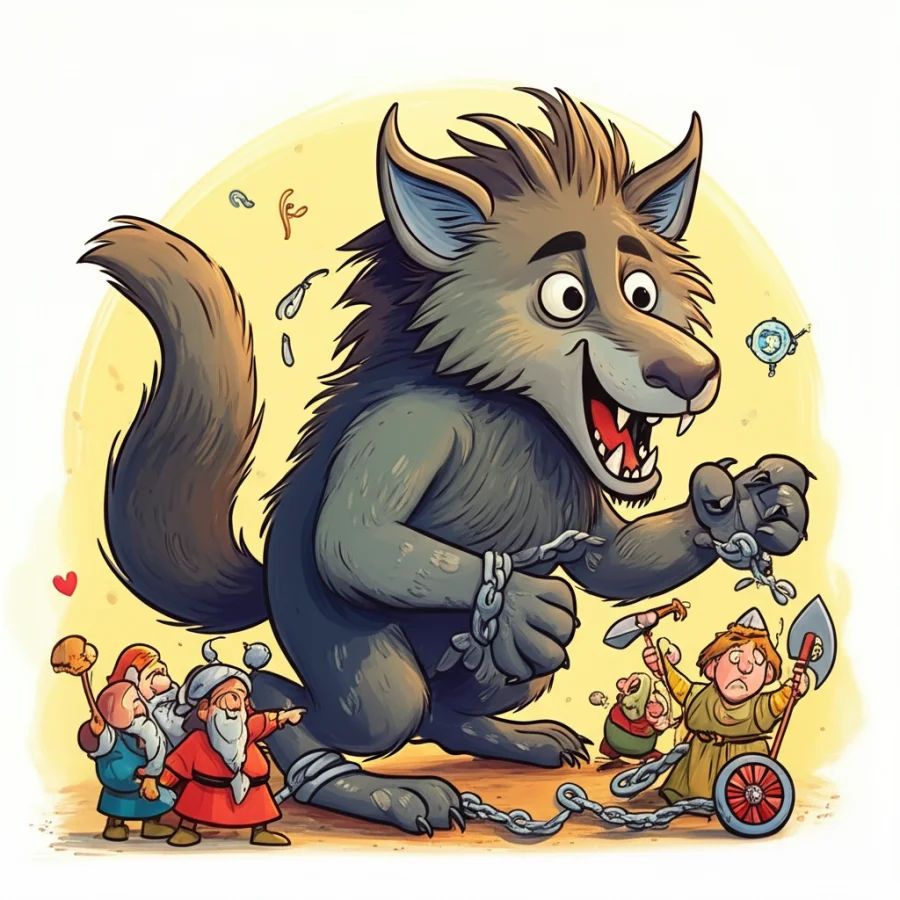
In the annals of human storytelling, few narratives capture the imagination with the stark power and raw grandeur of Norse mythology. Originating from the ancient Germanic peoples of Scandinavia, Iceland, and parts of continental Europe, these are not historical accounts but rather traditional stories passed down through generations by ancient communities. They form a rich tapestry of gods, giants, heroes, and monsters, offering a glimpse into a worldview shaped by a dramatic landscape and a profound sense of destiny. Among these powerful figures, none embodies a more primal, terrifying force than Fenrir, the colossal wolf whose very existence portends the twilight of the gods.
The cultural era in which these myths flourished, broadly known as the Viking Age (c. 793–1066 CE), was one of profound connection to nature, cyclical existence, and the inherent struggles within the cosmos. For the Norse people, the world was not a static creation but a dynamic realm of constant interplay between opposing forces: order and chaos, creation and destruction, light and shadow. Their environment – harsh northern lands, vast oceans, and towering forests – instilled a deep respect for natural power and a recognition of the fleeting nature of life. They envisioned a world tree, Yggdrasil, connecting nine distinct realms, sustained by a delicate balance that was perpetually threatened by forces of entropy and destruction. Within this worldview, fate, or wyrd, played a significant role, suggesting that even the gods were subject to an overarching destiny that would culminate in the cataclysmic event of Ragnarök. It was in this crucible of cosmic order and looming chaos that the legend of Fenrir took shape.
Fenrir, the subject of this particular narrative, is depicted as a monstrous wolf, a creature of immense size and terrifying strength. He is not merely a large animal but a being infused with destructive cosmic energy, one of the three monstrous children of the trickster god Loki and the giantess Angrboda. From his earliest days, he grew at an alarming rate, his jaws capable of swallowing the sun and moon. Symbolically, Fenrir represented the untamed, destructive aspects of nature, the chaotic forces that perpetually threaten to unravel established order. He embodied the ancient fear of overwhelming power, a force so potent that even the mighty Æsir, the gods of Asgard, could not truly defeat him, only temporarily contain him. His symbolic attributes speak not to a divine power to be worshipped, but to a profound ancient understanding of inevitable forces, of the ultimate end that awaits all things, even the gods themselves.
Our "encounter" with Fenrir, as recounted in the ancient sagas and Eddic poems, is not one of a mortal meeting the beast, but rather the gods’ desperate struggle to contain a burgeoning threat to their existence. It is a story steeped in dramatic tension and foreboding. The Æsir, dwelling in the shining halls of Asgard, watched Fenrir grow with increasing alarm. He grew so rapidly and became so immense that only the courageous god Tyr dared to feed him. The gods knew, through prophecies, that Fenrir was destined to play a pivotal role in Ragnarök, consuming Odin himself. Their fear was not irrational; it was a deep-seated dread of an inevitable, destructive force.
Determined to avert this grim prophecy, the gods first attempted to bind Fenrir with immense chains. They forged a mighty iron chain called Læding and challenged the wolf to test his strength against it. Fenrir, with a casual shrug, snapped it effortlessly. Undeterred, the gods forged an even stronger chain, Drómi, twice as stout as the first. Again, Fenrir, with a grin that showed teeth like daggers, flexed his muscles and shattered it into pieces. The Æsir grew desperate; no ordinary chain could hold this beast.
In their hour of need, Odin dispatched messengers to the dwarves, the master craftsmen of the underworld, renowned for their unparalleled skill. The dwarves, aware of the gravity of the situation, crafted a chain unlike any other, not of metal, but of six impossible ingredients: the sound of a cat’s footfall, the beard of a woman, the roots of a mountain, the sinews of a bear, the breath of a fish, and the spittle of a bird. This deceptively thin, silken ribbon was called Gleipnir, and it was imbued with powerful magic, light as a feather yet stronger than any iron.
The gods presented Gleipnir to Fenrir on the island of Lyngvi, in the middle of a vast lake. Fenrir, ever suspicious, eyed the slender ribbon. "This looks like a mere band," he growled, his voice a tremor in the earth, "but I suspect treachery. If you truly wish to test my strength, one of you must place his hand in my mouth as a pledge of good faith." A hush fell over the gods. To place a hand in Fenrir’s jaws was to invite certain doom. Yet, without a pledge, Fenrir would never allow himself to be bound.
It was the brave and honorable god Tyr, the god of war and justice, who stepped forward. Without hesitation, he placed his right hand deep into the wolf’s terrifying maw. The other gods then wrapped Gleipnir around Fenrir. The more the wolf struggled, the tighter and stronger the magical ribbon became. Panic flickered in Fenrir’s eyes as he realized he was truly trapped. With a frustrated roar, he snapped his jaws shut. Tyr’s hand was severed, a sacrifice for the greater good of the cosmos. The gods, though grim at Tyr’s loss, rejoiced. Fenrir was bound. They fastened the end of Gleipnir to a massive boulder, Gjöll, and then drove a huge peg, Thviti, deep into the earth to secure it further. Fenrir howled ceaselessly, his rage echoing across the realms, but he was held fast, his mouth propped open by a sword to prevent him from biting. There he remains, bound and biding his time, until the day of Ragnarök, when he will finally break free and fulfill his destructive destiny.
The story of Fenrir’s binding is rich with symbolism and meaning that would have resonated deeply with ancient Norse people. It represented the eternal struggle against chaos and the forces that threaten to overwhelm order. Fenrir embodies untamed, destructive power, a raw force of nature that cannot be reasoned with, only contained. Tyr’s sacrifice highlights themes of courage, selflessness, and the willingness to pay a terrible price for the common good – a concept deeply valued in a warrior society. The narrative also underscores the inevitability of fate; even the gods, with all their power and wisdom, could only delay, not prevent, Fenrir’s ultimate role in the world’s end. It speaks to a cyclical view of existence, where creation and destruction are two sides of the same coin, and even the most formidable powers eventually face their demise.
In the modern era, the myth of Fenrir continues to captivate and inspire, reinterpreted across various mediums. He appears prominently in fantasy literature, often as a formidable beast or a symbolic representation of primal power. In movies and television, from epic historical dramas to superhero franchises, elements of Fenrir’s story are woven into narratives of impending doom and heroic sacrifice. Video games frequently feature Fenrir as a boss character or a legendary foe, challenging players to overcome his immense power. Academically, the myth is studied for its cultural insights, its psychological implications, and its contribution to the broader understanding of comparative mythology. These modern interpretations celebrate the imaginative power of the story, not as a literal truth, but as a compelling piece of cultural heritage that speaks to universal human experiences of fear, courage, and destiny.
Ultimately, the tale of Fenrir is a powerful testament to the enduring human capacity for storytelling. It is a cultural narrative from a bygone era, meticulously crafted by ancient minds to explain their world and their place within it. It is not a belief system to be adopted, nor are its figures to be worshipped or validated as real entities. As Muslims, we recognize that only Allah is the true Creator and Sustainer of the universe, and all narratives outside of divinely revealed scripture are products of human imagination and cultural expression. The story of Fenrir, like countless other myths across civilizations, stands as a remarkable monument to our collective cultural heritage, reminding us of the profound ways in which imagination and storytelling have shaped human understanding and continue to enrich our world.







