fufufafa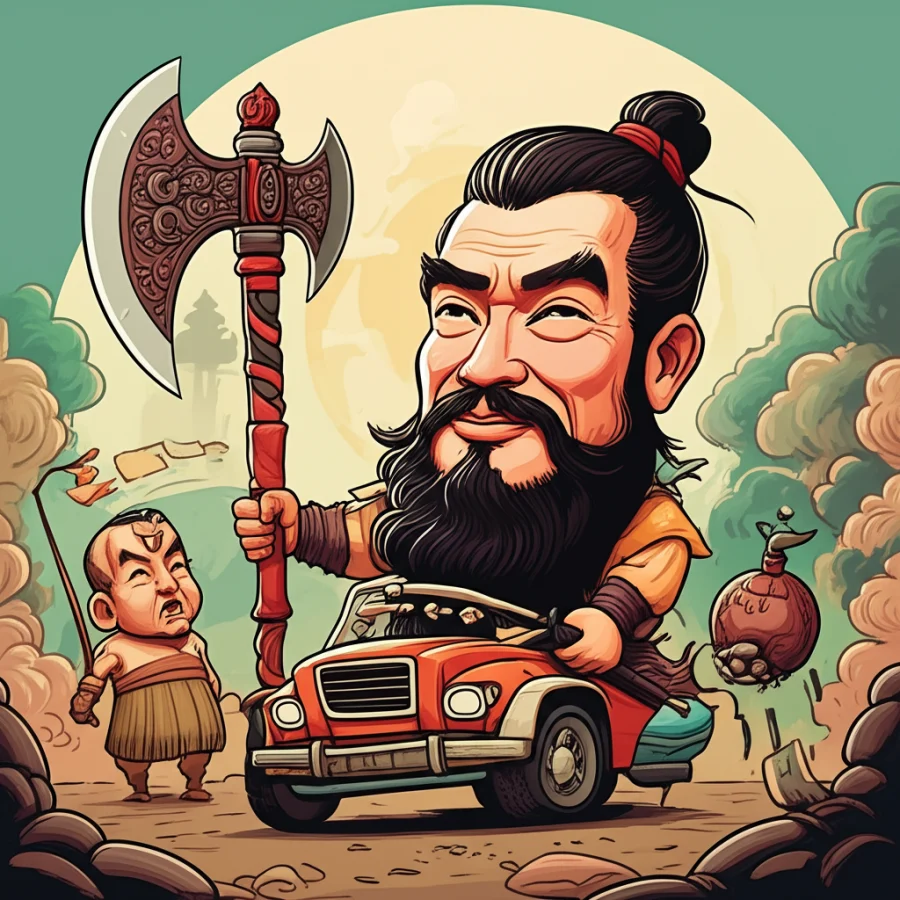
In the vast tapestry of human storytelling, where ancient whispers intertwine with the dawn of civilization, lies the myth of Pangu and his Heavenly Axe. This narrative, woven from the threads of early Chinese cosmology, offers a fascinating glimpse into how our ancestors grappled with the fundamental questions of existence: the origin of the cosmos, the nature of creation, and the forces that shape our world. It is a tale passed down through generations, a testament to the enduring power of imagination and the human need to make sense of the unfathomable.
The genesis of this legend can be traced back to a time when the world was a realm of potent spirits and unfathomable energies, a period before written records solidified into definitive histories. During the nascent stages of Chinese civilization, particularly during the Han Dynasty (206 BCE – 220 CE), these foundational myths began to coalesce and be recorded. The people of this era lived intimately with the natural world. Their understanding of the universe was often anthropomorphic, attributing human-like qualities to celestial bodies, geological formations, and the very forces of nature. The world was a dynamic entity, capable of both benevolent creation and terrifying destruction, and their stories reflected this awe and apprehension. They envisioned a primordial state of chaos, a formless void from which all things eventually emerged, a concept echoed in many creation myths across the globe.
Central to this particular narrative is the colossal figure of Pangu. Imagine him not as a god in the Abrahamic sense, but as a primeval being, a titan born within the cosmic egg. His form was immense, his existence predating the heavens and the earth. Pangu is often depicted with a formidable physique, his body imbued with the raw, untamed power of the nascent universe. His most significant attribute, however, is the Heavenly Axe. This is not merely a tool but a symbol of immense cosmic power, an extension of Pangu’s very being, capable of cleaving apart the primordial darkness. The axe itself is often described as celestial, forged from the essence of stars or the concentrated energy of the void. Its weight is immeasurable, its edge impossibly sharp, designed to carve order from chaos. Pangu’s symbolic attributes are those of immense strength, primal creation, and the ultimate architect of the physical world. He represents the initial, forceful act of separation that brought forth existence as we know it.
The story unfolds in the boundless darkness of the primordial void. For eighteen thousand years, Pangu slumbered within this cosmic egg, a swirling, undifferentiated mass of potential. When he finally awoke, the darkness was oppressive, suffocating. Driven by an instinctual need for space and light, Pangu stretched his mighty limbs. With a thunderous roar that echoed through the nothingness, he grasped the Heavenly Axe. The swing was colossal, a monumental effort that rent the very fabric of the void. The lighter, purer elements, the Yang, ascended to form the heavens, while the denser, heavier elements, the Yin, descended to become the earth.
However, the act of separating heaven and earth was not without consequence. Pangu, with his colossal strength, stood between the two realms, his body acting as a celestial pillar, preventing them from collapsing back into chaos. For another eighteen thousand years, he toiled, his body growing taller, pushing the heavens ever higher and the earth ever deeper. The constant strain and the immense responsibility took their toll. As Pangu’s strength waned, a profound weariness settled upon him, a curse born from the very act of creation. He had brought forth the world, but at the cost of his own immense vitality.
When Pangu finally succumbed to his exhaustion, his body, which had served as the foundation of the cosmos, dissolved into the myriad elements of the world. His breath became the wind and clouds, his voice the thunder, his eyes the sun and moon, his limbs the mountains, his blood the rivers, his hair the stars, his flesh the soil, and his sweat the rain. Thus, the world was formed from the sacrifice of its creator. Yet, it is said that the immense power unleashed by the Heavenly Axe, and the curse of separation and constant effort it represented, left an indelible mark. The very forces that sustain the world – the cycle of seasons, the flow of rivers, the movement of celestial bodies – are imbued with the echo of Pangu’s labor and the residual energy of his immense undertaking. Some interpretations suggest that the curse was not necessarily malicious, but rather the natural consequence of such a monumental act, a perpetual reminder of the effort required to maintain order against the ever-present threat of chaos.
The symbolism embedded within the myth of Pangu and his Heavenly Axe is rich and multifaceted. The cosmic egg represents the primordial state of undifferentiation, the potential from which all things emerge. Pangu’s awakening and the use of the Heavenly Axe symbolize the act of creation itself – a forceful, transformative process that requires immense power and effort. The separation of Yin and Yang reflects the ancient Chinese philosophical concept of dualistic forces that govern the universe, their interaction and balance being crucial for existence. Pangu’s dissolution into the elements is a powerful metaphor for sacrifice and the interconnectedness of all things. The idea of a curse can be interpreted as the inherent challenges and responsibilities that come with establishing and maintaining order, a constant struggle against entropy. It speaks to the perceived precariousness of existence, the idea that the world is not static but requires continuous effort to endure.
In the modern era, the myth of Pangu has transcended its ancient origins, finding new life in various forms of cultural expression. It serves as a foundational element in literature, particularly in historical fiction and fantasy novels exploring Chinese mythology. In movies and video games, Pangu and his Heavenly Axe are often depicted as powerful cosmic entities or legendary artifacts, contributing to rich and imaginative world-building. Cultural studies scholars analyze these myths for insights into ancient Chinese thought, their worldview, and their understanding of cosmology and the human place within it. The narrative continues to be a source of inspiration, a reminder of the enduring human fascination with origins and the creative forces that shape our reality.
It is crucial to reiterate that the story of Pangu and his Heavenly Axe is a traditional tale, a product of ancient human imagination and a way of understanding the world before scientific inquiry provided alternative explanations. As Muslims, we recognize that only Allah (God) is the true Creator and Sustainer of the universe. The concept of Pangu is a cultural narrative, not a divinely revealed truth or a being to be worshipped.
In conclusion, the myth of Pangu and his Heavenly Axe stands as a testament to the enduring power of human storytelling and the deep-seated need to explore our origins. It offers a window into the minds of ancient peoples, their awe of the cosmos, and their attempts to articulate the grand mystery of creation. While we understand these narratives through the lens of cultural heritage and imaginative exploration, they serve as a valuable reminder of the rich tapestry of human thought and the diverse ways in which our ancestors sought to comprehend their existence. These stories, though not to be believed as fact, continue to enrich our understanding of cultural heritage and the enduring tradition of human imagination.