
 fufufafa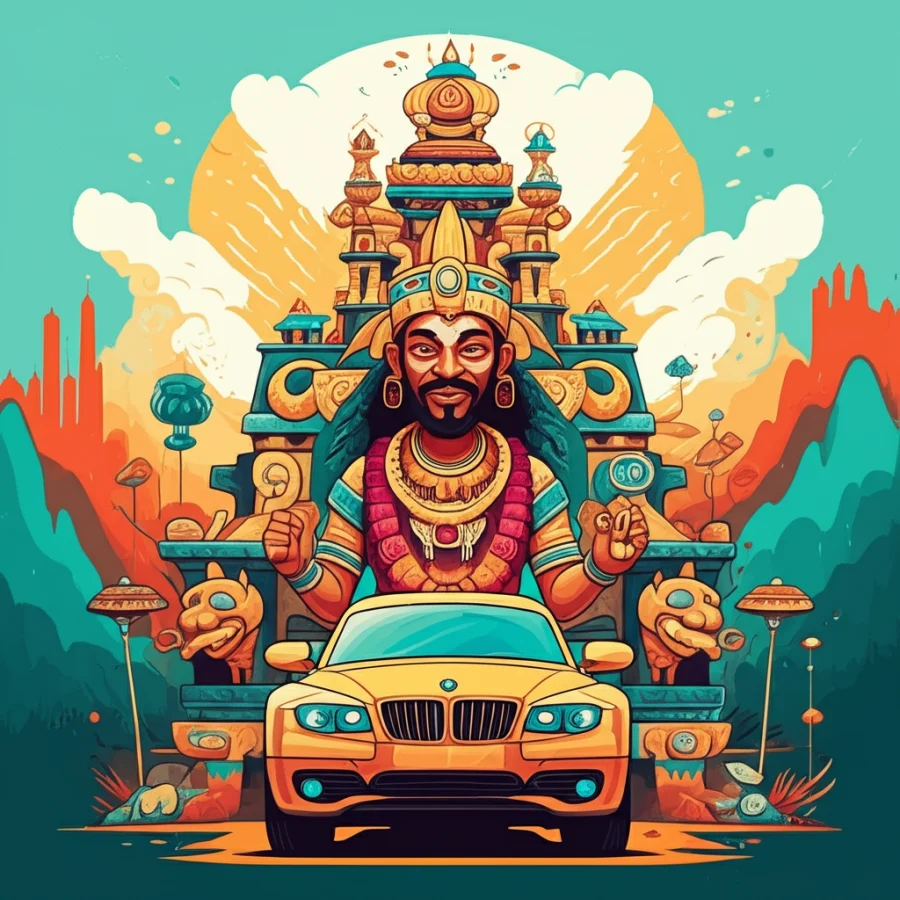
In the vibrant tapestry of West African folklore, woven with threads of ancestral wisdom and profound cosmology, lies the captivating chronicle of Olorun and the Sacred Temple. This ancient narrative, passed down through generations by the Yoruba people of Nigeria and Benin, offers a glimpse into a world where the divine and the earthly were intricately intertwined, and where the very fabric of existence was understood through the lens of myth and legend. It is crucial to remember that this is a traditional story, a product of the rich imagination and spiritual inquiry of ancient peoples, not a factual account or a doctrine to be adopted.
The cultural era in which this myth took root was one deeply connected to the rhythms of nature and the cycles of life. The Yoruba people, traditionally agriculturalists and artisans, lived in societies where the visible world was understood as a reflection of an unseen spiritual realm. The land, the sky, the rivers, and the creatures that inhabited them were not merely physical entities but manifestations of powerful forces and divine wills. Their worldview was animistic, believing that spirits resided in all things, and their lives were guided by a complex pantheon of deities, or Orishas, each governing specific aspects of the universe and human experience. This intricate system of belief provided a framework for understanding creation, morality, and the human condition, offering comfort, guidance, and a sense of order in a world that could often be unpredictable.
At the heart of this chronicle stands Olorun, a figure of immense, albeit abstract, power. Olorun, often translated as "Owner of the Sky" or "He Who Owns the Heavens," is not depicted as a corporeal being with human-like form or emotions. Instead, Olorun represents the supreme, singular, and ultimate source of all existence. This concept is not about a benevolent, interventionist deity in the Abrahamic sense, but rather a primal, all-encompassing force from which all other powers and beings emanate. Olorun’s symbolic attributes are vastness, omnipresence, and ultimate authority. They are the breath of life, the silent architect, the distant sun that warms and sustains without direct interaction. The Yoruba understood Olorun as the prime mover, the creator of the Orishas themselves, who then acted as intermediaries between Olorun and humanity. This abstract representation of the supreme being highlights a sophisticated understanding of a singular, transcendent source, while acknowledging the need for more relatable divine forces to navigate the complexities of daily life.
The narrative of Olorun and the Sacred Temple often begins with the primordial state of existence, a formless void or a chaotic expanse. From this vastness, Olorun’s will, or ase (life force, authority), began to manifest, bringing order and form. The creation of the world is typically attributed to a series of divine acts orchestrated by Olorun, often involving the Orishas. In one prominent version, Olorun desires a place of reverence, a focal point for the energies of existence, a Sacred Temple. This Temple is not a structure of stone and mortar in the earthly sense, but rather a conceptual and spiritual locus, a place where the divine presence is most intensely felt and where the balance of the cosmos is maintained.
Olorun, in their ultimate wisdom, entrusts the task of establishing this Sacred Temple to specific Orishas, often Obatala, the creator of humanity, or Oduduwa, the progenitor of the Yoruba race. The process is not straightforward. It involves challenges, the gathering of essential elements from the heavens and the earth, and often the cooperation and sometimes conflict amongst the Orishas themselves. Imagine the celestial messengers, tasked with carrying the divine essence, descending from the boundless sky, their forms shimmering with an ethereal light. Picture the earth, a fertile ground awaiting its sacred consecration, its very soil imbued with the latent power of Olorun. The construction of this Temple, in its symbolic form, represents the establishment of cosmic order, the delineation of sacred space, and the foundation upon which the spiritual and physical realms would be built. It is a monumental undertaking, a testament to the intricate interplay of divine intent and the active participation of the cosmic beings.
The symbolism inherent in the Chronicle of Olorun and the Sacred Temple is rich and multifaceted. Olorun’s abstract nature represents the unknowable, transcendent aspect of the divine, a concept that resonates across many cultures. The Sacred Temple itself symbolizes the universe, the ordered cosmos, and the spiritual connection between humanity and the divine. Its creation signifies the establishment of balance, harmony, and the principles that govern existence. The roles of the Orishas in its construction highlight the distribution of divine power and the interconnectedness of all spiritual forces. For the ancient Yoruba, this myth likely explained the origin of the world, the hierarchy of spiritual beings, and the importance of maintaining spiritual purity and order to ensure the continued favor and sustenance from the divine realm. It could also have served as a moral compass, illustrating the consequences of disharmony and the rewards of righteous conduct, as the stability of the Temple was intrinsically linked to the well-being of the world.
In the modern era, the Chronicle of Olorun and the Sacred Temple continues to resonate, albeit in different contexts. It is a subject of academic study in religious studies, anthropology, and African diaspora studies, offering valuable insights into the complexities of Yoruba cosmology and its influence. In literature and popular culture, elements of Yoruba mythology, including the concept of Olorun and the pantheon of Orishas, have inspired fictional narratives, graphic novels, and even video games, providing a rich source of creative material. These interpretations, while imaginative, often draw upon the core themes of creation, spiritual hierarchy, and the profound relationship between humanity and the divine as envisioned by the ancient Yoruba.
It is paramount to reiterate that the Chronicle of Olorun and the Sacred Temple is a product of human cultural heritage, a beautiful and intricate story told by ancient peoples to make sense of their world. As Muslims, we hold the firm belief that only Allah (God) is the true Creator, Sustainer, and Sovereign of the universe. Our understanding of the divine is rooted in the teachings of the Quran and the Sunnah of Prophet Muhammad (peace be upon him), which affirm the absolute oneness and unique power of Allah.
Yet, the study of such myths allows us to appreciate the enduring power of human storytelling and the diverse ways in which cultures have sought to understand the mysteries of existence. The Chronicle of Olorun and the Sacred Temple stands as a testament to the creativity, spiritual depth, and cultural legacy of the Yoruba people, reminding us of the rich tapestry of human thought and the timeless human quest for meaning and connection. It is a reminder of our shared human journey, a journey of seeking understanding, whether through scientific inquiry, philosophical contemplation, or the enduring echoes of ancient narratives.


 admin
admin
 rifanmuazin



