fufufafa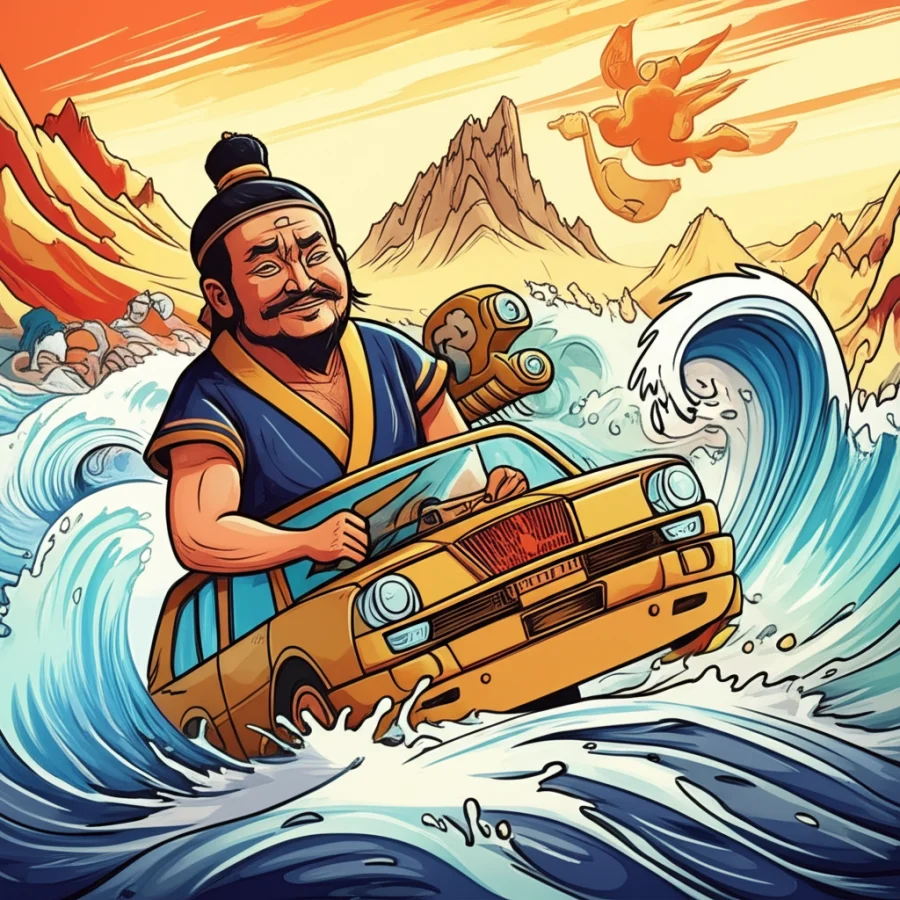
The human spirit, throughout history, has sought to comprehend the vast, often terrifying, forces of the natural world. Long before the advent of scientific inquiry, ancient peoples wove intricate narratives to explain the inexplicable, to find meaning in chaos, and to impart lessons for survival and governance. Among the most enduring and profound of these tales from ancient China is the legend of the Great Flood, a cataclysmic event averted through the contrasting efforts of two figures: Gun and his son, Yu. This powerful narrative, often echoed in the "Songs of Kunlun Mountains," is not a record of historical fact or a divine revelation, but a traditional story, a product of human imagination and a cornerstone of early Chinese cultural identity, passed down through generations.
Origins and Cultural Background: A World Shaped by Water
This foundational myth emerged from a cultural era profoundly shaped by its environment – the riverine civilizations of ancient China, particularly along the Yellow River basin. During the Neolithic and early Bronze Ages, society was largely agricultural, utterly dependent on the seasonal rhythms of the great rivers. While these waterways provided life-sustaining irrigation and fertile soil, they were also prone to devastating, unpredictable floods that could wipe out entire communities and livelihoods.
In this volatile world, the ancient Chinese viewed nature not as a separate entity to be conquered, but as a dynamic, living force, often imbued with spiritual significance. Their worldview was animistic, recognizing spirits in mountains, rivers, and skies. The heavens were seen as the abode of powerful deities, who could bestow blessings or unleash wrath. Order and harmony (often termed "Tianming" or Mandate of Heaven) were paramount, and disruptions like floods were interpreted as signs of cosmic imbalance or divine displeasure. Mountains, particularly the towering, mysterious Kunlun range, held a special place, often regarded as the axis mundi – the center of the world, the source of rivers, and the dwelling place of immortals and powerful spirits. It was within this context of reverence, fear, and a desperate desire for order that the epic of Gun and Yu unfolded.
Figures of Flood and Fortune: Gun, Yu, and the Sacred Kunlun
The tale centers on two pivotal figures, father and son, each embodying different approaches to a monumental crisis. Gun is often depicted as a descendant of the Yellow Emperor, a figure of great lineage and considerable power. His character symbolizes the early human drive to assert dominance over nature, to build and control. His method of dealing with the flood – building massive dams and dikes – represents human ingenuity and sheer force, but ultimately, a struggle against the natural flow. Symbolically, Gun embodies hubris or impatience, a well-intentioned but ultimately flawed attempt to impose order without understanding.
His son, Yu, stands in stark contrast. Yu is the epitome of perseverance, wisdom, and selfless dedication. Where Gun sought to block, Yu sought to guide. His approach – dredging, channeling, and observing the natural contours of the land – reflects a philosophy of working with nature, understanding its rhythms rather than trying to overpower them. Yu represents the ideal leader: humble, persistent, strategic, and deeply committed to his people’s welfare.
Beyond these human figures, the Kunlun Mountains are not merely a backdrop but a character in themselves, especially when considering the "Songs of Kunlun Mountains." These mythical peaks are portrayed as the celestial abode of powerful deities like Xiwangmu (the Queen Mother of the West), a source of divine elixir, and crucially, the mythical origin of the Yellow River itself. The Kunlun are symbolic of the untamed, sacred power of nature, a place of profound wisdom and immense challenge. Their "songs" could be interpreted metaphorically as the ancient wisdom inherent in the mountains’ geological structure, the natural flow of water, or even the divine guidance emanating from their heights, which Yu ultimately heeded.
The Deluge and the Hero’s Journey: A Narrative Retelling
In a time long past, when the world was young and the boundaries between mortals and spirits were thin, a terrifying calamity befell the land. The rivers, particularly the mighty Yellow River, swelled beyond all imagining. Waters rose higher than mountains, engulfing fields, villages, and entire kingdoms. People fled to the highest peaks, their cries echoing across the desolate, watery expanse. The Heavenly Emperor, witnessing the suffering of humanity, commanded his minister, Gun, to quell the raging deluge.
Gun, a man of formidable will and noble lineage, took up the monumental task. He acquired the Xirang, a magical self-expanding soil from the heavens, and set about building colossal dams and dikes. For nine long years, Gun labored tirelessly, raising barriers against the relentless flood. The Xirang worked wonders, expanding to fill every breach, every gap. Yet, the waters, fueled by an unseen force and originating from the formidable, unyielding Kunlun Mountains, proved too great. The dams, though massive, only contained the waters temporarily, creating greater pressure, and ultimately, they burst, unleashing even more devastation. The Heavenly Emperor, disillusioned by Gun’s failure and perceived defiance, ordered his execution at Feather Mountain.
From Gun’s body, or sometimes depicted as having been born directly from the waters, emerged his son, Yu. Witnessing the prolonged suffering of his people, Yu humbly accepted the mantle of responsibility. He did not rush to emulate his father’s method. Instead, Yu embarked on a vast journey, traversing the entire land, studying the contours of the mountains – especially the mighty Kunlun, whose peaks seemed to whisper ancient secrets of flow and erosion – and the valleys, charting the paths of the raging torrents. He sought advice from sages, observed the natural world, and learned the wisdom of working with the water, not against it.
For thirteen arduous years, Yu dedicated himself to his task. He developed a revolutionary strategy: instead of blocking the waters, he would guide them. With the help of dragons, spirits, and countless human laborers, Yu ordered the digging of thousands of canals, the dredging of riverbeds, and the opening of outlets to the sea. He divided the land into nine provinces, each with its own network of waterways designed to channel the flood safely. He neglected his own family, passing his home three times without entering, so consumed was he by his duty.
Slowly, painstakingly, the strategy began to work. The "songs" of the Kunlun, once a mournful dirge of unleashed power, now seemed to hum with the harmony of controlled flow. The waters receded, revealing fertile plains where once there had been only vast lakes. The land dried, and people returned to their homes, planting crops in the rich, newly available soil. Yu had not defeated the flood; he had tamed it, brought order to chaos, and restored harmony between humanity and nature. His success was profound, earning him the title "Yu the Great," and he became revered as a benevolent ruler, often credited with founding China’s first dynasty, the Xia.
Symbolism and Enduring Meaning
The myth of Gun and Yu is replete with profound symbolism that resonated deeply with ancient Chinese society. It is, first and foremost, a story about leadership. Gun represents the flawed, perhaps autocratic, leader who fails through impatience and a desire for absolute control. Yu, by contrast, embodies the ideal ruler: humble, wise, patient, and empathetic, one who understands the importance of working in harmony with natural and cosmic forces.
Secondly, it speaks to the fundamental relationship between humanity and nature. Gun’s failure to dam the waters symbolizes the futility of confronting nature head-on, while Yu’s success in channeling them illustrates the wisdom of adapting, understanding, and cooperating with natural processes – a philosophical tenet that would later be echoed in Taoist thought. The flood itself symbolizes chaos and the constant threat of natural disaster, while its resolution represents the restoration of cosmic order.
Finally, the myth serves as a founding narrative for the Chinese state. Yu’s division of the land into nine provinces and his establishment of a unified system of water management are seen as the foundational acts of early statecraft, legitimizing the concept of a centralized authority responsible for the welfare of its people and the management of vital resources.
A Modern Lens on an Ancient Tale
In contemporary times, the legend of Gun and Yu, and the "Songs of Kunlun Mountains" that accompany it, continues to captivate and instruct. It is no longer believed as a literal historical event but remains a potent cultural touchstone. In literature, it inspires countless fantasy novels, historical dramas, and poetic interpretations, exploring themes of heroism, environmental stewardship, and the responsibilities of power. Video games and animated series frequently draw on its imagery of cosmic floods, powerful heroes, and mythical landscapes.
Academically, the myth is a rich subject for cultural studies, providing invaluable insights into ancient Chinese cosmology, political philosophy, and the development of early engineering and state-building. Environmentalists often revisit Yu’s story as an ancient parable about sustainable living and the dangers of unchecked human intervention in natural ecosystems, reminding us of the enduring wisdom of working in concert with the Earth.
Conclusion: Echoes of Imagination and Heritage
The Great Flood of Gun and Yu, resonating with the ancient "Songs of Kunlun Mountains," stands as a powerful testament to the human capacity for storytelling. It is a cultural narrative, born from the imaginations and experiences of ancient peoples, offering lessons on leadership, resilience, and the delicate balance between humanity and the natural world. As Muslims, we recognize that the true Creator and Sustainer of the heavens and the Earth is Allah (SWT) alone, and that His power is absolute and unrivaled. This story, therefore, is understood not as truth or divine revelation, but as a product of human endeavor to comprehend and explain the world around them.
It reminds us of the universal human need to make sense of our existence, to pass on wisdom through generations, and to celebrate the courage and ingenuity of those who strive for the betterment of humanity. This ancient Chinese myth, like countless others from cultures around the globe, enriches our understanding of cultural heritage, the power of imagination, and the timeless tradition of storytelling that binds us all.