fufufafa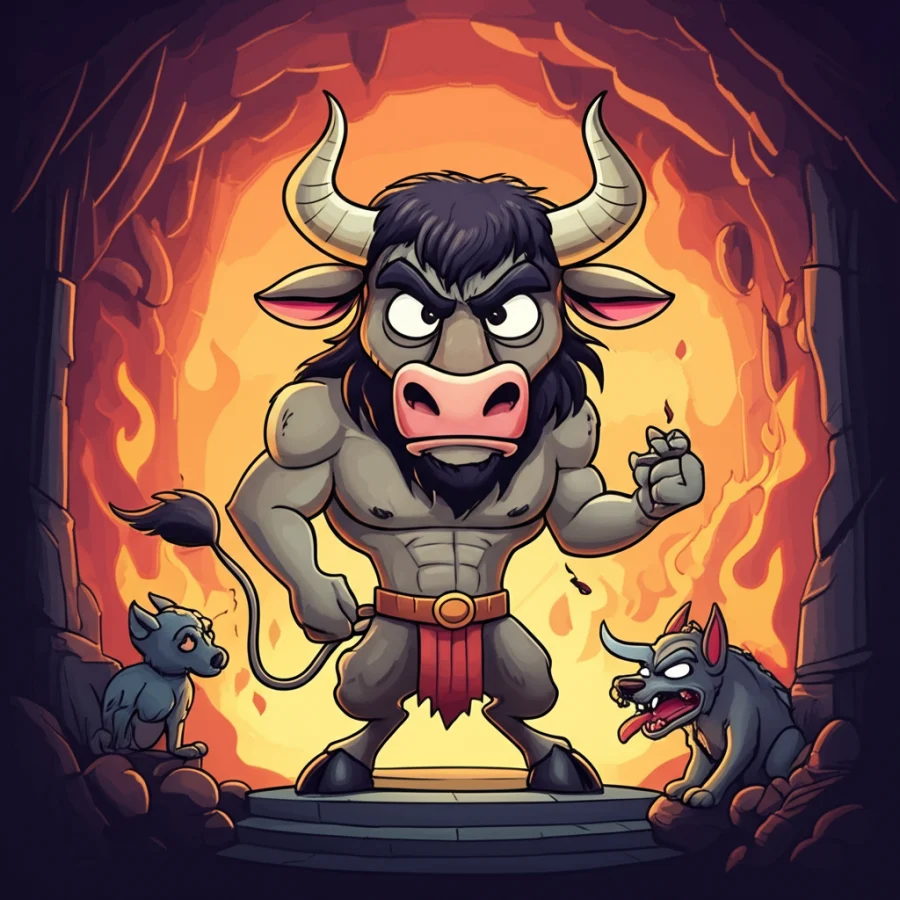
Disclaimer: This article explores a story from ancient mythology for cultural, historical, and educational purposes. The characters, events, and beings described are part of a folklore tradition and are not real. They are not intended to be believed, worshipped, or practiced.
Introduction
From the sun-drenched shores of the Aegean Sea, the ancient Greeks wove a rich tapestry of myths to explain the world around them. These stories, filled with powerful gods, daring heroes, and fearsome creatures, were the vehicles through which they explored morality, nature, and the human condition. One of the most enduring of these figures is the Minotaur, the bull-headed man of Crete. While its famous tale ends in a labyrinth on earth, another, lesser-known folkloric tradition speculates on its fate after death, casting it into the shadowy depths of the Underworld. This is the story of the Minotaur of Hades, a traditional narrative born from the ancient human imagination, exploring themes of judgment, punishment, and the inescapable nature of one’s own identity.
Origins and Cultural Background
This myth finds its roots in the Bronze Age civilizations of the Minoans on Crete and the later Mycenaean Greeks, flourishing between 3000 and 1100 BCE. The ancient Greeks lived in a world they perceived as being directly influenced by a pantheon of powerful, often capricious, gods and goddesses. For them, myths were not mere fairy tales; they were a framework for understanding everything from the changing of the seasons to the origins of their cities and the complexities of their own souls.
The Greek concept of the afterlife was centered on the Underworld, a vast, subterranean realm ruled by the god Hades. It was not strictly a place of punishment like the modern concept of hell. Rather, it was the destination for all mortal souls. It was a complex domain with different regions: the blissful Elysian Fields for heroes, the desolate Asphodel Meadows for ordinary souls, and the deep abyss of Tartarus for those who had committed terrible crimes against the gods. It was within this grim and ordered cosmology that the storytellers of old imagined a new, eternal role for the monstrous creature of Crete.
The Beast of Shadow and Stone
In the original myth, the Minotaur was a creature of tragic and terrifying origins. Its name was Asterion, meaning "the starry one," an ironic title for a being condemned to darkness. Born with the body of a powerful man and the head and tail of a bull, it was a physical manifestation of shame and divine punishment, the result of a curse laid upon King Minos of Crete. To hide this monstrous stepson, Minos commissioned the master craftsman Daedalus to build the Labyrinth, a vast, inescapable maze beneath his palace at Knossos.
Symbolically, the Minotaur represented the untamed, brutal side of nature and the savage beast that can lurk within humanity. It was a hybrid, an unnatural fusion that violated the expected order of the world. Its imprisonment in the Labyrinth symbolized the act of suppressing what is monstrous or shameful, hiding it away in the deep, twisting corridors of the subconscious. Its raw power, its roar, and its consumption of human tributes made it an object of pure terror, a physical embodiment of the fear of the unknown and the untamable.
Main Story: A New Labyrinth in the Underworld
The story told by the ancients did not end when the hero Theseus, guided by a thread of twine, slew the Minotaur in the heart of its earthly prison. According to the folkloric extension of the tale, death was not an escape for the creature, but a transition to a new form of servitude.
As its lifeblood soaked into the stone floor of the Labyrinth, the spirit of Asterion was torn from its body. It found itself a shade, a ghostly echo of its former self, standing on the misty banks of the River Styx, the boundary between the living and the dead. The grim ferryman, Charon, poled his skiff through the murky water, his eyes burning like coals as he regarded the monstrous soul. Unlike the trembling human shades, the Minotaur’s spirit retained its fearsome shape, a silent testament to its unnatural existence.
Upon being ferried across, it was brought before the three judges of the dead: Rhadamanthus, Aeacus, and, in a moment of profound irony, King Minos himself—the very man who had imprisoned it in life. The shade of the Minotaur could not speak, but its essence radiated a history of confusion, rage, and a loneliness born of its monstrous form. It had been a killer, but it had not chosen its nature. It was a victim of divine wrath as much as it was a perpetrator of violence.
The judges’ verdict was complex. The creature could not be sent to the Elysian Fields, for its hands were stained with the blood of the Athenian youths. Nor could it wander the Asphodel Meadows, for its potent, rage-filled spirit would terrorize the placid souls of the ordinary dead.
It was Hades, the solemn and unyielding king of the Underworld, who devised a fitting fate. He saw in the Minotaur’s eternal torment a useful tool. In the deepest part of his realm lay Tartarus, the prison for the Titans and the most wicked of mortals. Hades commanded that a new labyrinth be formed there—not of stone and mortar, but of shifting shadows, solidified despair, and the chilling echoes of eternal punishment.
And so, the Minotaur was reborn as a guardian and a prisoner once more. In this spectral maze, it was tasked with hunting the souls of the damned who sought to escape their torment. Its terrifying roar, once a sound of hunger, now became a cry of unending duty, a sound that promised recapture and a return to suffering. Its hooves no longer trod on solid ground but on the very essence of fear. It was a jailer bound to its own jail, its form a constant reminder of the transgression that created it. The Minotaur of Hades became a permanent fixture of the Underworld’s geography, a symbol that one’s nature, and the consequences of it, could follow them even beyond the grave.
Symbolism and Meaning
To the ancient people who told this story, the Minotaur’s fate in the Underworld served as a powerful moral lesson. It represented the idea of inescapable consequence. In life, the Minotaur was a symbol of a king’s hubris and a queen’s curse; in death, it became a symbol of perpetual punishment that perfectly mirrored its earthly existence. Its new role as the guardian of a spiritual labyrinth suggested that the mazes we are trapped in during life—be they of guilt, identity, or duty—can define our eternal state.
The story also explored the theme of justice. The Minotaur was both a monster and a victim. Its fate in Hades was not simple annihilation but a complex form of servitude, reflecting its dual nature. It was a powerful tool for ancient storytellers to contemplate whether a being could be held responsible for a nature it did not choose.
Modern Perspective
Today, the myth of the Minotaur continues to captivate the modern imagination. It has been reinterpreted in countless forms of media, often shifting from a purely monstrous figure to a more complex, tragic one.
In literature, authors have explored the Minotaur’s perspective, painting it as a lonely, misunderstood creature trapped by its appearance. Books like Rick Riordan’s Percy Jackson series reintroduce it to younger audiences as a classic monster to be overcome, while more literary works use it as a metaphor for humanity’s inner beast.
In video games, the Minotaur is a popular and formidable "boss" enemy. Games like Assassin’s Creed Odyssey and God of War allow players to face the creature in visceral combat, emphasizing its raw power and ferocity. The game Hades even features a version of Asterius the Minotaur as a noble, if challenging, guardian within its reimagined Underworld. In these contexts, it often symbolizes a great, primal obstacle that the hero must overcome to prove their strength and worth.
Conclusion
The myth of the Minotaur, both in its Cretan labyrinth and its spectral prison in Hades, is a testament to the enduring power of storytelling. It is a cultural artifact, a window into the worldview of the ancient Greeks and their attempts to grapple with complex ideas of sin, justice, and identity. These tales were never meant to be a literal account of reality but a symbolic exploration of the human heart.
As Muslims, we recognize that only Allah is the true Creator and Sustainer of the universe, and the only reality is that which He has ordained. These ancient myths are studied not as a source of belief, but as part of our shared human heritage. They reveal the profound creativity and imagination of past civilizations, reminding us that for millennia, people have used stories to navigate the dark and confusing labyrinths of their own existence.