
 fufufafa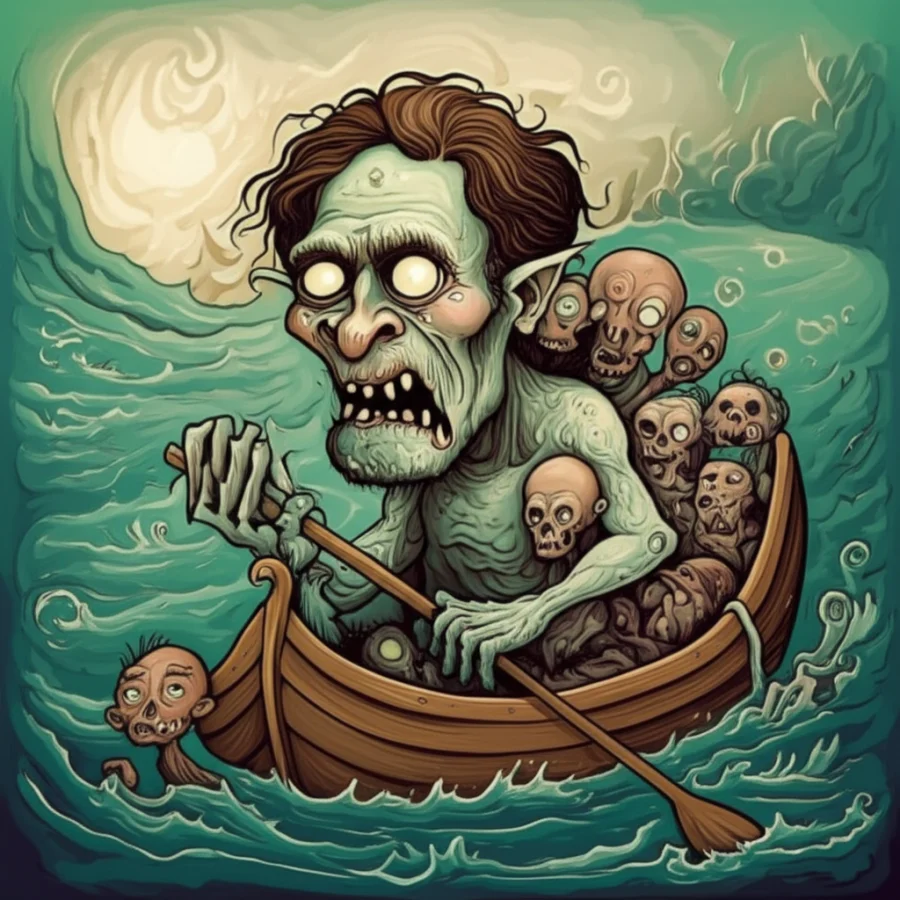
The biting winds that sweep across the stark, dramatic landscapes of Scandinavia have long carried with them tales as ancient as the glaciers themselves. Among these enduring narratives, few evoke the chilling embrace of the afterlife quite like the legend of the Draugr and the spectral River of Souls. This is not a story of divine decree or factual account, but a rich tapestry woven from the beliefs and fears of ancient Germanic and Norse peoples, a way for them to grapple with the mysteries of death, the persistence of the past, and the unseen forces they perceived in their world.
The era in which these stories took root was one of harsh beauty and formidable challenges. Life in these northern lands was a constant negotiation with the elements. Long, dark winters tested resilience, while the vast, untamed forests and fjords held both bounty and peril. The societies were often tribal, bound by kinship and a deep reverence for ancestral spirits and the natural world. Their worldview was animistic, seeing spirits and life forces in everything – from the rustling leaves to the roaring thunder. Death was not a simple cessation of being, but a transition, and the boundaries between the living and the dead were often perceived as porous. It was in this context, where the veil between worlds felt thin, that the concept of the Draugr and its connection to the spectral River of Souls emerged.
The Draugr, in these ancient tales, is a figure of profound dread and lingering presence. It is not merely a ghost, but a revenant, a being that has risen from the grave. Imagine a form that is both undeniably deceased and yet possesses a terrifying vitality. Its flesh might be the grey of ancient stone, its eyes burning with a cold, unholy light, and its strength far exceeding that of any living mortal. They are often depicted as guardians of their burial mounds, fiercely protective of their earthly possessions and their slumber. Their presence is not just a physical manifestation; it is an oppressive aura, a chilling stillness that heralds their approach. The Draugr embodies the lingering attachments of the soul to the earthly realm, a chilling testament to unresolved business or an unnatural disruption of the natural order of death.
The concept of the River of Souls, while not as universally detailed as the Draugr itself, speaks to a more profound cosmic understanding of the afterlife. It is envisioned as a spectral current, an ethereal waterway that carries the departed from the land of the living to their ultimate destination. This river is not a place of gentle passage, but often a turbulent, unforgiving journey. Some interpretations suggest it is a liminal space, a threshold between existence and oblivion, or perhaps a place of judgment and purification before the soul finds its final rest. The Draugr, bound to its earthly resting place, is often depicted as being unable to fully cross this river, forever tethered to the mortal world, its spectral form a perversion of the natural flow of souls.
Let us imagine a tale, as it might have been told around a crackling fire on a windswept night. In a village nestled beside a dark, brooding fjord, lived an old warrior named Bjorn. Bjorn had lived a life of valor, but in his final days, his heart was consumed by a gnawing fear. He had wronged a rival, a betrayal that haunted his dying thoughts. When Bjorn was laid to rest in his grand burial mound, the village elders whispered that his spirit would not find peace.
Weeks turned into months. A strange malaise settled over the fjord. The fishing nets came up empty, and the livestock grew sickly. Then, the whispers began: Bjorn had not rested. His form, pale and gaunt, was seen near his mound, his eyes fixed on the living with an unnerving hunger. He was the Draugr, a restless spirit tethered to his earthly rage.
One night, a brave young woman named Freya, her heart filled with a desperate courage, decided to confront the horror. She knew that Bjorn’s spirit was unable to cross the spectral River of Souls, a shimmering, indistinct current that seemed to flow just beyond the edge of perception, a river of light and shadow carrying the echoes of countless departed souls. Bjorn, in his torment, was trapped between the world of the living and the true passage to the beyond.
Freya approached the burial mound, her torch casting dancing shadows. She saw him then, a figure of decaying flesh and burning malice, his spectral hands reaching out as if to grasp at the very air. He let out a guttural moan, a sound that seemed to scrape against the very fabric of reality. Freya, though trembling, spoke not with a sword, but with words of release, of forgiveness, and of the natural order of the world. She spoke of the River of Souls, of its relentless flow, and of how his earthly attachments were holding him captive. She reminded him that even the greatest warrior must eventually surrender to the journey, to the current that carried all beings towards their ultimate fate.
As Freya spoke, a faint, ethereal glow began to emanate from the direction of the fjord. It was the spectral River of Souls, its presence growing stronger, its silent hum a powerful call. The Draugr of Bjorn, his form writhing with a newfound agony, seemed to be drawn, against his will, towards this spectral tide. His earthly rage, his lingering regrets, were being pulled from him, not by force, but by the irresistible momentum of the afterlife. With a final, sorrowful cry that dissolved into the wind, the Draugr of Bjorn was swept away, a phantom caught in the current of the River of Souls, finally embarking on the journey he had so feared.
To the ancient Scandinavians, the Draugr and the River of Souls likely represented a complex interplay of fears and hopes. The Draugr embodied the fear of a restless, vengeful death, the terrifying possibility that one’s existence might not simply end, but fester and return to haunt the living. It served as a cautionary tale, a reminder of the importance of living a life of integrity, for even in death, the consequences of one’s actions could linger. The River of Souls, on the other hand, offered a glimpse of a structured afterlife, a natural progression for all beings. It suggested that even in the face of death, there was a cosmic order, a journey that, however daunting, ultimately led somewhere. The spectral river could symbolize the passage of time, the inevitable flow of life and death, and perhaps even a form of spiritual cleansing or transformation.
In the modern world, these ancient myths continue to captivate our imaginations. The Draugr has become a popular figure in fantasy literature, video games, and films, often depicted as formidable undead adversaries, their icy grip a tangible threat. They represent a primal fear of what lies beyond the grave, a chilling embodiment of the persistent past. The concept of the River of Souls, while perhaps less explicitly named, often finds echoes in narratives of liminal spaces, journeys to the underworld, and the spectral pathways of the departed. These retellings, while entertaining, also serve as a reminder of the enduring power of these ancient stories to explore fundamental human anxieties about mortality and the unknown.
It is crucial to reiterate that the Draugr and the River of Souls are products of ancient storytelling and cultural beliefs, not factual accounts. As Muslims, we recognize that only Allah (God) is the true Creator and Sustainer of all existence, and that the ultimate destiny of all souls rests solely with Him. These narratives, however, offer a valuable window into the minds of our ancestors, revealing their worldview, their fears, and their attempts to understand the profound mystery of life and death. They stand as testaments to the enduring human need to create meaning, to tell stories, and to pass down wisdom and wonder through the generations. The whispers from the frost, carried by the wind and echoed in these tales, remind us of the rich tapestry of human heritage and the boundless capacity of our imagination.







